
The Living Document: Bridging the Gap Between Scientific Prose and Global Knowledge Bases
Annotating Atomic Components of Papers in Digital Libraries: The Semantic and Social Web Heading towards a Living Document Supporting eSciences
The paper introduces the Living Document (LD), a conceptual and technological framework that transforms static research papers into dynamic "document routers" by annotating their atomic components (words, images, data types). It leverages the Paper-of-a-Paper (POAP) ontology to integrate Semantic Web structured data with Social Web collaborative tagging, specifically optimized for the Life Sciences domain.
TL;DR
The research paper "Annotating Atomic Components of Papers in Digital Libraries" presents a vision of the Living Document (LD). Unlike a static PDF, a Living Document acts as a semantic router, connecting specific words, figures, and data within a paper to external biological databases and ontologies. By combining automated semantic tagging with social "folksonomies," the authors create a network where papers become active nodes in a global scientific knowledge graph.
The Motivation: Why Are Digital Papers Still "Analog"?
Despite being stored in digital libraries, most research papers today operate like their printed ancestors. You can read them, but you can't easily "click" a protein name to see its current status in UniProt or find other papers that used the same experimental biomaterial.
The authors identify a critical gap: Knowledge is trapped in the text. While databases (DBs) like GenBank are highly interrelated, the papers describing them are not. The motivation for the Living Document is to move from "collected intelligence" (just storing papers) to "collective intelligence" (networking the insights inside them).
Methodology: The Architecture of Connectivity
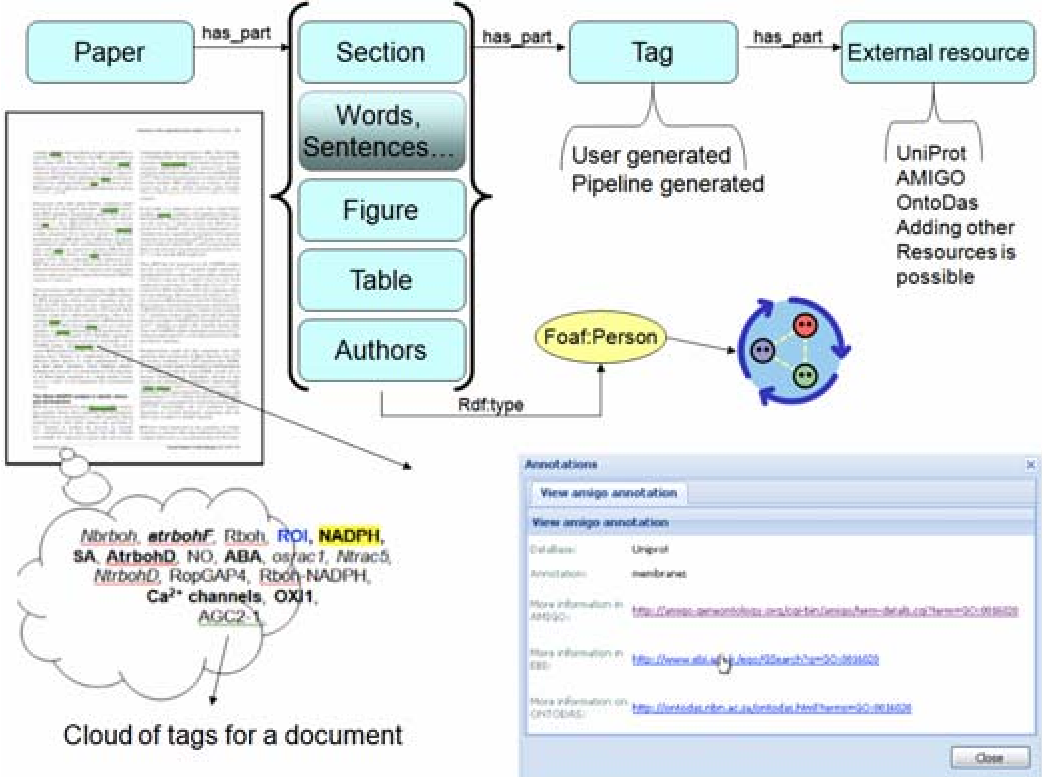
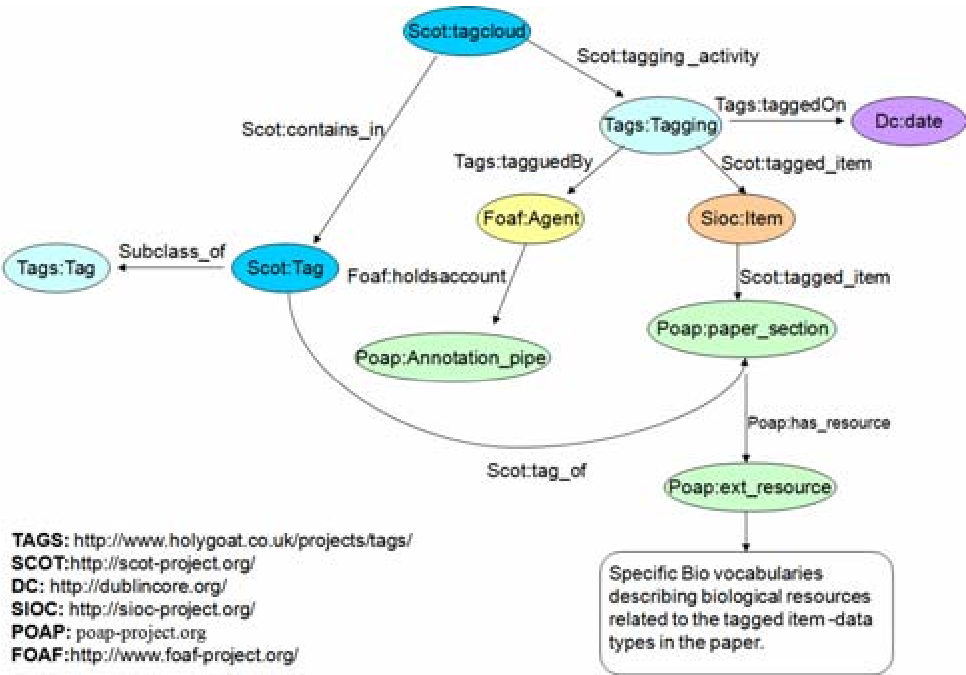
The core of this work is the Paper-of-a-Paper (POAP) Ontology. This model represents the internal structure of a paper (sections, images, terms) and how these map to the social tagging activity of the community.
1. The Core Architecture
The system uses a Service Provider Interface (SPI), allowing it to hook into various digital libraries (Elsevier, PubMed) and annotation pipelines (WhatIzIt).
2. Hybrid Tagging Mechanism
The LD employs two layers of semantics:
- Predefined Tags: Automatic extraction of ontology terms (e.g., Gene Ontology, SwissProt) using regular-expression-based filter servers.
- User-Generated Tags: Researchers can manually tag nuances that machines miss, such as specific experimental contexts or newly discovered synonyms.
Experiments and Results: Beyond Simple Search
The authors conducted informal evaluations with plant biologists which revealed the "serendipity" of the system:
- Discovery of Hidden Links: Two researchers discovered their papers were related through shared tags that neither had explicitly used as keywords.
- Accuracy: Tag-based recommendations consistently outperformed the "related papers" algorithms of traditional digital libraries.
- Synonymy Resolution: Community tagging identified biological motifs (like flg22) that were not explicit in databases or previous literature.
Critical Analysis & Conclusion
The Takeaway
This paper anticipates the shift toward Machine-Actionable Science. By breaking down a document into "atomic components," the authors lay the groundwork for a future where research is searchable not just by title, but by the specific molecules, methods, and results contained within.
Limitations & Future Work
While the framework is robust, its success depends on community adoption. Tagging takes effort; the "Social Web" aspect requires a critical mass of active researchers. Furthermore, the paper focuses on Life Sciences, leaving open the question of how well this generalizes to more abstract fields like Theoretical Physics or Philosophy.
The future of the Living Document lies in its integration into the authoring workflow (e.g., MS Word plugins) so that metadata is born at the moment of creation, rather than added as an afterthought.