
Beyond Individual Hubs: Enhancing LBSN Semantic Tagging with User Similarities and ELM
Annotating semantic tags of locations in location-based social networks
2019-07-16
Summary
Problem
Method
Results
Takeaways
Abstract
This paper introduces MSA-ELM, a multi-label semantic annotation framework for Location-Based Social Networks (LBSNs). It leverages a novel "Similar User Pattern" (SUP) feature to capture check-in regularities across users, achieving state-of-the-art performance in accurately tagging unlabelled locations.
## TL;DR
While your check-in history says a lot about where you are, your *social twin’s* history might say even more. This paper introduces **MSA-ELM**, a framework that extracts a new feature called **Similar User Pattern (SUP)** and uses an **Extreme Learning Machine** to solve the multi-label location tagging problem with unprecedented efficiency and accuracy.
## The Missing Link: Why Single-User Analysis Fails
Most Location-Based Social Network (LBSN) research treats users as islands. Traditional models look at how a single user behaves at a location (e.g., "User A always goes here at 12 PM") to guess if that place is a restaurant. However, approximately 30% of locations in LBSNs remain unlabelled.
The authors realized that **user check-in activities have social similarities**. If you and 10 other "fitness enthusiasts" frequent the same unlabelled spot at 6 AM, there is a high probability that the spot is a "Gym." Existing SOTA methods like Rank-SVM or ML-kNN struggle with the computational load of processing these complex social relationships, especially when a single location might have multiple tags (e.g., "Cafe" and "Snack Bar").
## Methodology: The SUP and MSA-ELM Framework
### 1. Extracting the Similar User Pattern (SUP)
The core innovation is the SUP feature. The authors don't just look at the location; they look at the *community* of the location.
- **Vector Space Model (VSM)**: They divide the 24-hour day into $m$ periods and $n$ tag classes, creating a user-group matrix.
- **Cosine Similarity**: By calculating the similarity between user vectors, they identify the "top-k" similar users for any given check-in.
- **Probability Estimation**: The tag of an unlabelled location is estimated based on the distribution of tags from similar users at similar times.
### 2. MSA-ELM: Speed meets Precision
Traditional Multi-label learning is slow. To fix this, the authors utilize an **Extreme Learning Machine (ELM)**. ELM is known for its extremely fast learning speed because its hidden layer weights are randomly assigned rather than iteratively tuned.
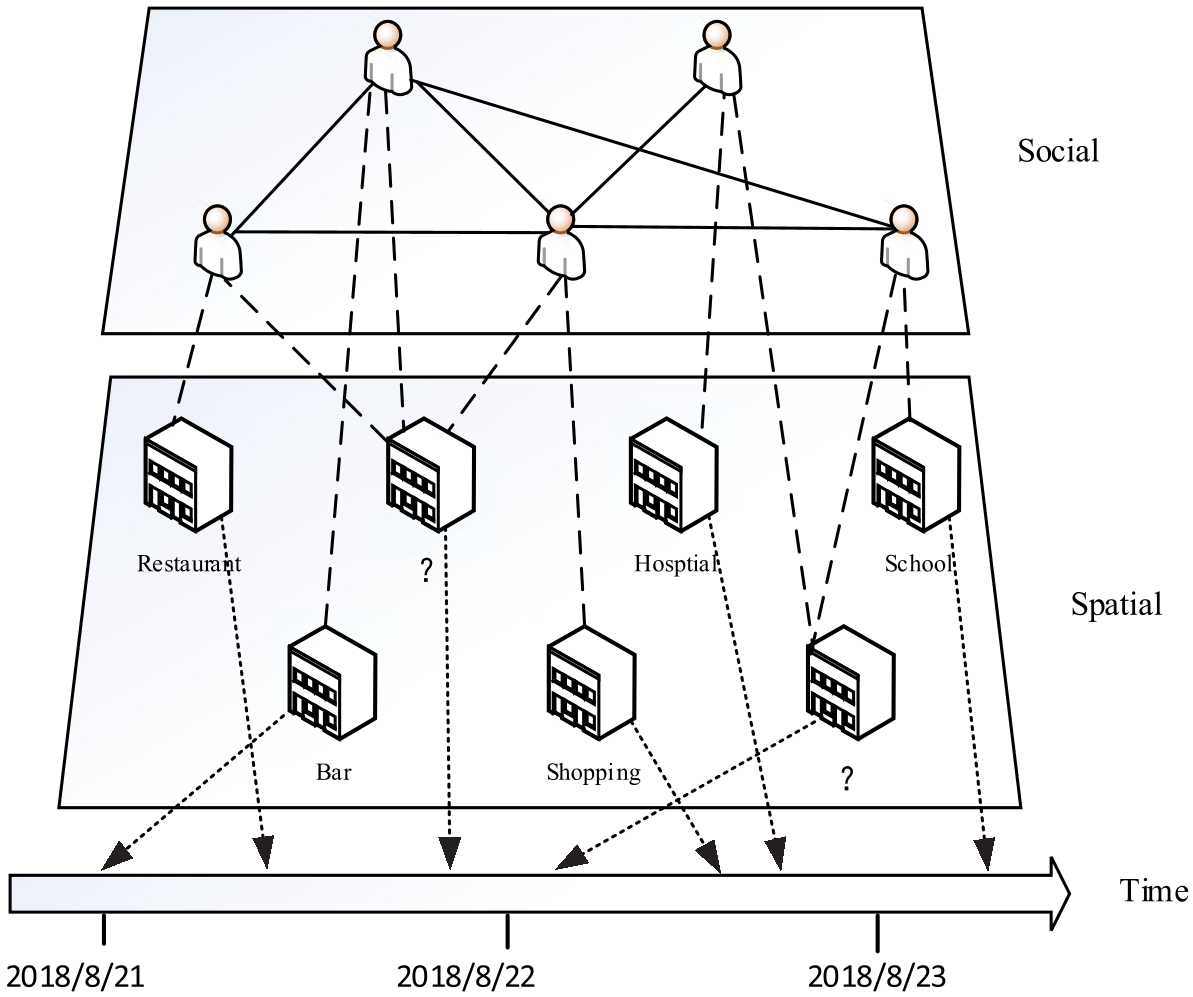
The **MSA-ELM** algorithm transforms the multi-label problem into $n$ binary classification problems (one for each potential tag). This allows the model to handle locations with overlapping identities efficiently.
## Experimental Evidence: SOTA Validation
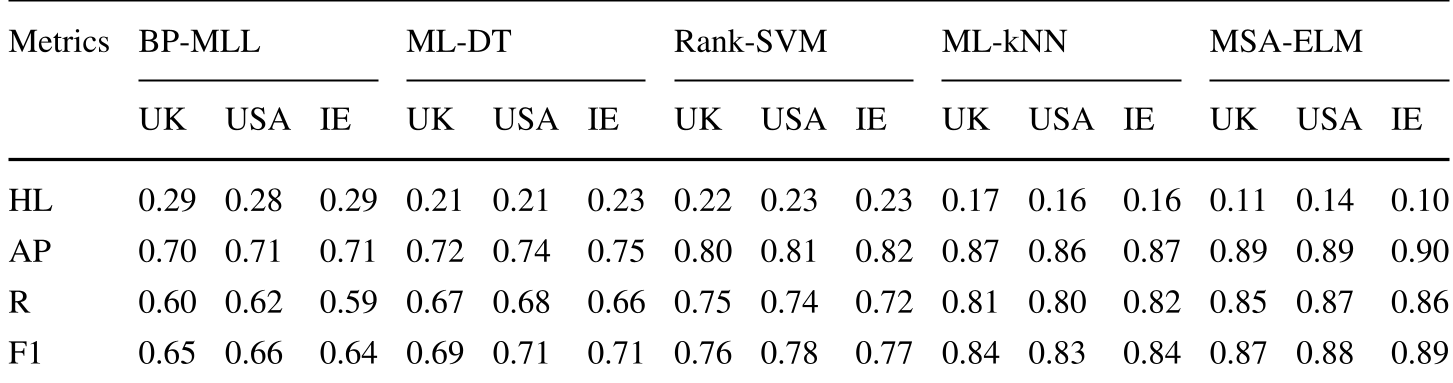
The authors tested their approach on datasets from the UK, USA, and Ireland. The results were clear:
- **SUP vs. Others**: The SUP feature outperformed Explicit Patterns (EP) and Individual Regularity (IR) because it compensated for users who have irregular daily habits.
- **Efficiency**: MSA-ELM achieved a training time of ~1.10s, compared to 2110s for Rank-SVM—a massive **1900x speedup**—all while maintaining higher average precision.
## Critical Insight: The Value of Social Regularity
The takeaway for AI practitioners is twofold. First, in social data, **collaborative features (SUP)** often provide better regularization than individual features because they filter out the "noise" of personal oddities. Second, for real-time LBSN applications, **ELM-based architectures** provide a viable alternative to heavy Deep Learning models when training latency is a bottleneck.
### Limitations & Future Work
While impressive, the model relies on the availability of check-in data. In "cold-start" scenarios where a location has very few visitors, the SUP feature's effectiveness might plateau. Future research could explore integrating spatial-temporal graph embeddings to fill these data gaps.
## Conclusion
MSA-ELM represents a significant shift from "location-centric" to "user-community-centric" annotation. By acknowledging that places are defined by the people who visit them, the authors have provided a faster, more accurate way to map the semantic landscape of our social world.