
Decoding Malicious Intent: A Structural Approach to Anomaly Detection in Social Networks
Anomaly detection in Online Social Networks using structure-based technique
This paper proposes a structure-based anomaly detection methodology for Online Social Networks (OSNs) by modeling them as graphs. Using metrics like friend count () and egonet edge count (), the study applies the OddBall algorithm to identify malicious users based on their deviation from power-law distribution patterns.
TL;DR
Online Social Networks (OSNs) are breeding grounds for malicious activities like spamming and phishing. While most tools look at what users say, this paper focuses on who they connect to. By treating the network as a graph and applying power-law distribution analysis, the researchers developed a method to flag "structural outliers"—users whose friendship patterns are mathematically impossible for normal social behavior—achieving a detection F-Score of nearly 67%.
Background: The Limits of Content Analysis
Most modern anomaly detection systems are Behavior-Based. They analyze message frequency, hours spent online, or specific URL patterns. However, these methods are highly technology-dependent; a metric that works for Facebook might fail for Twitter or LinkedIn.
The authors argue for a Structure-Based (or Graph-Based) approach. The core intuition? Human social structures follow a specific "Inductive Bias." In a healthy social network, your friends are likely to be friends with each other. Malicious actors, such as bot controllers or spammers, often break this rule by creating "star" structures (connecting to many unrelated people) or "cliques" that don't fit the natural growth of a social graph.
Methodology: The Power of the Egonet
The research utilizes the concept of an Egonet—a subgraph centered on a single user (the ego) and their immediate neighbors (friends).
1. Metric Calculation
The paper focuses on two primary metrics:
- : The number of friends of user .
- : The number of edges (friendships) within that user's egonet.
2. The Power Law Fitting
In normal social settings, and follow a Power Law. The authors used the formula . Any node that significantly deviates from this line is considered an anomaly. For the Twitter dataset used, the fitted curve was determined to be .
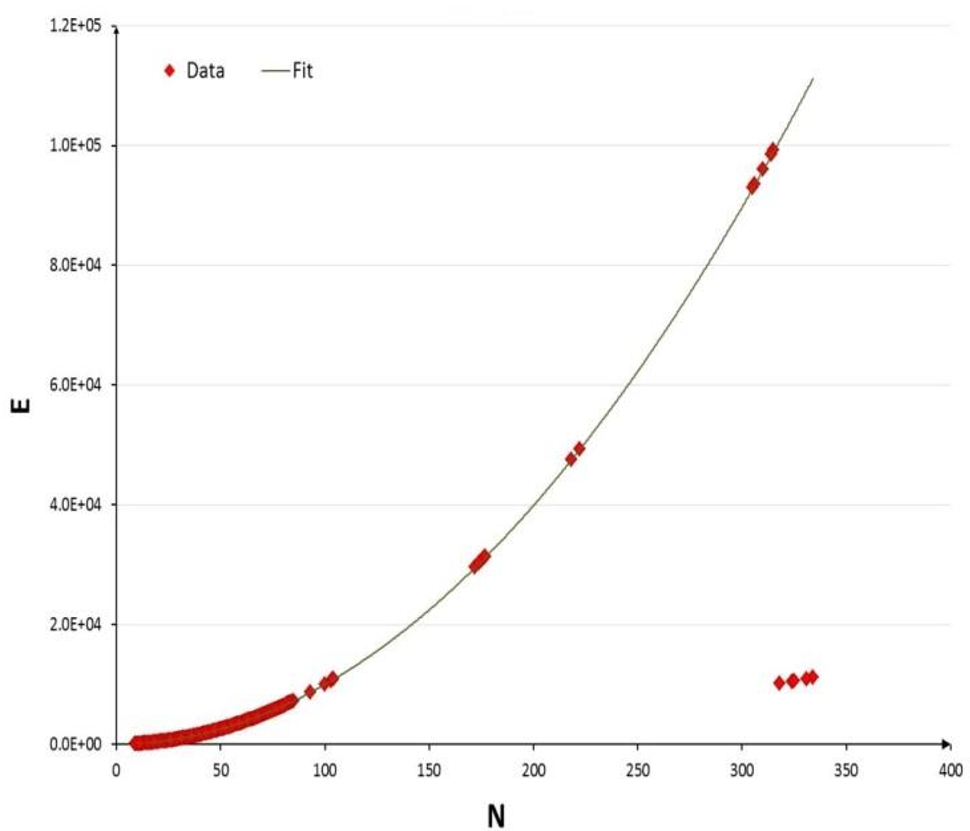 Figure 1: Distribution of friends () vs. friendships () showing the majority of users clustering along a predictable path.
3. Anomaly Scoring
To quantify the "strangeness" of a user, the paper employs an anomaly score formula that measures the vertical distance between a user's actual value and the predicted value on the fitted curve. The further a point stays from the curve, the higher its penalty.
Experimental Insights
By analyzing a Twitter dataset from the Stanford Network Analysis Project (SNAP), the researchers observed:
- Normal Patterns: 74% of high-degree nodes followed standard social patterns (near-cliques).
- Detection Accuracy: Using the calculated deviation threshold, they achieved a Precision of 74% and a Recall of 61%.
- Final F-Score: The resulting 66.87% F-Score represents the percentage of users with high anomaly scores who were confirmed to be engaged in malicious activities.
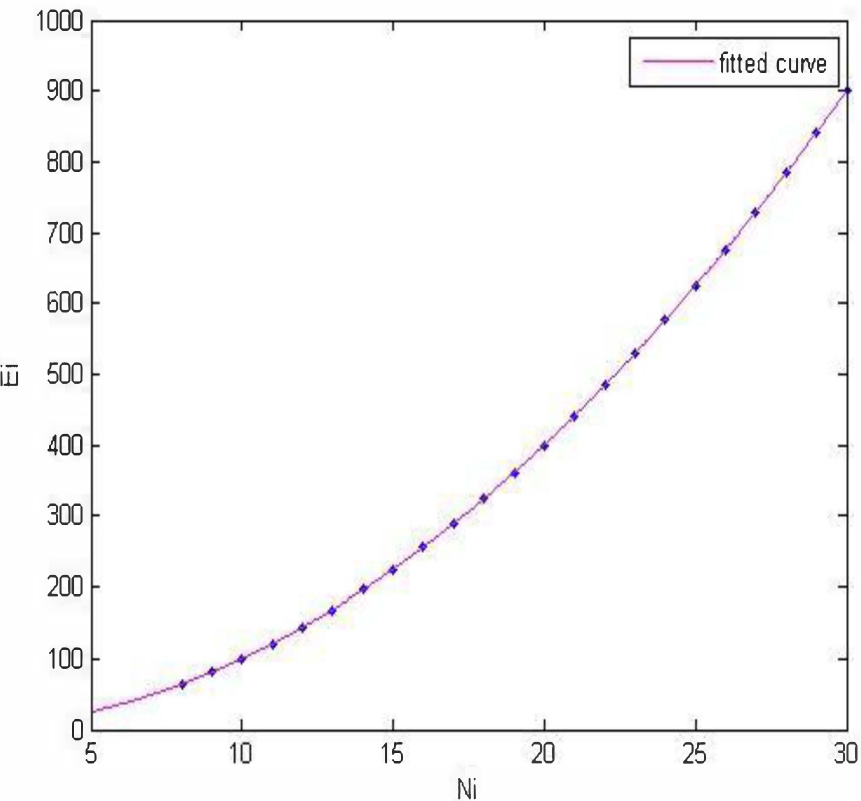 Figure 2: The regression line helps distinguish between "normal" high-degree users and "anomalous" ones.
Critical Analysis & Conclusion
Takeaway
The study proves that Social Geometry is a powerful tool for security. Because attackers are often constrained by the need to reach many victims quickly, they cannot easily mimic the complex, organic "triangle-heavy" structures of real human friendships.
Limitations
- Complexity: While more robust than behavior-based models, calculating the egonet metrics for every user in a billion-node graph (like the modern Facebook graph) is computationally expensive.
- Static Nature: The paper focuses on a static snapshot. Modern attackers might evolve their strategies to "fake" organic growth over time.
Future Outlook
The next logical step for this research is the integration of Temporal Dynamics. By observing how these graph metrics change over hours or days, we could identify anomalous "bursts" of connection-forming, making it even harder for spammers to hide.