
Decoupling Identity from Location: A Lightweight Path to Private Spatial Crowdsourcing
Anonymity-Based Privacy-Preserving Task Assignment in Spatial Crowdsourcing
This paper introduces an anonymity-based privacy-preserving framework for Server Assigned Tasks (SAT) in Spatial Crowdsourcing (SC). It leverages a Bitwise XOR Homomorphic Cipher combined with Oblivious Transfer (OT) to achieve secure task assignment, reaching State-of-the-Art (SOTA) efficiency for mobile environments.
TL;DR
Researchers have developed a new privacy-preserving task assignment protocol for Spatial Crowdsourcing (SC) that provides k-anonymity without the heavy computational "tax" of standard encryption. By combining Bitwise XOR Homomorphic Ciphers with Oblivious Transfer (OT), the system allows a server to find the best worker for a task (e.g., the closest driver) without ever knowing where any individual worker is located or who the non-selected candidates are.
Context & Motivation: The Privacy-Precision Paradox
In Spatial Crowdsourcing (like Uber or DoorDash), the server needs to know worker locations to optimize efficiency—a mode known as Server Assigned Tasks (SAT). However, this creates a massive privacy risk.
Existing solutions usually fall into two categories, both flawed:
- Differential Privacy (DP): Adds noise to locations. The catch? It degrades accuracy, leading to sub-optimal assignments.
- Heavy Cryptography: Uses tools like Paillier or ElGamal encryption. The catch? These are computationally "expensive," draining mobile batteries and causing server-side bottlenecks as the number of workers () grows.
The authors' insight is simple but powerful: Don't hide the data; hide the owner. Instead of encrypting coordinates, they use a lightweight cipher to shuffle "travel costs" so the server knows a worker is 5 minutes away, but doesn't know which one.
Methodology: The XOR-OT Architecture
The proposed system introduces a Key Dealer (KD). Unlike a "Trusted Third Party," the KD is only "semi-honest"—it provides keys but never sees the actual task data or the final assignment.
1. The Bitwise XOR Homomorphic Cipher
This is the "secret sauce" for speed. Instead of traditional multiplication-based encryption, it uses the XOR property ().
- Each worker encrypts their travel cost using keys provided by the KD.
- When the SC-server receives all worker strings and XORs them, it reveals a permuated list of all travel costs.
- Visual Result: The server sees a list of costs (e.g., [10m, 5m, 12m]) but has no idea which ID belongs to which cost.
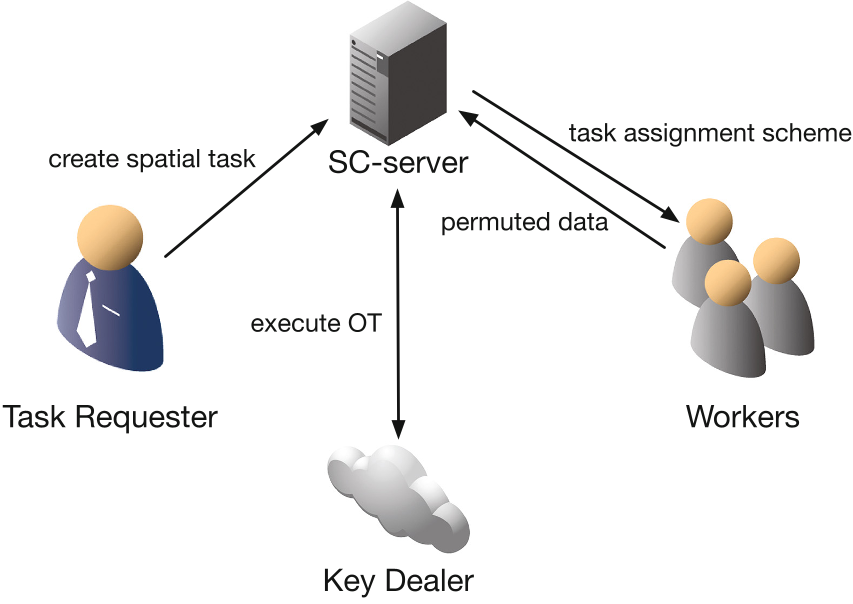 Figure 1: The Four-Entity Architecture: Task Requester, SC-Server, Workers, and Key Dealer.
2. Oblivious Transfer (OT) for Identity Recovery
Once the server identifies the "winner" (the worker with the minimum cost at, say, Position 2), it needs to know who that is to send the task. To do this without the KD knowing who won, they use 1-out-of-n OT. The server requests the ID at Position 2; the KD sends it over, but the protocol ensures the KD doesn't know which index was requested.
Performance & Experiments
The protocol was tested against varying data lengths () and worker counts ().
- Efficiency: At , encryption takes a mere 0.031 ms, essentially free for a smartphone.
- Scalability: Even at , the system remains viable. While the server's decryption takes ~3.8 seconds on a single core, modern multi-core servers can drive this down to near 1 second.
- Communication: The overhead is minimal. For 5,000 workers, the total communication is ~238 KB—smaller than a single smartphone photo.
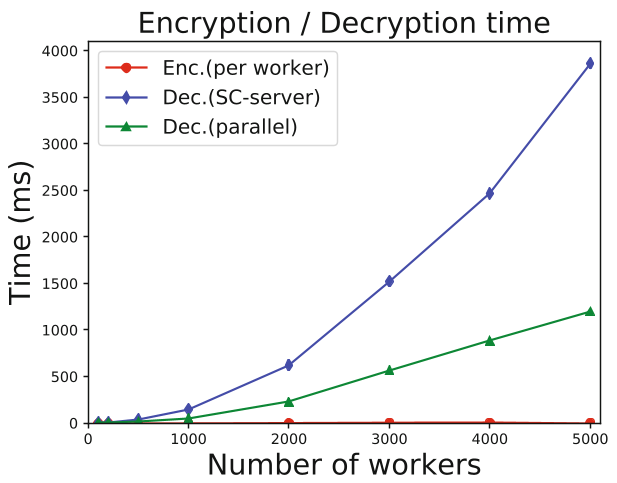 Figure 2: Performance scaling as the number of workers (n) increases. The linear growth demonstrates the model's suitability for large-scale urban SC applications.
Critical Insight: Why This Matters
The brilliance of this work lies in its Inductive Bias toward efficiency. It acknowledges that in mobile crowdsourcing, the bottleneck isn't bandwidth; it's the CPU/Battery on the worker's device and the throughput on the server. By replacing expensive modular exponentiations with bitwise XORs, the authors have made privacy "cheap" enough for real-world deployment.
Limitations: The model assumes the SC-Server and the Key Dealer do not collude. If they were to share data, the anonymity would collapse. Future research could explore removing this dependency using Multi-Party Computation (MPC).
Conclusion
This paper proves that we don't need to sacrifice assignment quality for privacy. By rethinking how we mask identity rather than just masking coordinates, we can build efficient, global-scale spatial services that respect user anonymity.