
Specialized Anonymization: Balancing Privacy and Utility in German Legal Rulings
Anonymization of german legal court rulings
The paper presents a machine learning framework for the automatic anonymization of German legal court rulings using BERT-based contextual embeddings and BiLSTM architectures. It focuses on "contextual sensitivity prediction" to distinguish between sensitive personal data and insensitive legal entities, achieving a recall of up to 79.1% on district court datasets.
TL;DR
Researchers from the Technical University of Munich have developed a deep learning pipeline to automate the anonymization of German court decisions. By leveraging BERT and BiLSTM architectures, the system focuses on the context of a word rather than the word itself to decide if it should be hidden. This addresses the critical trade-off between protecting personal privacy and maintaining the readability of legal precedents.
The "Over-Anonymization" Trap
In the legal world, a document stripped of all dates, locations, and organization names is useless. Standard Named Entity Recognition (NER) creates a "scorched earth" effect: it finds every entity and deletes it.
The authors identify a core research insight: Sensitivity is context-dependent. A court's name is an entity but is public information; an expert witness's name is an entity and is highly sensitive. Existing rule-based systems fail to see this distinction, leading to high costs and a lack of data for legal-tech innovation.
Methodology: Learning from the Gaps
The biggest hurdle was the lack of "raw" (non-anonymized) data for training. To solve this, the authors used a clever workaround:
- Placeholder Detection: They built a rule-based system to find existing anonymization markers (like "Xxxx" or "E.") in public documents.
- Masked Contextual Training: They used a BERT backbone. By masking the sensitive spots and providing "alternative" random passages as negative samples, they trained a BiLSTM layer to classify whether a specific "gap" in the text should be sensitive based on the surrounding German legal syntax.
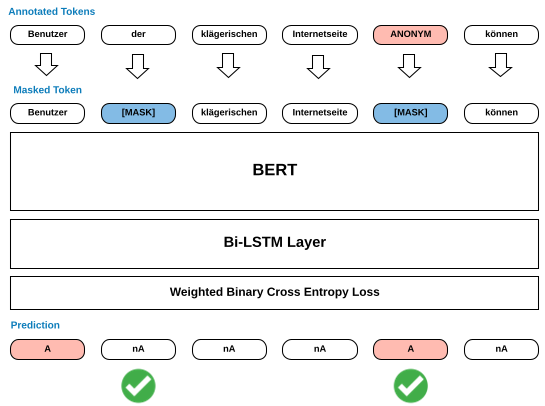 The architecture combines BERT embeddings with a BiLSTM classifier to predict sensitivity token-by-token.
Experimental Battleground: District vs. Financial Courts
The models were tested on real-world rulings from Munich’s District and Financial courts. The results revealed a fascinating technical challenge: The Domain Shift.
| Model Variant | Evaluation Set | Precision | Recall |
|---|---|---|---|
| RNN1 | Munich District Court | 68.9% | 79.1% |
| RNN1 | Munich Financial Court | 64.7% | 54.6% |
The sharp drop in performance for the Financial Court (Recall falling from ~79% to ~54%) proves that "legal German" is not a monolith. Financial courts have stricter, different rules for sensitive data (e.g., account numbers or specific financial dates) that a model trained on general civil rulings simply hasn't seen.
Deep Insight: The "Validation-Test Gap"
A significant contribution of this paper is the identification of the Validation-Test Gap. Because the training data only contained placeholders, the model was essentially learning to recognize "where a human already decided to hide something." When applied to raw text where the entities are still visible, the model's performance can falter. The researchers mitigated this by masking the input during training, ensuring the model relies on the sentence structure (Inductive Bias) rather than specific names.
Conclusion and Future Outlook
While the system isn't ready for "unsupervised" automation (the recall isn't yet at the 99%+ level required for legal safety), it provides a powerful "human-in-the-loop" tool.
The authors also introduced a Pseudonymization tool to help courts create their own training data locally, solving the "chicken-and-egg" problem of training privacy models without violating privacy. As legal-tech grows, this work sets the stage for a future where legal precedents are accessible to all, without compromising the privacy of the individuals involved.