
Anonymizing Geo-Social Networks: Why Hiding Your Identity Requires More Than Deleting Your Name
Anonymizing geo-social network datasets
This paper introduces a framework for anonymizing Geo-Social Network (GSN) datasets by addressing the unique risk of user re-identification through location data. The authors propose the "Top Locations" model and two new privacy properties, --anonymity and --anonymity, implemented via a modified hierarchical agglomerative clustering algorithm (Union-Split) and social edge perturbation.
TL;DR
As social networks like Foursquare and Facebook Places integrated geographic data, they created a new privacy frontier. This paper highlights that you aren't just defined by who you know, but by the top 3 places you frequent. The authors propose a clustering and edge-rewriting method to ensure that every user in a dataset looks like at least others in both their spatial habits and their social circle.
The Motivation: The "Fingerprint" of Your Daily Routine
Why is geo-social data so hard to anonymize? Previous research found that 80% of cellphone users are uniquely identifiable by just their top three locations (typically home, office, and a favorite third place).
In a Geo-Social Network (GSN), an attacker doesn't need to break high-level encryption. If they know you work at a specific building and often visit a certain coffee shop, they can find you in a "naively" anonymized dataset. Worse, if they know your friend works at the CS department, that social link acts as a "structural signature" to unmask you.
Methodology: The Top Locations Model
The authors move beyond simple point-location cloaking. They introduce the Top Locations Model (), where a user’s signature is a tuple of geographic regions.
1. --Anonymity
This property ensures that for every user, there are others with identical (cloaked) top locations.
- The Distance Challenge: How do you measure how "far" two sets of locations are? The authors calculate the Minimum Bounding Rectangle (MBR) for all possible pairings () of locations between two users to find the most efficient clustering.
2. --Anonymity: The Social Link
The paper’s most "academic" insight is -equivalence. It’s not enough for you to be hidden; your neighbor's locations must also match the neighbor signatures of other people.
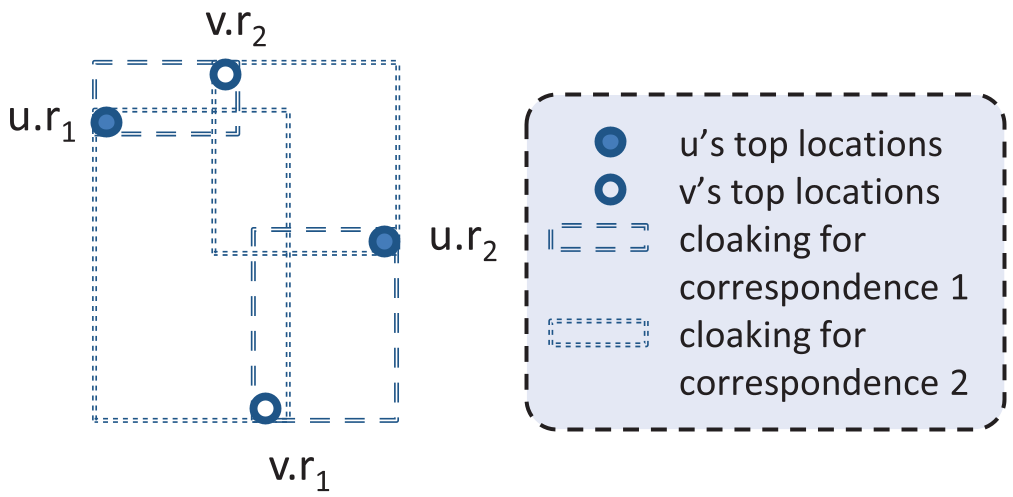 Figure 1: Example of location cloaking in the model, showing how regions are merged to form an anonymity set.
The Anonymization Algorithm
The authors use a modified Union-Split clustering approach:
- Iterative Merging: Start with each user as a cluster. Merge the "closest" clusters (those requiring the least area expansion).
- Splitting: If a cluster gets too big (), split it to keep location precision as high as possible.
- Edge Perturbation: Once users are grouped, the social graph is modified. Using the "Insert/Remove" strategy, edges are added or deleted between groups so that every member of Cluster A has a friend in Cluster B, making their "neighbor profiles" indistinguishable.
Experimental Results
The researchers tested their approach on a synthetic dataset of 1,500 users, calibrated against real-world cellular sector tracking data.
- Location Utility: As (the size of the anonymity set) increases, the area of the "cloaked" regions naturally grows. However, the study found the growth stabilizes, suggesting a "sweet spot" where privacy doesn't completely destroy geographic utility.
- Network Structure: The "Insert/Remove" strategy proved superior for maintaining the graph's density. The "Insert-only" method, while preserving all original social links, tended to "bloat" the network, doubling the total number of edges at low values.
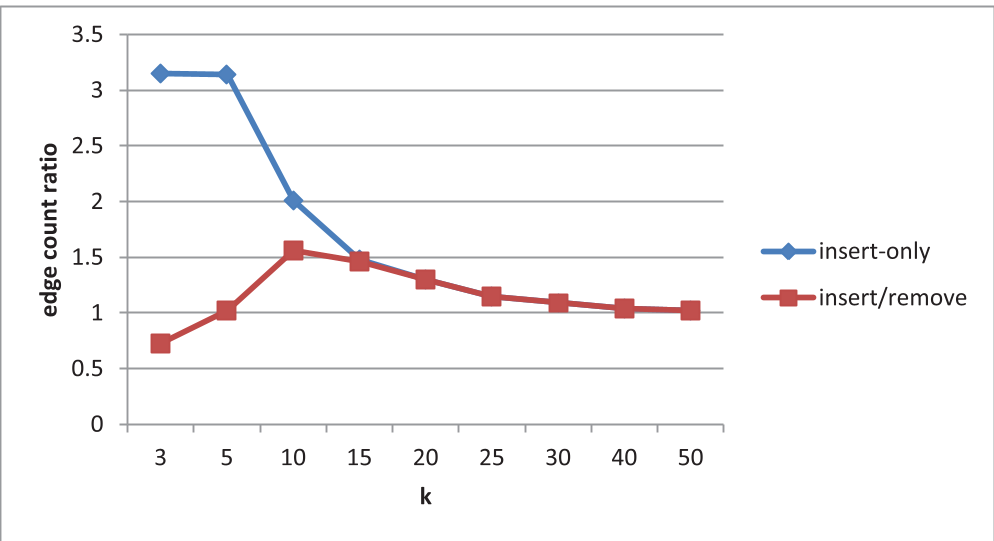 Figure 2: Performance comparison of the Insert-only vs. Insert/Remove strategies regarding edge count ratio.
Critical Analysis & Conclusion
Takeaway: This work was a pioneer in recognizing that spatial and social data cannot be anonymized in silos. The -anonymity property sets a high bar for privacy.
Limitations:
- Computational Complexity: The permutation calculation makes the algorithm expensive as the number of ranked locations () increases.
- Synthetic Data: The study relied on a 1,500-user synthetic set; real-world GSNs like Foursquare (now part of Foursquare City Guide/Swarm) are vast, highly sparse, and exhibit power-law distributions that might make -clustering far more distortive.
Future Outlook: Modern research has shifted toward Differential Privacy, which adds noise rather than clustering users into boxes. However, the "Top locations" remains a vital threat model for any researcher handling spatial datasets today.