
APTM: Balancing Anonymity and Efficiency in Crowdsourcing Task Matching
Anonymous Privacy-Preserving Task Matching in Crowdsourcing
This paper introduces APTM, an anonymous privacy-preserving task matching scheme for multi-user crowdsourcing. By integrating Short Group Signatures with Public Key Encryption with Keyword Search (PEKS), it enables secure, single-keyword matching that protects both task and worker privacy while achieving SOTA performance in identity anonymity and worker revocation.
TL;DR
In the sharing economy, crowdsourcing platforms like Amazon MTurk face a critical dilemma: how to match workers to tasks without exposing sensitive task details or worker identities to an untrusted server. APTM (Anonymous Privacy-Preserving Task Matching) solves this by fusing Short Group Signatures with Searchable Encryption. It provides a "Swiss Army Knife" for crowdsourcing: protecting data confidentiality, ensuring worker anonymity, allowing for efficient revocation, and maintaining owner traceability—all while outperforming traditional broadcast-based encryption models.
The "Broken" State of Privacy in Crowdsourcing
Modern crowdsourcing delegates complex tasks to a distributed workforce. Traditionally, the platform (crowd-server) sees everything: what the requester wants (Task Privacy) and who the worker is (Identity Privacy).
Current solutions have significant Inductive Bias gaps:
- Searchable Encryption (SE): Great for single users, but in multi-requester/multi-worker setups, sharing a key means if one worker is revoked, the entire system's keys must be redistributed.
- Proxy Re-encryption: Often requires the server to know the identities of users to perform key transformation, failing the "Anonymity" test.
- One-sided Protection: Many spatial crowdsourcing papers protect location but ignore the sensitive nature of the task content itself.
Methodology: The Fusion of PEKS and Group Signatures
The core insight of the APTM scheme is to treat a "query" not just as a search request, but as an anonymous credential.
1. System Architecture
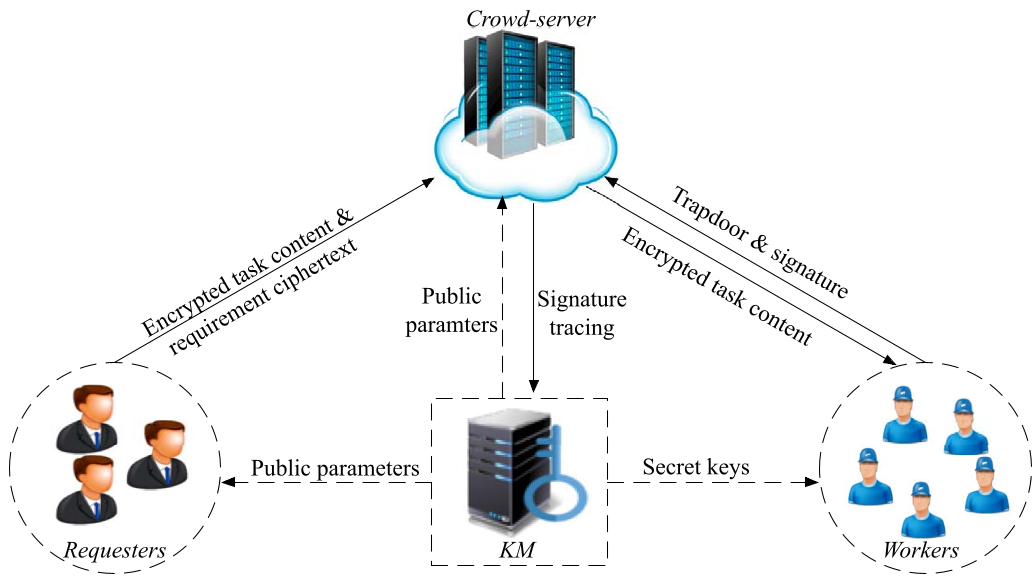
The system involves four entities: the Key Manager (KM), Requesters, Workers, and the Crowd-Server. The KM acts as the Trust Anchor, handling enrollment and the "tracing" of dishonest users.
2. The Matching Logic (PEKS)
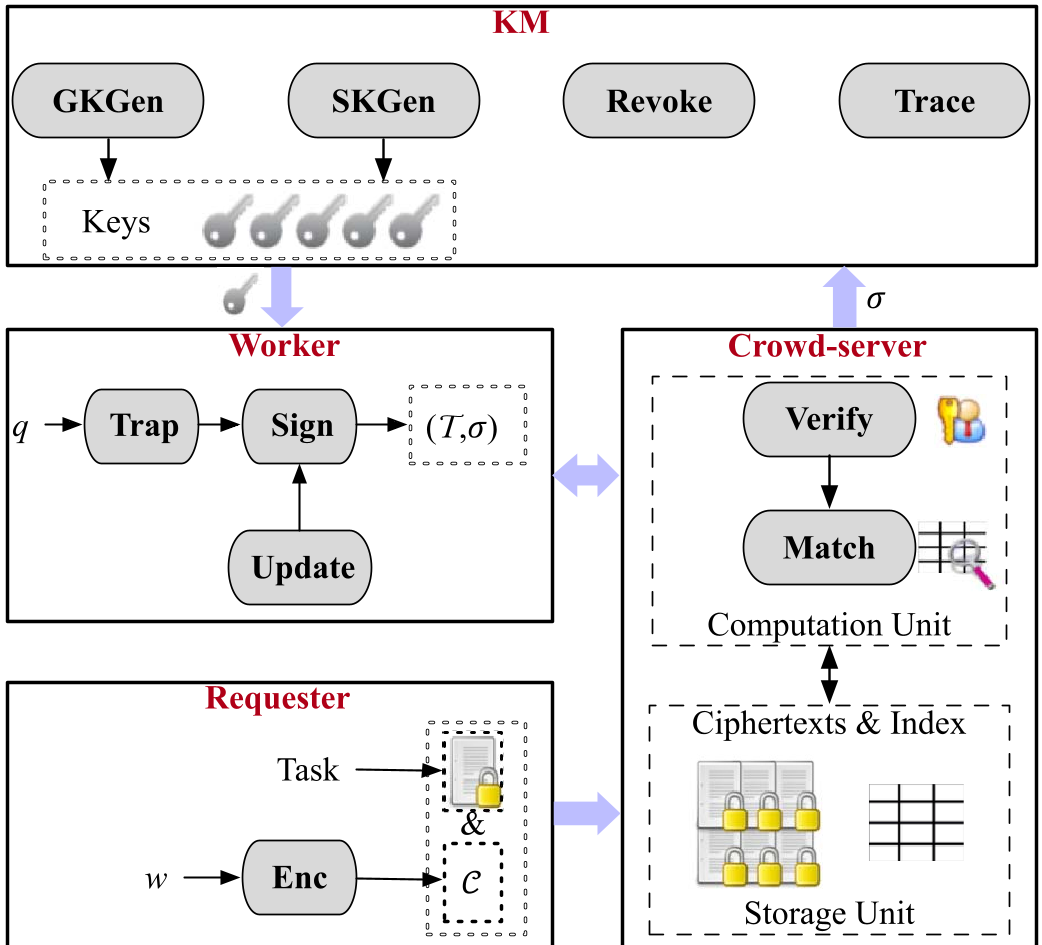
Requesters use a public key to encrypt task keywords. Workers generate a Trapdoor (T) using their secret key. The server uses a Bilinear Pairing operation to check if the trapdoor matches the ciphertext without ever learning the underlying keyword.
Mathematical Intuition: The matching relies on the property: This allows the server to verify equality in the exponent, preserving the privacy of the base and .
3. Anonymous Authentication (Short Group Signatures)
To prevent unauthorized workers from querying, every trapdoor is accompanied by a group signature. This signature proves: "I am a legitimate member of the authorized worker group," without revealing "I am Alice."
Efficient Revocation: The Technical Edge
One of the paper's strongest contributions is the Worker Revocation mechanism. In traditional systems, revoking a user requires re-keying everyone. APTM uses a "Revocation List" (RL) approach where the KM updates the Group Public Key, and non-revoked workers update their own keys locally. This results in constant-time verification for the server, regardless of how many workers have been kicked out of the system.
Experimental Performance
The authors implemented APTM using the Charm framework and PBC library.
- Scalability: The system scales linearly with the number of workers during initialization but maintains near-instant speeds for daily operations.
- Comparison: APTM dominates SEMEKS in encryption and trapdoor generation time. For a query with 10 keywords, APTM is approximately 2x faster.

Critical Insight & Future Outlook
APTM successfully bridges the gap between cryptographic theory and crowdsourcing utility. However, the scheme is currently limited to single-keyword matching. While the authors mention "extensibility" to fuzzy or multi-keyword search, the current computational overhead for complex Boolean queries on mobile worker devices might still be a bottleneck.
The Takeaway: If you are building a decentralized labor marketplace, the APTM framework provides the necessary mathematical rigor to ensure that "trusting the platform" is no longer a prerequisite for user privacy.
Limitations:
- The "Honest-but-curious" server model assumes no collusion between the server and requesters.
- The revocation list (RL) grows over time, which may slightly increase the local update time for workers who log in after a long absence.