
Beyond the Digital Footprint: Building a Safe, Anonymous Social Network for Media Sharing
An Anonymous Social Network Site to Share Pictures
This paper presents the development and empirical evaluation of an anonymous Social Network Site (SNS) designed specifically for picture sharing. Built using PHP and MySQL, the platform mitigates privacy risks by requiring only an e-mail address and forgoing personal identifiers, achieving stable performance during a month-long real-world pilot.
TL;DR
As privacy concerns on mainstream social media platforms escalate, this paper proposes a solution through an Anonymous Social Network Site (SNS). By eliminating the collection of personal metadata and focusing on a specialized "fotolog" (photo blog) format, the researchers demonstrate that social connectivity—sharing, commenting, and group formation—does not require sacrificing personal security.
Context & Motivation: The Identity Trap
Social Network Sites are double-edged swords. While they boost productivity and connectivity, they serve as goldmines for malicious actors. The authors highlight chilling real-world consequences of "identity-first" networking, ranging from legal trouble due to tracked monikers to kidnapping cases fueled by overshared family details.
The core insight of this work is that anonymity is a feature, not a bug. By restricting user data to just an e-mail address, the "Social Contract" of the platform shifts from identity-exposure to content-interaction.
Methodology: The "Fotolog" Architecture
The system was developed using a classic but robust LAMP stack (Linux, Apache, MySQL, PHP).
1. Architectural Design
The platform distinguishes between two user roles:
- Guest Users: Restricted to viewing images and reading public comments.
- Registered Users: Empowered to upload photos, manage a personal "fotolog," and interact with the friend-matching system.
2. The Friendship Algorithm
Unlike traditional platforms where "friends" are manually searched, this SNS uses a more organic discovery mechanism. The system tracks the number of reviews and access frequency to suggest "fotologs" most akin to a user’s preferences. However, it still maintains a manual confirmation gate for creating formal relationships to prevent spamming.
 Caption: The minimal user profile interface, requiring only a nickname, email, and aesthetic preferences.
Real-World Evaluation
The researchers didn't just build the tool; they stress-tested it during a local competition in Carcaixent, Spain. Over 30 days, they tracked traffic dynamics using Google Analytics—a rarity in early SNS research which usually focused on user demographics rather than session-level performance.
Key Metrics:
- Visits: 4,779 total visits.
- Engagement: An impressive 15.85 pages per visit, suggesting that users weren't just "landing" on the page but actively browsing deep content.
- Retention: 26.8% were new visits, indicating a healthy mix of returning users and steady growth.
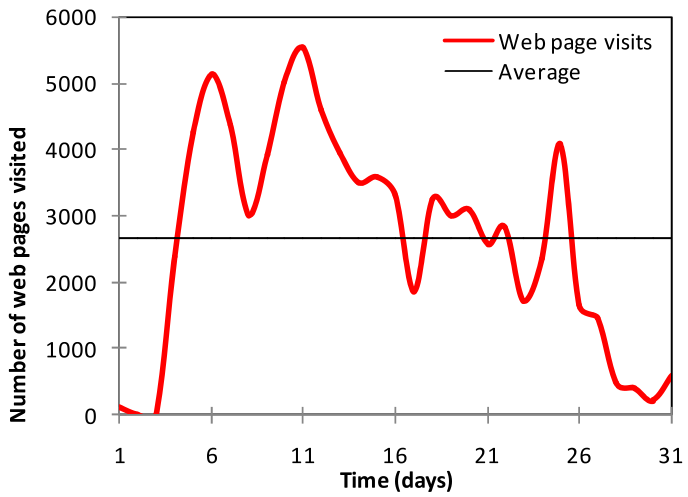 Caption: Daily web page views showing significant peaks during weekends, correlating with the social behaviors of the student/worker demographic.
Critical Analysis & Discussion
The authors distinguish their work from contemporary studies (like those of MySpace or Facebook) by pointing out a fundamental research paradox: If a system is truly anonymous, you cannot study its demographics.
While other researchers analyzed age and gender, this paper focuses on behavioral telemetry (time on site, abandon rates, referral sources).
- Referral Insights: Interestingly, 51% of traffic was direct, and 43% came from links, showing that the community was self-driven rather than reliant on search engines (which only accounted for 6%).
Limitations
The platform is currently limited to photo-sharing. For a modern audience, the lack of real-time communication (Instant Messaging) or video support might be perceived as a drawback. Furthermore, while the e-mail-only registration protects identity from other users, it still leaves a centralized "point of failure" in the database that manages those emails.
Final Takeaway
This paper serves as a precursor to the modern "privacy-first" movement. It proves that by limiting the scope of a social network to a specific purpose (like a digital neighborhood photo competition), we can maintain high engagement while providing a protective shield of anonymity. For future developers, the "Carcaixent Test" demonstrates that community-driven platforms thrive when they align with local social events and rituals.