
Beyond Local Optima: Efficiently Searching for Global Truth in Crowdsourcing
Answer Aggregation for Crowdsourcing Microtasks using Approximate Global Optimal Searching
The paper proposes an "Iterative Optimization Strategy" (IOS EM) for answer aggregation in binary micro-task crowdsourcing. It introduces a Dominance Ordering Model (DOM) and a Cut-point Neighbor Search (CNS) algorithm to refine the local optimal results of standard Expectation-Maximization (EM), achieving higher likelihood and more accurate ground-truth estimation.
TL;DR
Answer aggregation in crowdsourcing often relies on the Expectation-Maximization (EM) algorithm, which is notorious for getting stuck in local optima. This paper introduces IOS EM, an iterative optimization strategy that uses a Dominance Ordering Model and Cut-point Neighbor Search to "nudge" EM results toward a global maximum likelihood, significantly improving the accuracy of both task answers and worker quality assessments.
Background & Motivation: The Local Optimum Trap
In micro-task platforms like Amazon Mechanical Turk, the "wisdom of the crowd" is often diluted by varying worker expertise. The standard academic response is the EM algorithm: it guesses the task answers, uses those guesses to estimate worker quality, and iterates.
However, the authors point out a critical flaw: EM is greedy. It is highly dependent on initialization and often misses the true global maximum of the likelihood function. While researchers have proposed globally optimal solutions before, they are usually computationally prohibitive for large-scale tasks. The authors ask: Can we find a middle ground that is more accurate than standard EM but more efficient than a full global search?
Methodology: Pruning and Searching the Mapping Space
The authors propose a multi-stage pipeline to refine crowdsourced results:
- Initial Categorization: Use a standard EM pass and a fully connected neural network to provide a baseline for worker quality and task answers.
- Dominance Ordering Model (DOM): To avoid searching every possible answer combination (which is ), they construct a Directed Acyclic Graph (DAG) based on "Dominance." A response set dominates another if it contains more correct indications from higher-quality workers. This allows the algorithm to prune the search space significantly.
- Cut-point Neighbor Search (CNS): They define a "cut-point" as the boundary between tasks mapped to "1" vs "0". The algorithm iteratively tests neighboring mappings to see if they increase the overall likelihood .
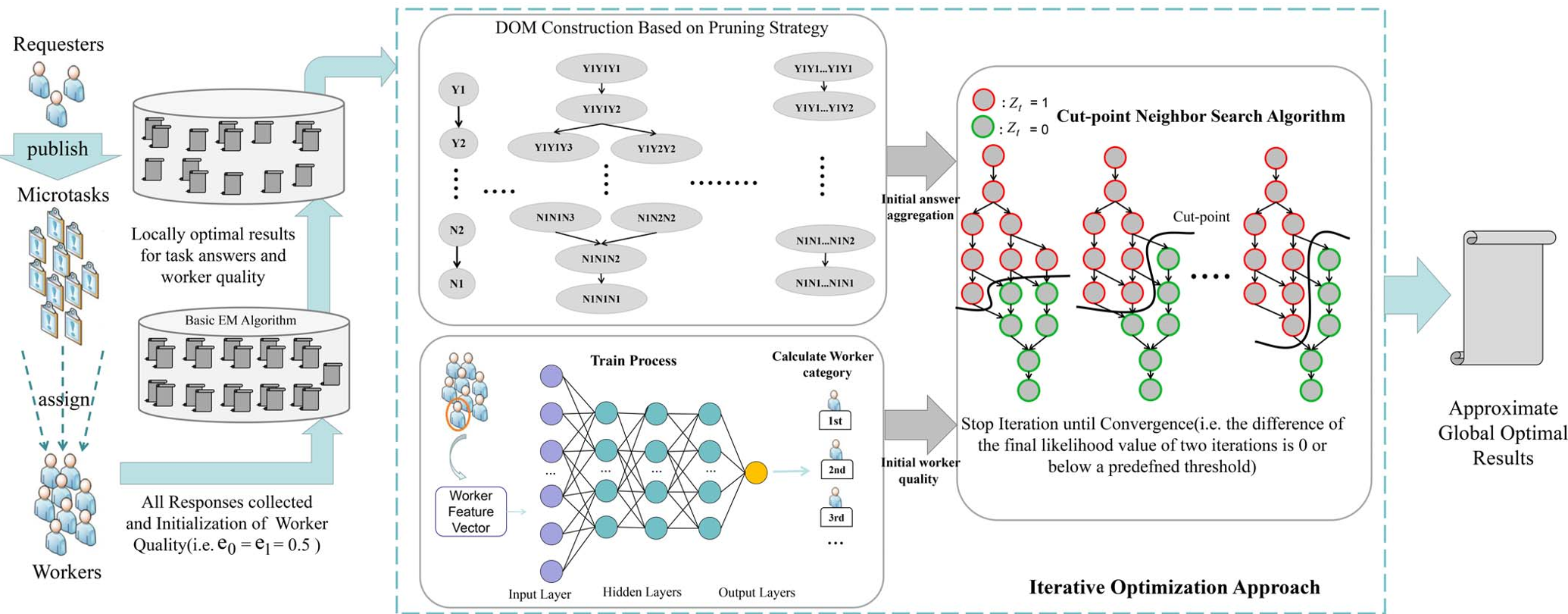 Figure 1: The architecture of the IOS EM pipeline, from raw response collection to the final neighbor search.
The Math of Likelihood
The core objective is to maximize the likelihood , which is a product of worker error rates () given the estimated ground truth. By finding a mapping that yields a higher , the algorithm mathematically guarantees a model that better fits the observed worker responses.
Experimental Validation
The authors tested their method on synthetic data and a real-world sentiment analysis dataset (movie reviews from Rotten Tomatoes).
Key Findings:
- Likelihood Gains: Across different initialization models, IOS EM consistently found higher likelihood values than basic EM.
- Reduced Error Rate: Improved likelihood directly correlated with a lower error rate (ER) in identifying the true sentiment of movie reviews.
- Worker Fidelity: The Average Euclidean Distance (AED) between estimated and actual worker quality was lower, meaning the model "understands" the workers better.
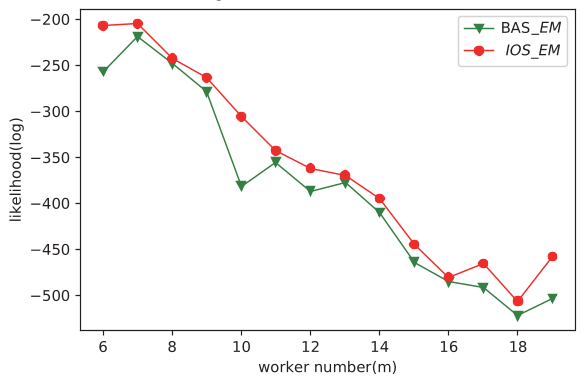 Figure 2: Performance metrics showing IOS EM (Iterative Optimization Strategy) outperforming basic EM across various data scales.
Critical Insight: Why This Matters
The bridge between "local optima" (EM) and "global optima" (exhaustive search) is often built with heuristics. This paper’s contribution isn't just a new algorithm, but the validation of Dominance Ordering as a pruning tool. It proves that we don't need to check every combination to find a better answer; we just need to look in the "neighborhood" of high-quality worker responses.
Conclusion and Future Work
The proposed IOS EM framework provides a robust alternative for quality control in binary crowdsourcing tasks. While the current work focuses on Yes/No (binary) labels, the structural approach of using cut-points and neighbor searches could potentially be extended to multi-class classification or more complex worker models (e.g., accounting for task difficulty). For practitioners running large-scale labeling jobs, this suggests that the "standard EM" output should be treated as a starting point, not the final word.