
BayesCrowd: Optimizing Skyline Queries over Incomplete Data via Hybrid Intelligence
Answering Skyline Queries over Incomplete Data with Crowdsourcing(Extended Abstract)
The paper introduces BayesCrowd, a novel framework for answering skyline queries over incomplete datasets by integrating Bayesian networks with crowdsourcing. It addresses the challenges of data incompleteness and computational complexity, significantly outperforming existing methods like CrowdSky in terms of latency and monetary cost.
TL;DR
Skyline queries are essential for multi-criteria decision making, but they break when data is missing. BayesCrowd bridges this gap by combining the statistical power of Bayesian Networks with the human judgment of Crowdsourcing. It solves the computational bottleneck of probability estimation using an Adaptive DPLL algorithm and introduces smart task selection strategies that reduce monetary costs by 10x compared to previous SOTA.
Problem & Motivation: The Incompleteness Trap
In a "Skyline Query," we look for objects that aren't "dominated" by any others (e.g., a hotel that is both cheap and close to the beach). However, in real-world datasets—due to sensor failures or privacy concerns—attributes are often missing.
Current machine-learning methods attempt to "guess" missing values, but they lack the ground-truth accuracy needed for definitive ranking. Previous crowdsourcing methods, while more accurate, were inefficient: they asked too many questions of human workers, leading to massive budgets and "latency hell" where queries took forever to resolve.
Methodology: The BayesCrowd Architecture
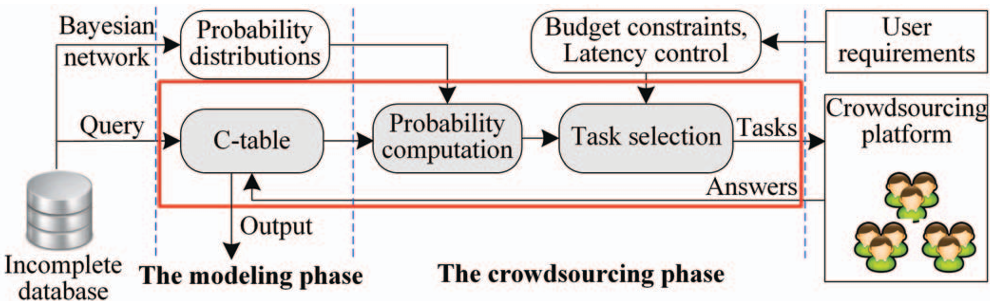
The framework operates in two distinct phases: Modeling and Crowdsourcing.
- Bayesian Modeling: The system trains a Bayesian network to understand correlations between attributes. If one attribute is missing, the network provides a probabilistic estimate based on others.
- C-Table Representation: It uses a conditional database (c-table) to store propositional formulas representing the conditions under which an object belongs to the skyline.
- Adaptive DPLL (ADPLL): Calculating the exact probability of an object being in the skyline is #SAT-hard. BayesCrowd uses ADPLL to break complex logical expressions into independent parts, speeding up the math significantly.
Optimal Task Selection
To stay within budget and latency , the paper proposes three strategies for choosing which "missing data" to ask humans about:
- Frequency-Based (FBS): Asks about the most common missing attributes. (Fastest)
- Utility-Based (UBS): Uses Information Gain to find the task that clears up the most uncertainty. (Most Accurate)
- Hybrid Heuristic (HHS): A middle ground that balances speed and accuracy.
Experiments & Results
The authors tested BayesCrowd against the previous leader, CrowdSky, using real-world NBA stats and synthetic data.
Key Findings:
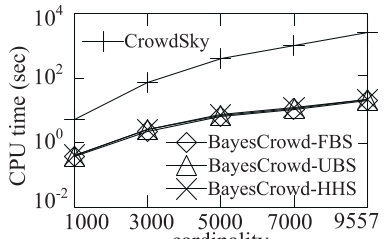
- Efficiency: BayesCrowd is ~100x faster than CrowdSky as the dataset scales.
- Cost-Effectiveness: It requires significantly fewer "human tasks" to reach a stable answer, saving budget.
- Scalability: While CrowdSky's time cost explodes with data size, BayesCrowd remains relatively stable.
Critical Analysis & Conclusion
Takeaway
BayesCrowd proves that you don't need a "crowd" to do everything. By using Bayesian Networks to handle the easy statistical inferences and saving Crowdsourcing for the most "informative" missing variables, you can achieve SOTA results with a fraction of the resources.
Limitations & Future Work
The current model assumes workers are always correct. In the future, incorporating worker reliability models (handling noisy or malicious answers) would make the framework even more robust for public platforms like Amazon Mechanical Turk. Additionally, exploring this framework in dynamic/streaming data environments could be a promising next step.