
Ant-Miner: Leveraging Swarm Intelligence to Predict the Viral Spread of Opinions
Ant-Based Simulation of Opinion Spreading in Online Social Networks
The paper presents a novel framework for simulating opinion spreading in Online Social Networks (OSNs) by combining Text Mining, Social Network Analysis, and Swarm Intelligence. Using the Ant-Miner algorithm to derive rule-based models of influence, the method successfully predicts shifts in public sentiment and evaluates the impact of targeted marketing interventions.
TL;DR
This paper introduces an innovative simulation framework that mirrors nature to understand social influence. By combining Text Mining to capture sentiment and Ant-Based Mining to discover influence rules, the researchers can predict whether a product's reputation will flourish or fail. The study moves beyond simple "adoption" models to account for the complex interplay between positive and negative opinions in a dynamic network.
The Motivation: Moving Beyond Static Snapshots
Marketing managers face a daunting challenge: Online Social Networks (OSNs) are chaotic. Traditional Social Network Analysis (SNA) provides a static map of who is connected to whom, but it rarely explains the why and how of opinion shifts. Most existing models suffer from three fatal flaws:
- They assume users start with no opinion.
- They ignore negative feedback loops.
- They assume influence is uniform rather than rule-based.
The authors propose a "what-if" simulation engine that treats opinion formation as a pattern-matching problem solved by autonomous "ants."
Methodology: The Ant Colony in the Machine
The core of the methodology is the integration of sentiment extraction with Swarm Intelligence.
1. Opinion Mining (The "What")
Using Support Vector Machines (SVM), the authors classify forum postings into positive, negative, or neutral categories. This creates a "sentiment map" of the existing network.
2. Rule Discovery via Ant-Miner (The "How")
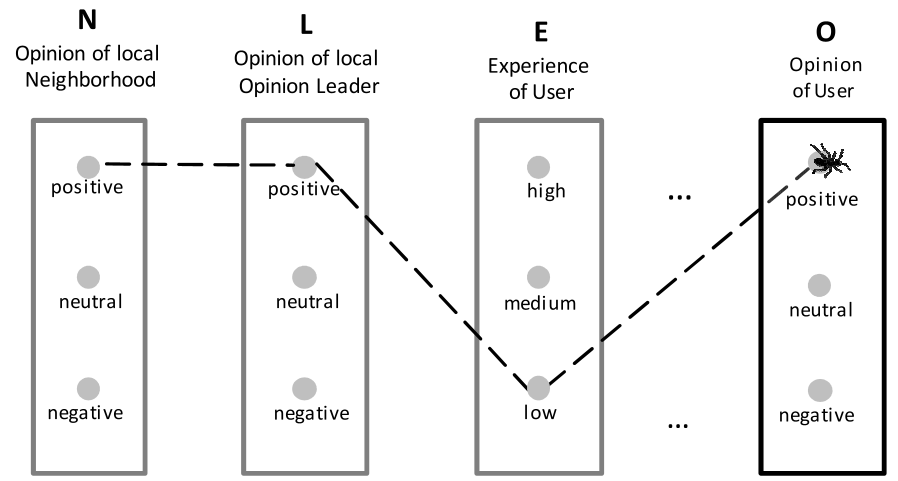
The most ingenious part of the work is the use of the Ant-Miner algorithm. Instead of basic regressions, artificial ants traverse a graph of attributes (like a user's reputation, the centrality of their friends, and average neighborhood sentiment).
- Ants deposit pheromones on paths that represent high-accuracy rules (e.g., "IF neighbor sentiment is negative AND user reputation is low, THEN user becomes negative").
- Evaporation ensures that weak or coincidental rules disappear, leaving only the most robust patterns of social influence.
Experiments & Critical Results
The researchers tested their model on data from GameStar.de, focusing on three major game releases: Fallout 3, Far Cry 2, and Dead Space.
Prediction Accuracy
The Ant-Miner achieved impressive accuracy in predicting how users would react based on their "Ego-network" (the immediate circle of friends and influencers).
| Game | Friendship Network | Discussion Network | Club Network |
|---|---|---|---|
| Dead Space | 84.00% | 87.85% | 87.00% |
| Far Cry 2 | 63.50% | 75.29% | 67.78% |
Tactical Insights from What-If Analysis
The simulation highlighted a critical strategic distinction between types of influencers. In the case of Far Cry 2, which was trending toward a negative disaster (-0.96 average opinion), the researchers simulated changing the minds of different "Opinion Leaders."
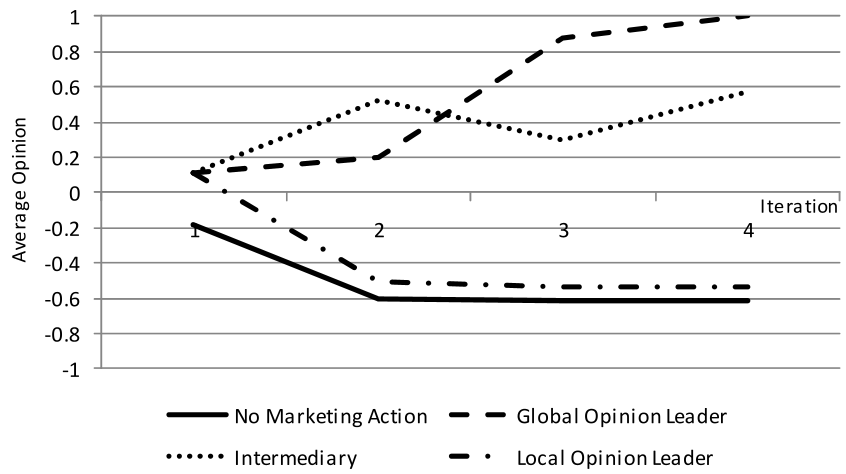
- Local Opinion Leaders: Converting them had the least impact.
- Intermediaries: Showed moderate success.
- Global Opinion Leaders: Due to their "closeness centrality," converting even 25% of negative global influencers was the most effective way to swing the entire network's sentiment back toward positive territory.
Deep Insight: Why This Matters
The beauty of this research lies in its interpretability. Unlike modern deep learning models that might predict a trend without explanation, the Ant-Miner produces explicit binary rules. This allows a CMO to see exactly which logic is driving the brand's perception.
Limitations: While the model is robust, it relies on manual classification for training data, which is difficult to scale. Furthermore, it treats the network structure as relatively stable during the opinion shift, whereas in reality, controversial opinions often cause "unfriending" or restructuring of the network itself (Echo Chambers).
Conclusion
This work bridges the gap between swarm intelligence and social science. By treating social influence as a discoverable set of rules rather than a random probability, it gives companies a "flight simulator" for marketing. For future research, integrating these ant-based rules with Large Language Models (LLMs) could automate the sentiment analysis phase, creating an end-to-end autonomous market intelligence system.