
MOEA/D-ADACO: Balancing Cost and Control in Social Network Rumor Suppression
Ant Colony Optimization for the Control of Pollutant Spreading on Social Networks
This paper introduces a biobjective optimization model and a specialized Ant Colony Optimization algorithm (MOEA/D-ADACO) to control pollutant spreading (such as rumors) in social networks. The approach treats node blocking as a multiobjective task to balance the trade-off between maximizing spreading suppression and minimizing control costs.
TL;DR
Controlling the spread of "pollutants" (rumors or malware) in social networks is typically viewed as a "top-K node" selection problem. This paper argues that the fixed- approach is flawed. Instead, it proposes a biobjective model that simultaneously maximizes suppression effect and minimizes control cost. To solve this, the authors developed MOEA/D-ADACO, an Ant Colony Optimization variant that adaptively decides how many and which nodes to block, outperforming traditional greedy and genetic algorithms in both quality and speed.
Problem & Motivation: The Hidden Cost of "Blocking"
Most existing literature on influence minimization focuses solely on the "Effect": How many nodes can we save by blocking a set ?
However, there are two major blind spots in this SOTA logic:
- Fixed Dimension: We don't actually know if blocking 10 nodes or 100 nodes is "best."
- Operational Cost: In a professional social network, blocking a high-degree node (like a key influencer) isn't free—it damages the network's service quality and connectivity.
The authors' insight is to treat this as a Multiobjective Optimization Problem (MOP). They use Expected Diffusion Value (EDV) to measure effect and PageRank (PR) values to quantify the "cost" of blocking specific nodes.
Methodology: Ant Colony meets Decomposition
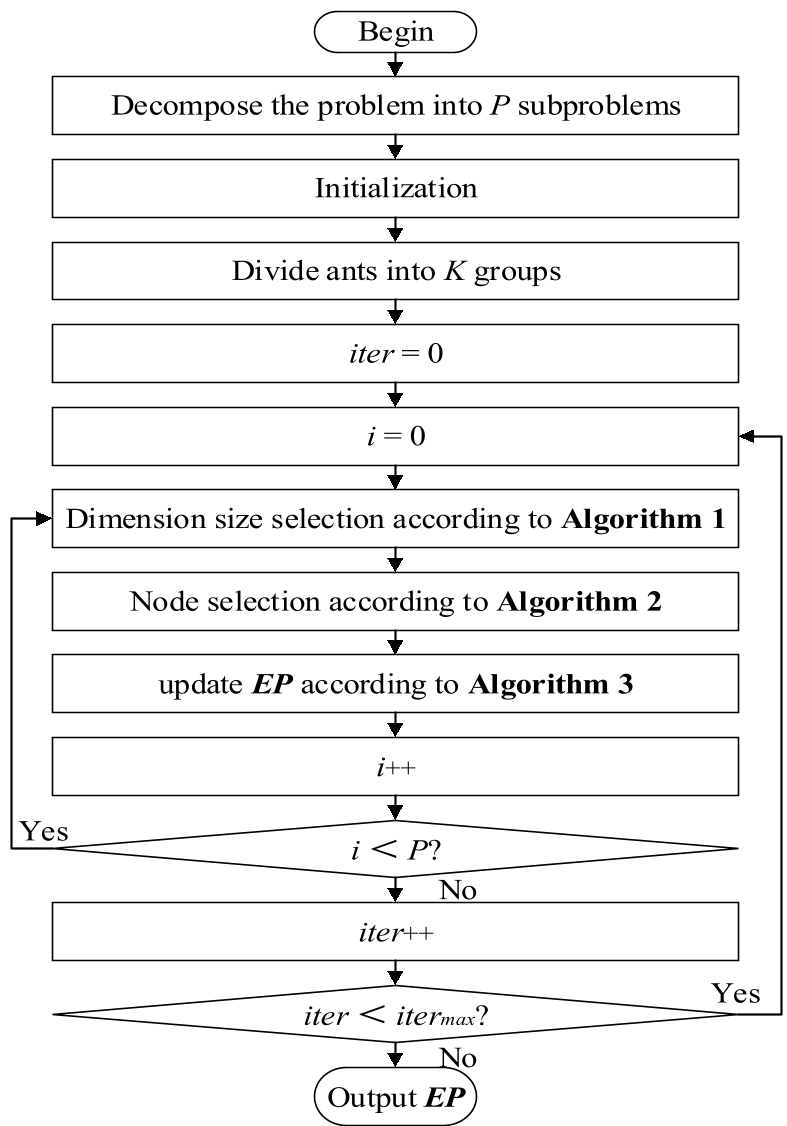
The core of the paper is MOEA/D-ADACO. It builds on the MOEA/D (Decomposition) framework, which breaks a complex biobjective front into a set of single-objective subproblems.
1. Dual-Pheromone Mechanism
Unlike standard ACO, this algorithm uses two types of "chemical trails":
- (Dimension Pheromone): Guides the ants on the optimal number of nodes to select.
- (Node Pheromone): Guides the ants on which specific nodes are the most "cost-effective" for suppression.
2. Adaptive Dimension Selection
Before an ant starts picking nodes, it "decides" on a dimension size based on the strength of the pheromone. This allows the population to explore solutions of different sizes simultaneously, eventually converging on the most efficient set sizes for the Pareto Front.
Experiments & Results
The authors tested their model on six real-world datasets, including Facebook, Google+, and Twitter.
SOTA Comparison
Compared to the classic Hill-Climbing (HC) greedy algorithm and NSGA-II/III, the proposed method found much more diverse and efficient trade-offs.
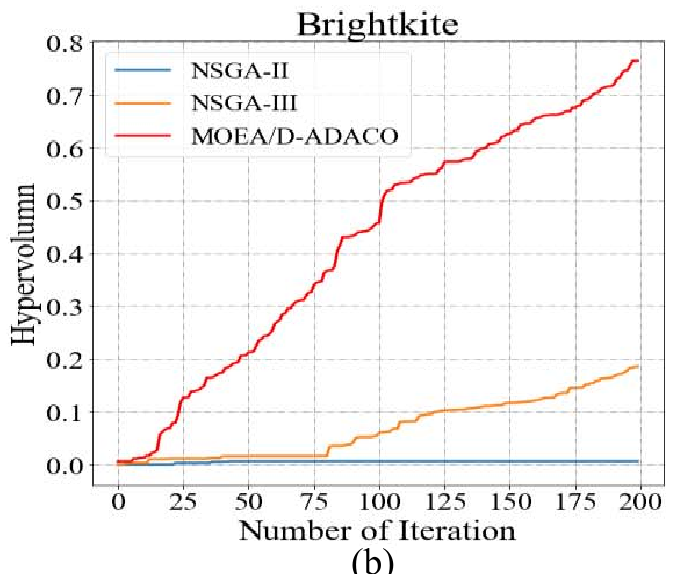
- Effectiveness: MOEA/D-ADACO achieved higher Hypervolume (HV) scores, meaning its Pareto Front was closer to the theoretical optimum.
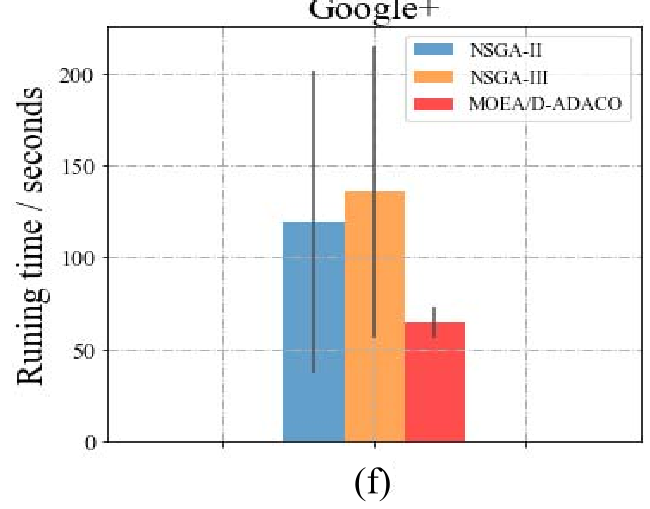
- Efficiency: Because ACO avoids the heavy computational overhead of "Nondominated Sorting" (the bottleneck of NSGA algorithms), MOEA/D-ADACO was significantly faster. In the Deezer dataset, it ran 21 times faster than NSGA-III.
Visual Evidence of Convergence
The convergence curves show that while NSGA-II often struggles to improve after initial iterations in large-scale networks, MOEA/D-ADACO continues to refine the front, thanks to the collective intelligence of the ant groups sharing pheromones.
Critical Insight: Why it Works
The success of this work lies in its Inductive Bias. Social networks are naturally discrete and combinatorial. Ant Colony Optimization is inherently designed for discrete path-finding. By adding the adaptive dimension selection, the authors transformed the "fixed-set" constraint into an optimization variable, allowing the algorithm to discover that "less is often more"—blocking a few strategic low-cost nodes can be more efficient than blocking many high-cost ones.
Conclusion
The paper effectively demonstrates that pollutant control in social networks is not just about power, but about efficiency. MOEA/D-ADACO provides a robust, fast, and flexible tool for administrators to manage network health without destroying the network's value.
Limitations: The model assumes a static network. In real-world scenarios, social ties evolve, and a dynamic version of this ACO model would be the next logical step for researchers in this field.