
Beyond the Code: Why Culture Decides if You'll Pirate Software
An Exploratory Examination of Antecedents to Software Piracy: A Cross-Cultural Comparison
This study investigates the individual-level factors driving software piracy through a cross-cultural comparison between the United States and Jordan. Utilizing the Theory of Reasoned Action (TRA) as a foundational framework, the researchers demonstrate that cultural context significantly alters the predictive validity of traditional behavioral models and the influence of psychological moderators.
TL;DR
Why is software piracy a minor issue in some countries but the "norm" in others? This study reveals that the psychological "roadmap" to piracy is not universal. While Americans are driven by personal ethics and social norms, Jordanians are influenced more heavily by specific cultural identifiers like public self-consciousness and moral idealism, rendering Western behavioral theories like the Theory of Reasoned Action (TRA) almost useless in non-Western contexts unless heavily modified.
The "Western Bias" in Behavioral Science
For decades, researchers have used the Theory of Reasoned Action (TRA) to predict everything from bank adoption to illegal downloading. The logic is simple: your Attitude (is it good?) and Subjective Norms (do people I care about like it?) dictate your Intention.
However, this study exposes a massive blind spot. While this model works perfectly for a US audience, it fails to explain behavior in Jordan. The researchers argue that culture and individual personality are indivisible—meaning a "one-size-fits-all" software protection strategy is doomed to fail in a global market.
Methodology: A Tailored Framework
To find out what makes different cultures "tick," the authors introduced four psychological moderators into the TRA model:
- Public Self-Consciousness: How much do you care about your social image?
- Religiosity: How much does faith guide your daily ethics?
- Idealism vs. Relativism: Do you believe in universal rules, or "it depends"?
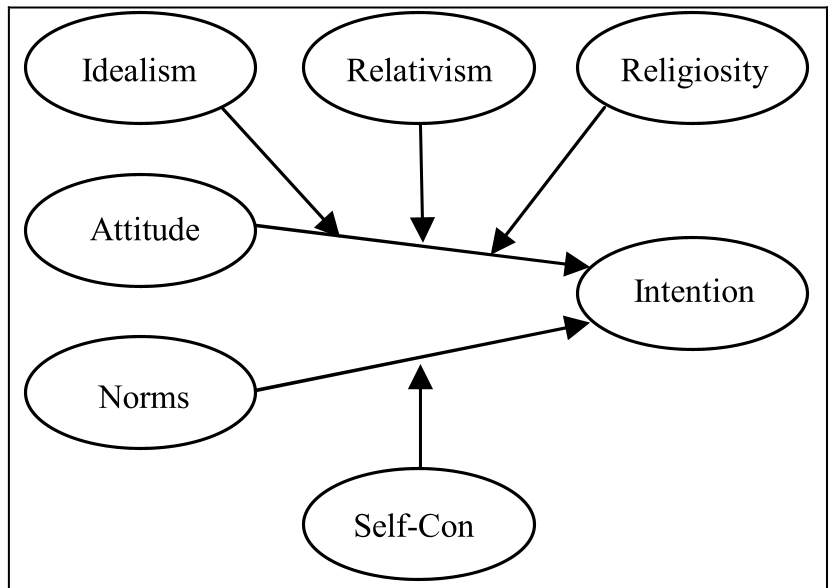 The Research Model linking TRA with cultural psychological moderators.
Key Findings: The Great Divide
The results were stark. In the US, Attitude and Subjective Norms were strong predictors of piracy. If an American thinks piracy is unethical, they generally don't do it.
In Jordan, the story was completely different:
- The TRA Failure: Neither attitude nor social norms significantly predicted the intent to pirate for Jordanians in the basic model.
- The Public Image Paradox: High public self-consciousness in Jordan increased the intent to pirate. Why? In a collectivist culture, being "helpful" to a friend by giving them a copy of software may be seen as more socially valuable than obeying a distant corporate license.
- Idealism's Role: In Jordan, high levels of idealism (striving for "right" outcomes) acted as a powerful moderator, whereas it had little effect in the US data.
Performance Comparison
| Metric | US Sample | Jordan Sample |
|---|---|---|
| TRA Variance Explained () | 42.8% | 3.5% (Insignificant) |
| Full Interaction Model () | 47.6% | 36.9% |
| Key Driver of Piracy | Individual Attitude | Public Self-Consciousness |
Critical Insight: The Collectivist Loophole
The most fascinating takeaway is that in the US, "social norms" usually mean "don't break the law." In Jordan, "social norms" might mean "help your community." This implies that Western software companies effectively "speak the wrong language" when they use fear of the law or individual ethical appeals in Middle Eastern markets.
Future Outlook and Limitations
While the study provides a vital correction to Western-centric research, it is limited by its use of student samples and the focus on only two countries.
For practitioners, the message is clear: Anti-piracy is a cultural challenge, not just a legal or technical one. In the future, we may see AI-driven software licensing that adapts its "nudge" strategies based on the cultural and psychological profile of the user base, shifting from legal threats to community-based value propositions in collectivist regions.