
AnthillSched: Balancing the Flow in Irregular and I/O-Intensive Parallel Pipelines
AnthillSched: A Scheduling Strategy for Irregular and Iterative I/O-Intensive Parallel Jobs
AnthillSched is a novel parallel job scheduling strategy designed for Irregular, Iterative, and I/O-intensive (3I) applications, specifically focusing on filter-labeled stream programs. It utilizes a simple empirical heuristic to determine the optimal number of filter instances based on input parameters, aiming to balance CPU and I/O demands.
TL;DR
AnthillSched is a specialized scheduler for "3I" jobs—applications that are Irregular, Iterative, and I/O-intensive (common in data mining). Moving away from traditional CPU-centric scheduling, it uses a historical heuristic to dynamically scale the number of "filter" instances in a processing pipeline. By balancing the data flow between stages based on actual I/O and compute history, it achieves up to a 57% reduction in response times compared to standard balanced scheduling.
Background: The "3I" Challenge
Most parallel schedulers are built with a "CPU-first" mentality. However, modern data mining tasks (like the ID3 decision tree algorithm) fail to fit this mold. These jobs are:
- Irregular: Execution time depends on the data itself, making analytical cost models inaccurate.
- Iterative: Patterns of access change with every pass over the data.
- I/O-Intensive: Performance is often throttled by disk or network bandwidth rather than clock speed.
Existing solutions like Gang Scheduling (running components simultaneously) often leave CPUs idle while waiting for disk I/O, or fail to account for the asynchronous nature of stream-based processing.
Motivation: Why Flow Balance Matters
The authors identified that in a filter-stream model, a single slow stage (filter) creates backpressure that stalls the entire pipeline. If you assign too many resources to an I/O-heavy stage but too few to a compute-heavy stage, the system becomes inefficient. The core insight is that the number of filter copies must be proportional to the relative load of both bytes processed and CPU time consumed.
Methodology: The AnthillSched Heuristic
AnthillSched operates on a simple but effective workflow:
- Mapping Phase: Run the application once in a sequential "controlled execution" for different input parameters. Record the execution time () and data size () for each filter .
- Scheduling Phase: When a new job arrives, calculate the number of copies () per filter using the formula:
- Iterative Refinement: If a filter uses "broadcast" (sending data to all next-stage copies), the scheduler recalculates the input volume for the next stage and runs the calculation again to prevent new bottlenecks.
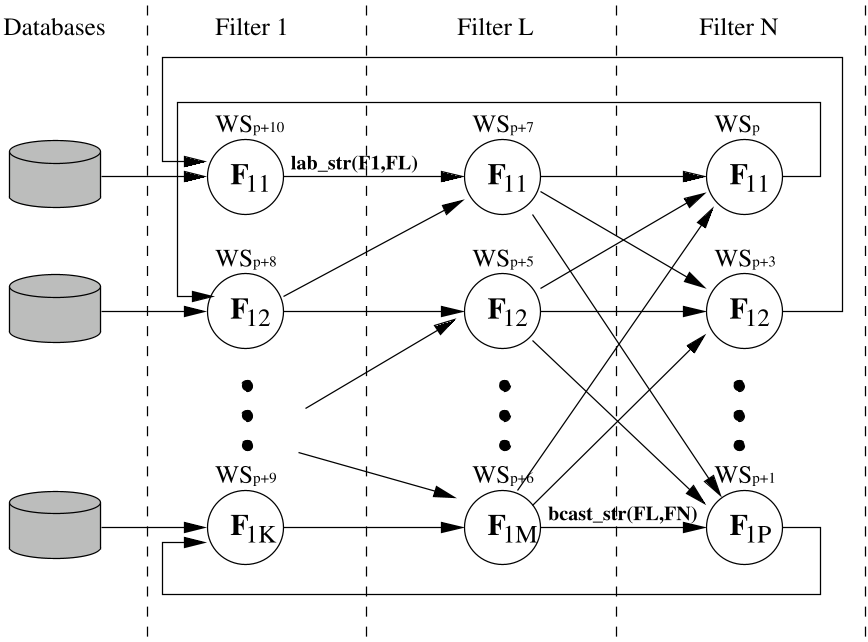 Figure 1: The Anthill filter-stream model showing how filters connect via labeled streams.
Experimental Validation
The team tested AnthillSched against two baselines:
- Balanced Strategy (BS): Equal number of processors to every filter.
- All-in-all Strategy (AS): Every filter runs on every node simultaneously.
Using real-world logs from the Tamanduá data mining platform, they simulated light, medium, and heavy workloads.
Key Findings:
- The "Short Job" Optimization: The authors found that parallelizing jobs that take less than 5 seconds actually hurts performance due to overhead. Their "Optimized AnthillSched" (OAS) skips parallelization for these.
- Heavy Load Superiority: Under saturated conditions, OAS outperformed the competition across all metrics: Execution time, Wait time, and Social Slowdown.
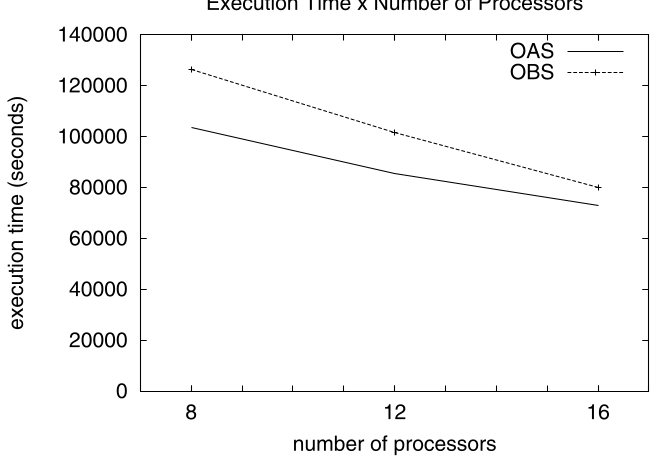 Figure 2: Performance metrics under heavy load across different processor counts (8, 12, 16).
Critical Analysis & Conclusion
Takeaway
AnthillSched proves that for irregular pipelines, "Fair" (Balanced) is not "Efficient." By looking at the historical relationship between input parameters and resource consumption, the scheduler can preemptively allocate more "workers" to the specific stages that will become bottlenecks for that specific dataset.
Limitations
- Cold Start: The heuristic requires at least one controlled execution per parameter set. If an application is run with entirely new, unexpected parameters, the interpolation might be less accurate.
- Hardware Homogeneity: The experiments were conducted on a 16-node Linux cluster with identical specs; performance in highly heterogeneous environments (where nodes have different disk/CPU ratios) remains to be explored.
Future Outlook
The authors suggest that future iterations could incorporate dynamic run-time monitoring to refine allocations on the fly, moving closer to a truly "self-healing" data pipeline.