
Anti-Coordination and Social Interactions: Why the Network Matters More When We Disagree
Anti-coordination and social interactions
The paper introduces the first formal model of social interactions based on anti-coordination games (e.g., the Chicken game) played over fixed networks. It demonstrates that unlike coordination games, the underlying network topology drastically dictates individual strategy choices and system-wide efficiency.
TL;DR
In the world of social interaction models, "birds of a feather flock together" has been the dominant theme. But what happens when the goal is to be different? Yann Bramoullé’s seminal paper explores anti-coordination—situations like the "Chicken" game—where agents gain by Choosing the opposite of their neighbors. The core discovery: while you can always agree with everyone in a coordination game, you cannot disagree with everyone unless the network structure (graph) allows it. This physical constraint makes the network architecture the primary driver of social outcomes.
Problem & Motivation: The Gap in Social Interaction Theory
Most economic models of social interaction assume strategic complementarity—if your friends buy an iPhone, you are more likely to buy one. However, many real-world scenarios involve strategic substitutes:
- Urbanization: If your neighbor develops their land, the resulting congestion makes you less likely to develop yours.
- Public Goods: If your neighbor experiments with a new farming technology, you might "free-ride" and wait for their results rather than experimenting yourself.
- Market Specialization: Developing countries may specialize in primary goods because their trading partners dominate high-tech sectors.
The author notes that while coordination is easy on any graph (everyone just does the same thing), anti-coordination is hard. If three people are all connected in a triangle, they cannot all be different from one another. This "frustration" is the key to understanding why network structure is so much more critical here than in standard conformity models.
Methodology: The Logic of Frustration
The author utilizes the concept of a Potential Game. He defines a Frustration Function (): Essentially, frustration measures the "cost" of failed anti-coordination (where partners play the same strategy). Nash equilibria are simply the local minima of this function.
The Bipartite Advantage
A major insight is that Bipartite Graphs (networks that can be split into two groups where links only exist between groups) are the only structures that allow for zero frustration. In these networks, everyone can successfully anti-coordinate with all their partners.
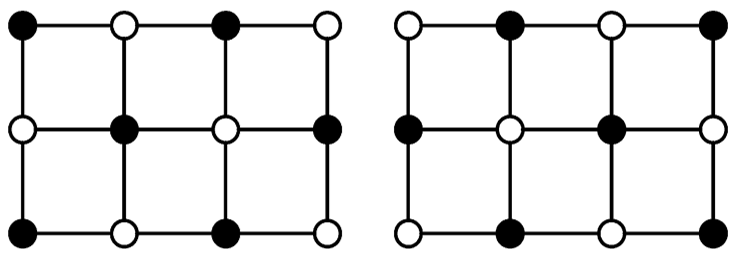 In a lattice (a type of bipartite graph), strategies alternate like a chessboard, reaching a perfect equilibrium regardless of the specific payoffs.
General Networks and Core-Periphery Paradoxes
For general networks, finding the absolute minimum of frustration is computationally "hard" (specifically, it maps to the MAX-CUT problem in computer science, which is NP-complete). This suggests that in large, complex social systems, reaching a perfect anti-coordinated state is mathematically unlikely.
The Core-Periphery Surprise
In a Core-Periphery network (a dense "core" of elites connected to a sparse "periphery"), the author uncovers a counter-intuitive behavior. Usually, if a strategy (say, Strategy A) becomes more profitable, more people should play it.
However, in these networks:
- The core agents respond to the higher payoff by playing A.
- Because the peripheral agents want to anti-coordinate, they are forced to switch to B.
- If the periphery is large enough, the total number of people playing A actually decreases even though A became more attractive!
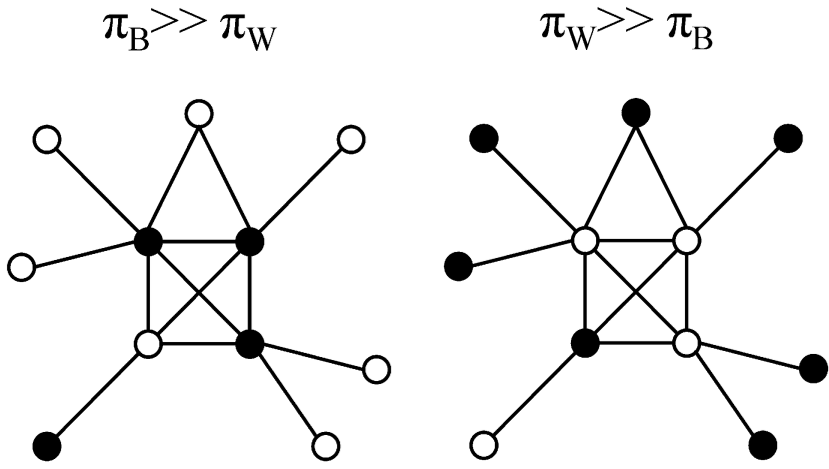 Figure: How a profitable strategy can lose "market share" due to the disproportionate influence of core agents.
Critical Analysis & Conclusion
The paper’s most profound takeaway is the Efficiency Paradox. Typically, economists assume more connections (trade, social links) lead to better outcomes. Bramoullé shows that in anti-coordination games, less is often more. Bipartite graphs, which have fewer links than complete graphs, often yield higher social welfare because they eliminate the structural "frustration" that forces agents into suboptimal choices.
Takeaways for Modern Research:
- Network Design: When designing platforms where users compete for resources (e.g., spectrum allocation or niche markets), "thinning" the network into bipartite-like structures can prevent congestion.
- Limitations: The model assumes fixed links. In reality, agents might cut ties with partners they cannot anti-coordinate with. Future research should look at Endogenous Network Formation.
- Complexity: Since finding global equilibria is NP-Hard, real social systems likely settle for "good enough" local minima, leaving a gap between theoretical efficiency and social reality.
In summary, Bramoullé proves that when we want to be different, the "shape" of our social circle determines our success far more than the rewards on the table.