
The paper introduces the Antipodal Method for computing 3D Generalized Winding Numbers (GWNs), a technique for robust point-in-volume queries on complex, non-manifold, or open surfaces. By decomposing the GWN into a signed ray-surface intersection count and a surface boundary integral, it achieves state-of-the-art performance, outperforming previous exact methods by 22x and approximations by 3x on CPUs.
TL;DR
Calculating whether a point is "inside" a complex, messy 3D model is a foundational but expensive problem in computer graphics. The Antipodal Method breaks this bottleneck by replacing slow 3D surface integrals with a lightning-fast combination of a single ray-cast and a 1D boundary integral. It is 22x faster than previous exact methods, making precise "insidedness" queries feasible for interactive speeds even on massive, broken meshes.
Background: The Robustness of Winding Numbers
Generalized Winding Numbers (GWNs) are the "gold standard" for point-in-mesh tests because they don't break when a mesh has holes, self-intersections, or non-manifold edges. However, the cost of being robust is typically high: you either integrate over every single triangle (slow) or use octree-based approximations (imprecise).
The Antipodal Method changes the math, positioning itself as a precise and fast alternative that works for both standard meshes and complex parametric (NURBS) surfaces.
Problem & Motivation: The Surface Integration Tax
Existing SOTA methods, like the hierarchical winding number, attempt to speed up the calculation using Barnes-Hut-style approximations for far-away geometry. Yet, for points near the surface, they still revert to expensive calculations. The core pain point is that these methods treat the entire surface as the source of the winding value. The authors’ insight: only the boundaries and the topology truly matter.
Methodology: The "Antipodal" Breakthrough
The core intuition behind the Antipodal Method is reminiscent of the "shoelace formula" for 2D polygons, but elevated to 3D spherical geometry.
1. The Integer Part (Ray Casting)
The method picks an arbitrary direction and shoots a ray. The number of signed intersections provides the "base" integer winding number. This handles the bulk of the "insidedness."
2. The Fractional Part (Boundary Integral)
When a surface is open (has boundaries), the winding number isn't just an integer. The authors derived a formula showing that this fractional component can be computed solely by looking at the surface boundary projected onto a unit sphere.
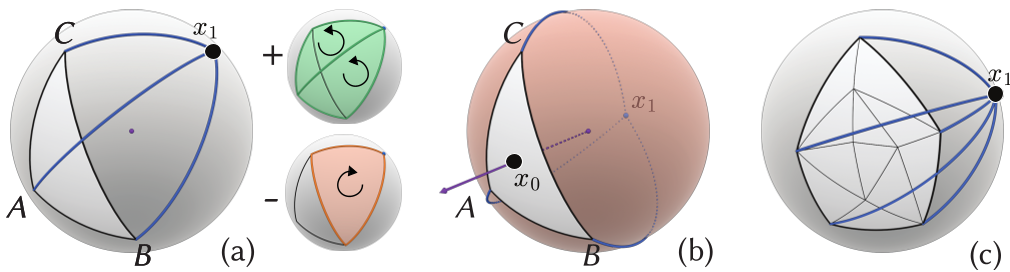 Fig 4: By connecting boundary edges to an 'antipodal' point on a sphere, the method reduces the complex 3D problem into a 1D line integral.
By picking a specific vector field (a "gradient of height") with singularities at antipodal points, the integral simplifies into a sum of signed spherical triangle areas (for meshes) or an adaptive 1D quadrature (for parametric surfaces).
Experiments & Results: Brute Force Performance
The researchers tested the Antipodal Method against the libigl implementations of Fast Winding Numbers and Hierarchical Winding Numbers across the Thingi10K dataset.
- CPU Performance: 22x faster than the hierarchical exact method.
- GPU Performance: Because the method is "embarrassingly parallel," it can process 10^9 queries per second. This allows for real-time voxelization or slice visualization at 120 FPS.
- NURBS: For parametric surfaces, it outperformed the previous best (Spainhour & Weiss 2026) by 5.6x on average.
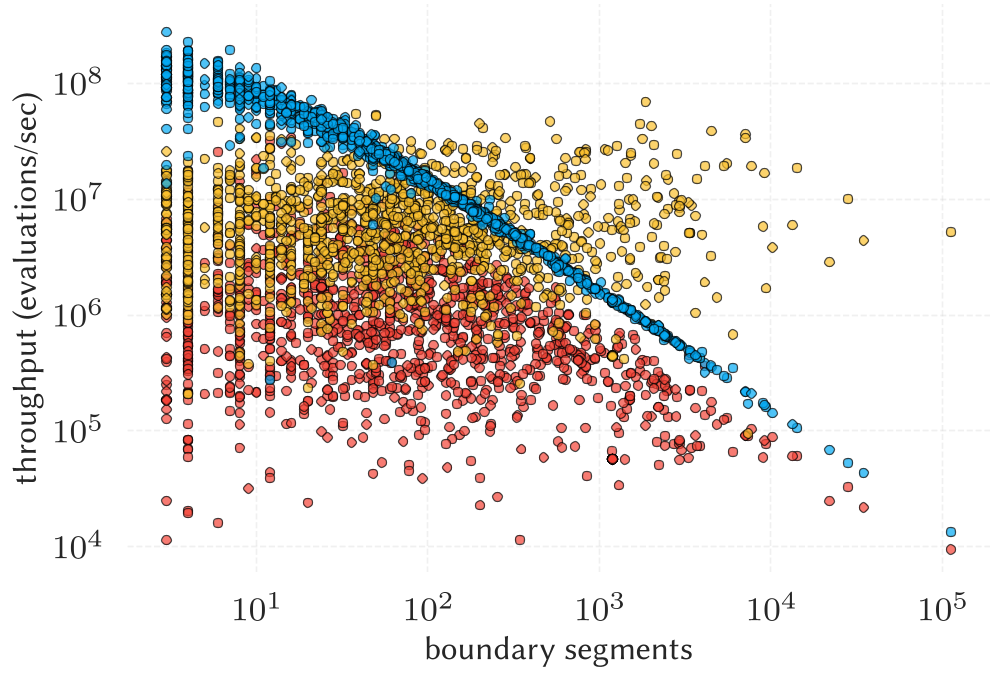 Fig 2: Log-log plots show that while other methods struggle as complexity increases, the Antipodal Method scales linearly with the number of boundary segments.
Critical Analysis & Conclusion
Takeaway
The Antipodal Method proves that we have been over-calculating GWNs for over a decade. By moving from surface-based logic to boundary-based logic, we gain massive speed with zero loss in precision.
Limitations
The primary bottleneck of the method is now the number of boundary segments. For "polygon soups" (where every triangle is essentially its own boundary), the complexity reverts to O(N). However, for most real-world CAD and 3D-printing models, boundary segments are orders of magnitude fewer than total faces.
Future Outlook
This method is a perfect candidate for integration into interactive mesh Boolean tools, real-time physics simulators, and neural SDF (Signed Distance Function) training pipelines where fast point-in-volume queries are the primary computational cost.