
API as a Social Glue: Mapping the Hidden Network of Developer Expertise
API as a social glue
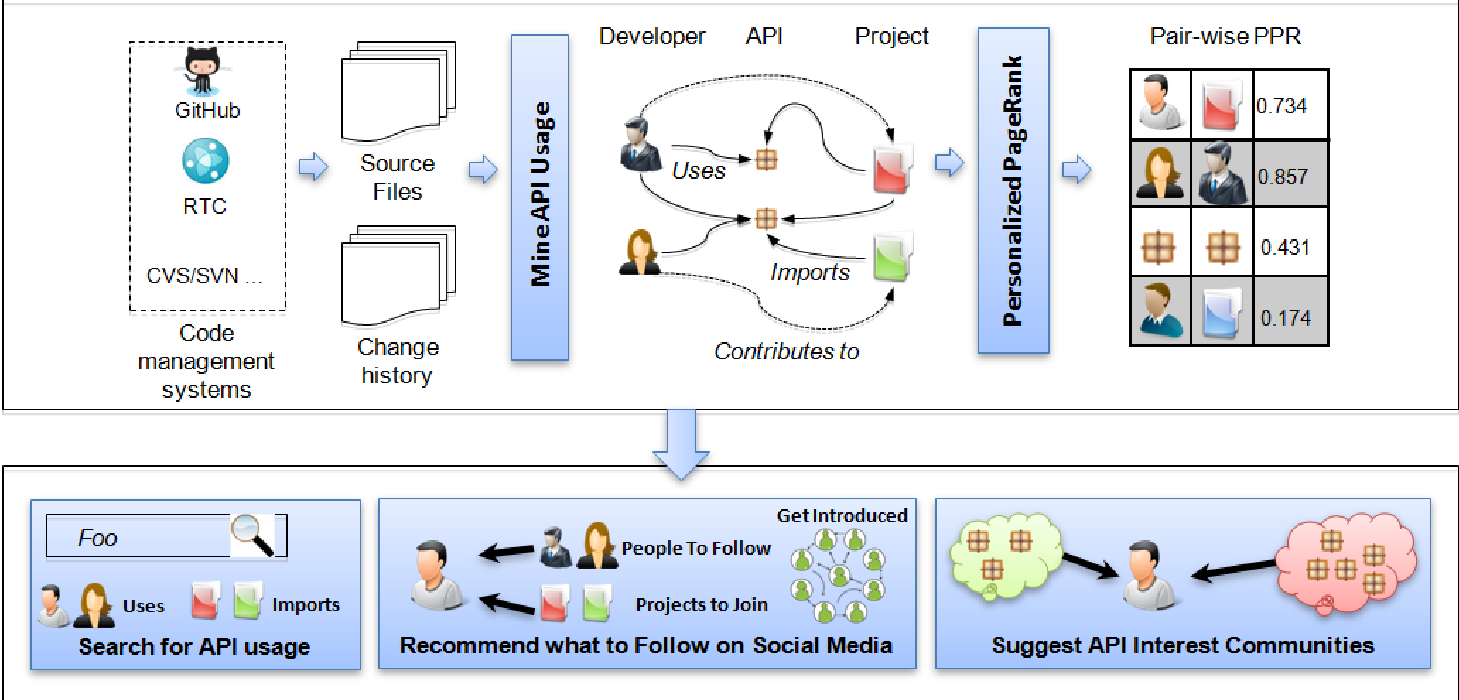
The paper introduces APINet, a recommendation system that treats library APIs as a "social glue" to bridge the gap between developers, projects, and expertise. By mining Java import statements and commit histories from GitHub, it constructs a cross-project social network and uses Personalized PageRank (PPR) to recommend relevant people and projects.
TL;DR
Social platforms like LinkedIn use professional titles, but in the world of code, APIs are the true currency of skill. This paper presents APINet, a system that mines GitHub data to build a social network where connection is driven by shared library usage (e.g., Lucene, Spark, Android SDK). By applying Personalized PageRank to this "API-Project-Person" graph, it automatically suggests mentors, collaborators, and relevant new projects.
Problem & Motivation: The Manual Discovery Gap
In modern software engineering, developers are often "islands." While GitHub allows you to "follow" projects, discovering which project to follow or who is an expert in a specific niche remains a manual effort.
Current expertise-finding tools are mostly intra-project, helping you find who knows a specific file within a company. The authors noticed a critical insight: Third-party library APIs are project-independent. If you are an expert in org.apache.lucene in Project A, that skill is perfectly transferable to Project B. APINet seeks to use these APIs as the "social glue" to unite the fragmented landscape of open-source development.
Methodology: Building the API-Centric Social Graph
APINet operates on a tripartite graph structure. The core innovation lies in how it measures the strength of the relationship between a person and a package.
1. Mining Expertise Heuristics
Instead of complex static analysis, the authors use a high-throughput heuristic:
- Confidence Score: If Developer authored 100% of the commits for a file containing package , we are 100% confident they know .
- Inverse Document Frequency (IDF): To avoid "noisy" common libraries (like
junitorlog4j), the edges are weighted by IDF. Rare, specialized APIs carry more weight in defining a developer's profile.
2. The Power of Personalized PageRank (PPR)
To find connections that aren't direct, the system uses PPR. This allows the system to realize that two developers are similar even if they use different libraries, provided those libraries are often used together in similar projects.
Experiments: Validating the "Social Glue"
The authors tested APINet on 568 top-starred Java projects.
- Project Recommendation: To test accuracy, they removed the direct link between a developer and their projects. The PPR algorithm was able to "re-discover" and recommend the developer's own projects back to them in the Top 10 for nearly 80% of the test group.
- Community Detection: Using the Louvain algorithm, they identified 97 distinct "API Communities" (e.g., a Mobile Development community grouping Blackberry, Android, and Cordova APIs).
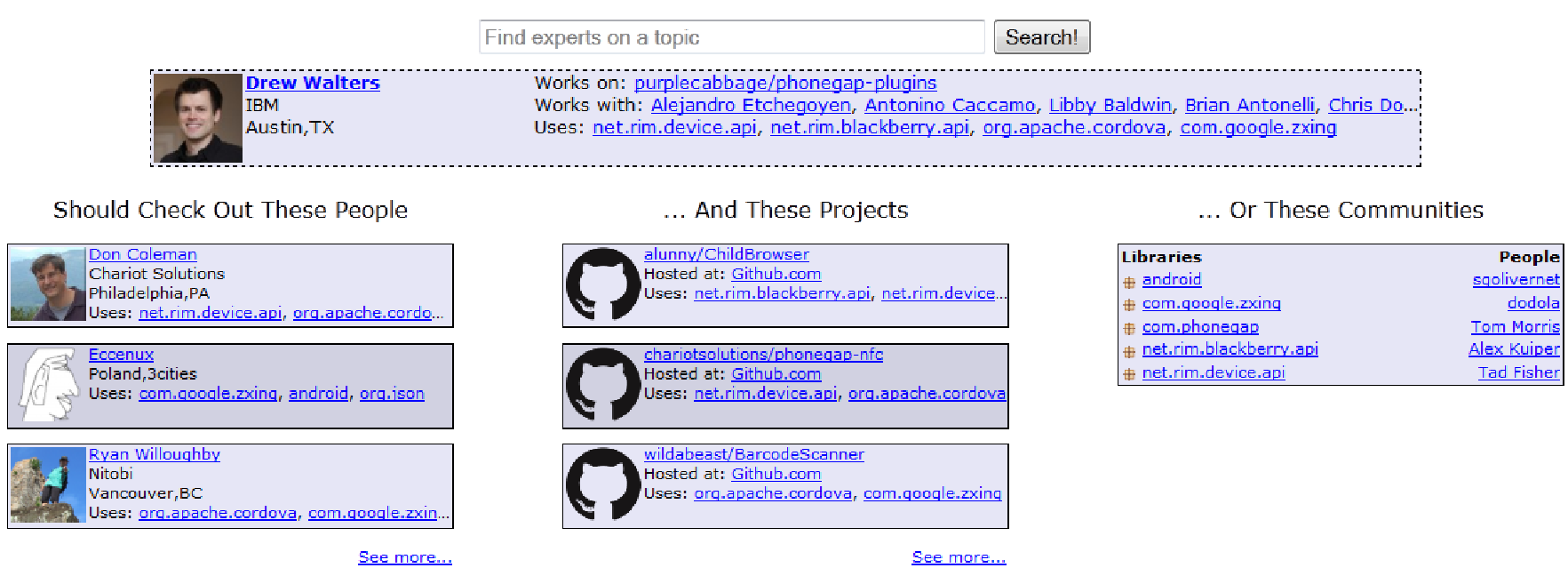 Figure: The prototype showing a developer's profile, including their identified API communities and recommended connections.
Critical Analysis & Future Outlook
Strengths:
- Scalability: By using file-level imports instead of deep AST (Abstract Syntax Tree) parsing, the system can digest thousands of projects using any build system.
- Intuition: Using "shared tools" as a proxy for "shared interests" is a highly effective social heuristic.
Limitations:
- Granularity: Importing a package doesn't always equal expertise. A core contributor has more skill than someone who just fixed a typo in a file containing that import.
- Language Bias: The current prototype is limited to Java, though the concept is language-agnostic.
Conclusion
APINet demonstrates that our "fingerprint" as developers is localizable in the libraries we choose to import. As the software ecosystem becomes increasingly modular, graph-based discovery systems like this will be essential for team formation, specialized recruitment, and navigating the vast sea of open-source repositories.