
AppInspect: Shedding Light on the Shadow Ecosystem of Social Apps
Appinspect: large-scale evaluation of social networking apps
This paper introduces AppInspect, a large-scale automated framework designed to evaluate the security and privacy risks of third-party social networking applications. By analyzing the Facebook ecosystem, the authors identified massive information leaks and poor security practices across hundreds of thousands of apps, leading to direct collaborative mitigation with Facebook.
TL;DR
Third-party apps are the "Wild West" of Online Social Networks (OSNs). AppInspect is a comprehensive framework that automates the audit of these apps at scale. In a study of over 400,000 Facebook apps, researchers discovered that millions of user authentication tokens and private IDs are leaked to advertisers and trackers, while many app servers remain unpatched and vulnerable to remote exploitation.
Problem & Motivation: The Illusion of Control
When you click "Play Game" on a social platform, you aren't just starting a quiz; you are authorizing a data transfer to a server that the social network provider (like Facebook) does not manage. The researchers identify a critical dilemma:
- Prior Work focused on small-scale manual audits (e.g., the top 100 apps).
- Design Opaque: Platforms have moved toward "one-click" authorizations that hide the extent of data access.
- Infrastructural Rot: Host servers for these apps are often poorly maintained, creating "low-hanging fruit" for attackers to harvest the data of millions.
Methodology: How AppInspect Audits the Ecosystem
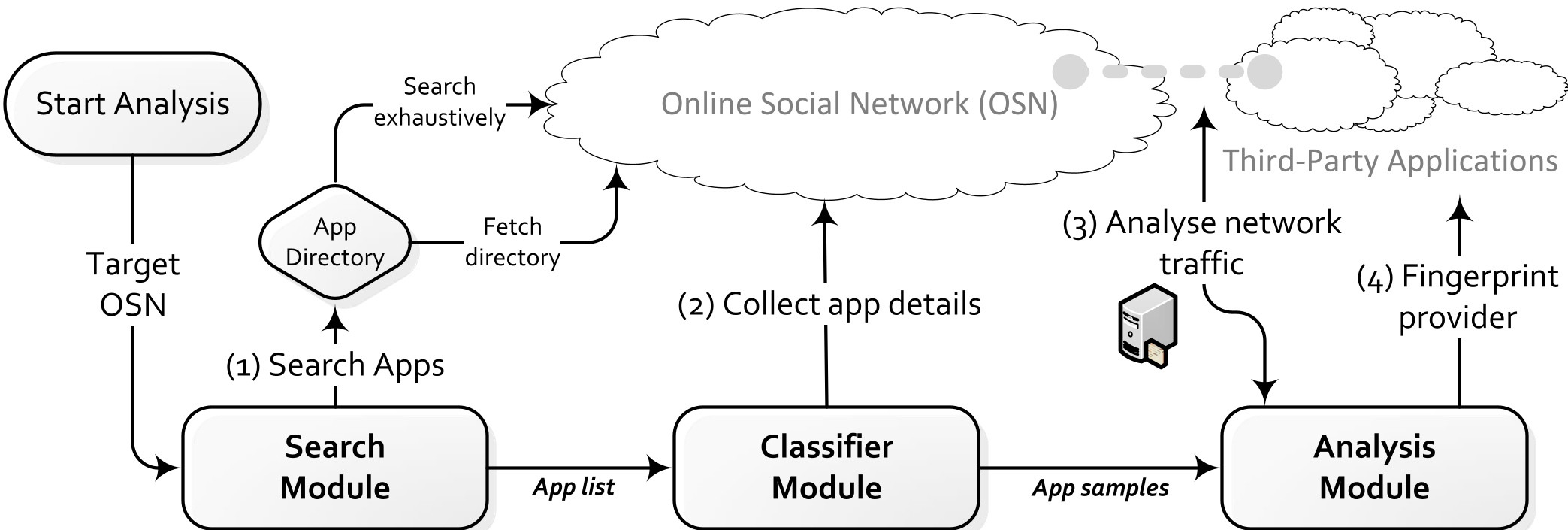
The researchers built a modular pipeline to handle the scale of hundreds of thousands of applications.
1. The Search & Classifier Modules
Since Facebook removed its central directory, AppInspect uses trigram searching (probing for "abc", "abd"...) and integer ID probing to "discover" hidden apps. It then categorizes them by type (Canvas, Connect, Mobile) and scraps the permissions they request.
2. The Analysis Module (The Core)
The framework automates a web browser to "install" apps on bogus test accounts. It captures all network traffic through a transparent proxy to spot:
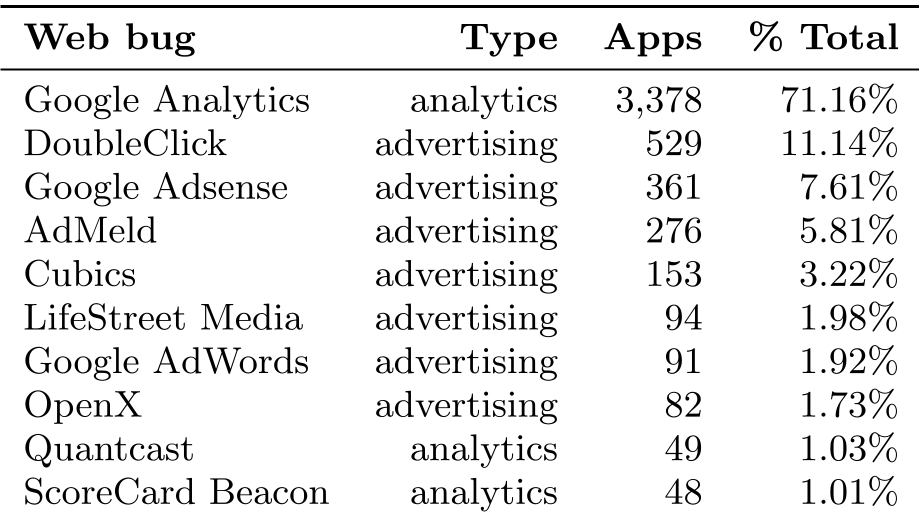
- Web Trackers: Based on a database of over 1,200 ad networks.
- Information Leaks: Searching for the test user's ID or OAuth tokens in HTTP headers and URIs.
- Host Fingerprinting: Scanning for open ports (SSH, FTP) and checking software version banners against vulnerability databases.
Experiments & Results: A Security Nightmare
The researchers analyzed the top 10,624 apps (covering 94% of cumulative active users).
Permission Overreach
They found that 60.2% of providers requested personal email addresses. Some "horoscope" apps requested over 27 unnecessary permissions, effectively harvesting a user's entire digital life for a simple text prediction.
Dangerous Data Leaks
The most alarming finding was the leakage of OAuth tokens.
- HTTP Referer Leaks: 14 apps leaked session tokens to Google Analytics and DoubleClick. One popular game leaked an average of 4.7 million tokens per month.
- PII Transfers: 315 apps sent unique user IDs directly to third-party trackers via URI parameters, allowing trackers to link "anonymous" web browsing to a real-world identity.
Vulnerable Infrastructure
The study proved that app developers are not security experts.
- 40% exposed SSH; 39% exposed FTP.
- Multiple hosts were running outdated versions of ProFTPD and Nginx susceptible to buffer overflow attacks, potentially allowing hackers to hijack servers containing millions of user records.
Critical Analysis & Conclusion
The legacy of this paper is significant: the researchers collaborated with Facebook to fix these widespread issues, proving that automated auditing is the only way to police such a massive ecosystem.
Takeaways for the Industry:
- Sanitize Traffic: Developers must prevent tokens from appearing in HTTP Referers or URI parameters.
- Randomize IDs: OSNs should provide app-specific "scoped" IDs rather than global user IDs to prevent cross-app tracking.
- Mandatory Reviews: The "move fast and break things" era for third-party access must end; platforms need rigorous, LinkedIn-style app review processes.
Limitations: AppInspect relies on looking for known tokens/strings. It struggles with obfuscated data or malicious backend "data-selling" schemes that don't involve the client-side browser. Future work must bridge the gap between automated scanning and detecting the "intent" of data usage.