
AppInspect: Exposing the "Shadow" Ecosystem of Social Networking Apps
Appinspect: large-scale evaluation of social networking apps
This paper introduces AppInspect, a large-scale automated framework designed to evaluate the security and privacy risks of third-party applications in Online Social Networks (OSNs). Applied to the Facebook ecosystem, the framework successfully enumerated over 434,000 apps and identified significant SOTA-level vulnerabilities, including mass data leakage and insecure hosting infrastructures affecting millions of users.
TL;DR
Third-party apps (horoscopes, games, quizzes) are the lifeblood of social platforms, but they operate in a "security wild west." Researchers developed AppInspect, a framework that crawled 434,687 Facebook apps to reveal that many are leaking sensitive user data and authentication tokens to third-party ad networks, while running on poorly maintained, vulnerable servers.
Background: The Illusion of Control
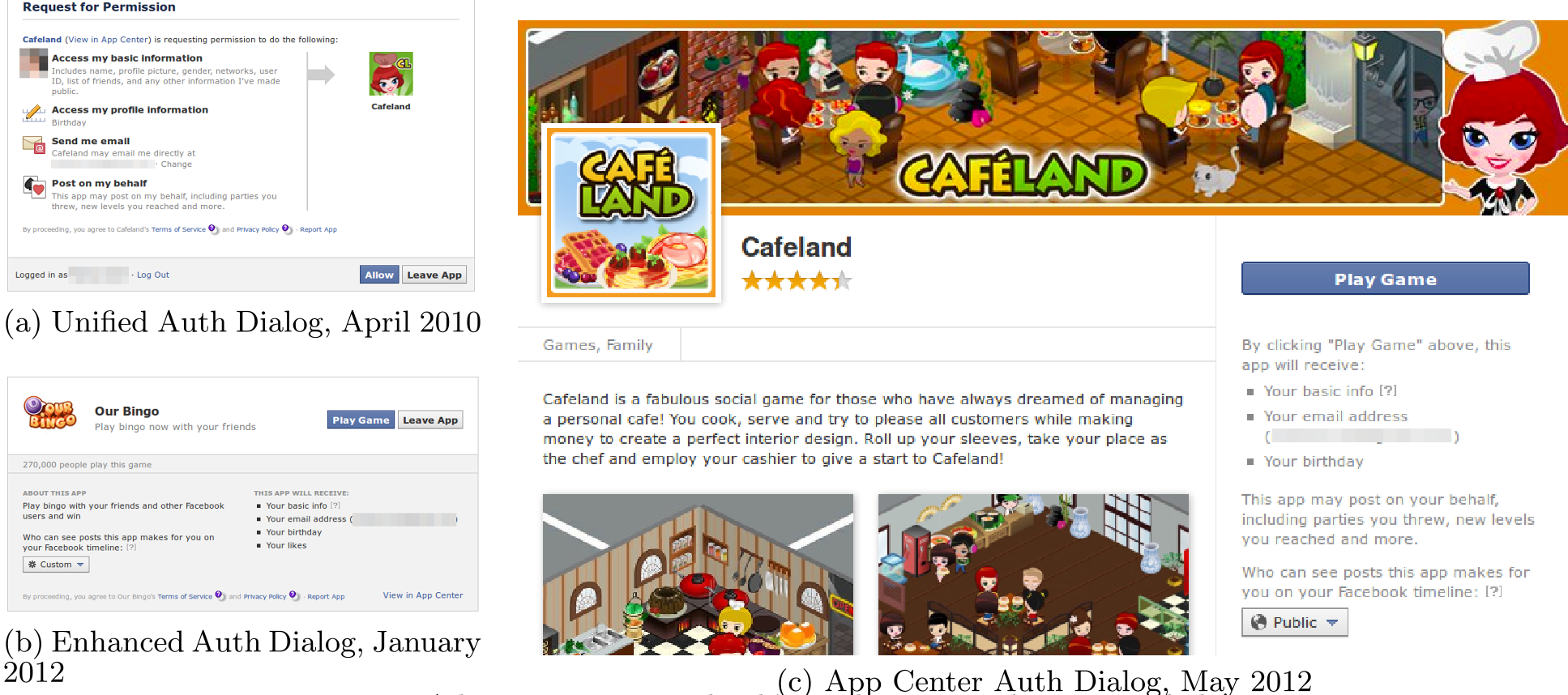
When you click "Play Game," you aren't just giving data to the game; you are trusting an unknown developer’s server infrastructure. This paper identifies a critical "Contextual Gap": while Facebook provides the interface, the actual code runs on third-party servers beyond Facebook's control. Users are often misled by evolving UI designs that hide exactly what data is being harvested.
Methodology: Peering into the Black Box
The researchers didn't just look at what apps asked for; they looked at what apps did.
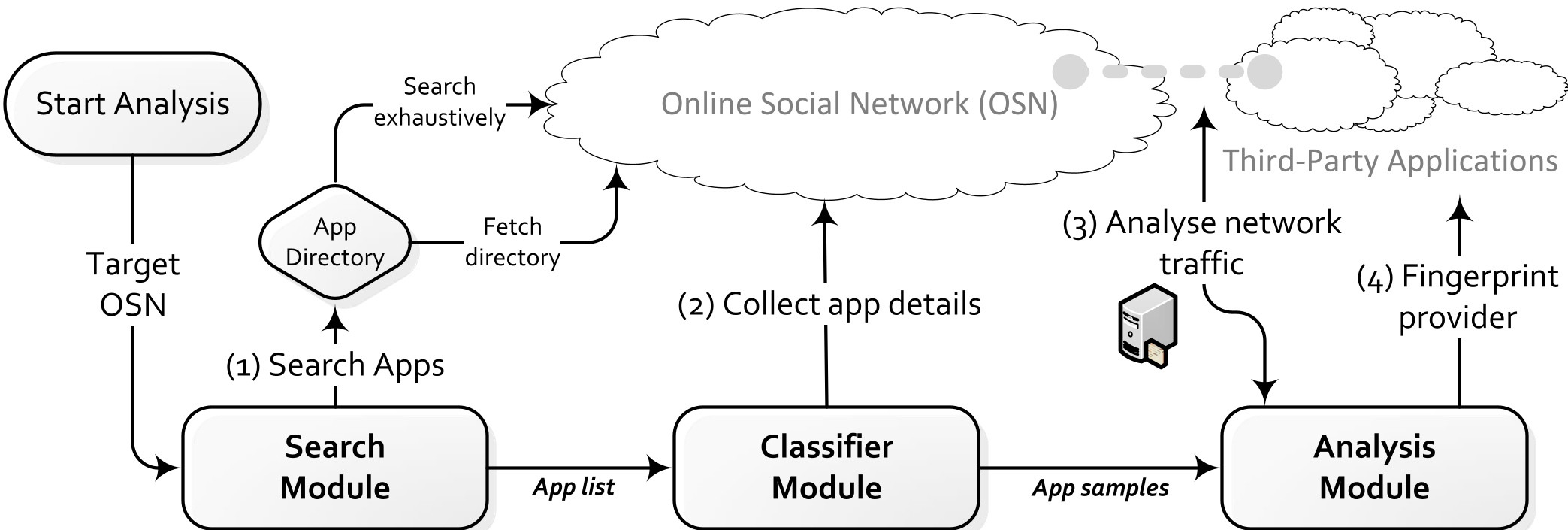
1. The Search Engine for Apps
Since Facebook doesn't provide a public directory for all apps, AppInspect used character trigram searches to find almost half a million apps.
2. Traffic Sniffing and Fingerprinting
By automating a browser to "install" these apps, the system captured all network traffic. It specifically looked for:
- PII Leaks: Does your Facebook ID or birthdate appear in the URL of an ad-request?
- Token Leaks: Is the "Master Key" (OAuth token) being accidentally sent to Google Analytics via the HTTP Referer?
- Infrastructure Risks: Are these servers running 10-year-old software with known exploits?
Key Findings: A Privacy Nightmare
Permission Overreach
The study found that a staggering 60.24% of application providers requested users’ personal email addresses. While some apps (like dating or job hunting) have a legitimate need, many "Daily Quote" or "Horoscope" apps requested excessive permissions (up to 27 distinct types) that had nothing to do with their functionality.
The "Referer" Disaster
One of the most shocking discoveries was the leakage of OAuth tokens. Because of poor web development practices, when an app loads a third-party tracker (like Google Analytics), it often sends the current URL—which contains the user's private access token—to that tracker.
- Impact: 14 popular applications were found leaking these "keys to the kingdom," allowing anyone with access to those tracker logs to impersonate users.
Insecure Hosting
It’s not just about malicious intent; it’s about competence. Many apps were hosted on servers with:
- Publicly exposed FTP and SSH ports (over 38% of hosts).
- Remote Buffer Overflows: One host with 1.2M users was vulnerable to a specific exploit (CVE-2010-4221) via its FTP service.
Depth Insight: The "Web Tracker" Synergy
Many "free" apps monetize by embedding trackers. The study identified 139 distinct trackers. The danger here is Identity Mapping: when a tracker receives your unique Facebook ID alongside their standard cookie, they can link your real-world identity to your browsing habits across the entire web. This effectively kills anonymity.
Critical Analysis & Future Work
Takeaway: The paper’s collaboration with Facebook led to several fixes, but the structural problem remains. Apps are "ephemeral"—they pop up, harvest data, and disappear.
Limitations:
- Obfuscation: The framework looks for raw IDs; it might miss data that is encrypted or hashed before being leaked.
- Back-end Selling: If a developer sells their database to a broker directly from their server, no network analysis can catch it.
Future Outlook: As OSNs move toward "Super Apps" (like WeChat), the AppInspect methodology must evolve to handle more complex API interactions and mobile-specific protocols (iOS/Android SDKs), where the data flow is even more opaque.