
Beyond the Crowd: Automating Medical Veracity with Evidence-Based Machine Learning
Evaluation of Applied Machine Learning for Health Misinformation Detection via Survey of Medical Professionals on Controversial Topics in Pediatrics
The paper presents an automated health misinformation detection system that cross-references medical claims with Evidence-Based Medicine (EBM) databases. By utilizing NLP and Multi-Layer Perceptrons, the system achieves 80% precision in matching professional medical consensus on controversial pediatric topics.
TL;DR
Researchers from the University of Alberta have developed a system that moves beyond "social likes" to verify health claims. By anchoring natural language processing (NLP) in the rigorous framework of Evidence-Based Medicine (EBM), their system achieved an 80% precision rate in matching the opinions of seasoned pediatricians on controversial topics like autism and ADHD.
The Misinformation Crisis in Pediatrics
The "Infodemic" is not a new phenomenon. From the debunked link between vaccines and autism to modern COVID-19 myths, social media algorithms often prioritize engagement over accuracy. The inherent danger is that traditional AI safety nets—like crowdsourcing or voting—rely on the "wisdom of the crowd," which is easily manipulated in medical contexts.
The authors argue that medical truth shouldn't be a popularity contest. Instead, it must be rooted in the Hierarchy of Evidence, where systematic reviews and randomized controlled trials (Level I evidence) hold more weight than expert reports (Level VII).
Methodology: Bridging Layperson Language and Medical Fact
The proposed system functions as a bridge between how non-experts talk and how science is recorded. The workflow is divided into three critical phases:
- Medical Phrase Classification: A Multi-Layer Perceptron (MLP) trained on SNOMED and Consumer Health Vocabulary (CHV) distinguishes medical keywords from general conversation.
- Evidence Retrieval: The system queries the TRIP database, which aggregates high-quality literature from MEDLINE, PubMed, and Cochrane. It ranks results using Normalized Discounted Cumulative Gain (NDCG), weighted by the level of evidence.
- Veracity Determination: A shallow Convolutional Neural Network (CNN) compares the "unknown" claim to the "known" fact. It doesn't just look at word overlap; it analyzes semantic similarity, sentiment polarity, and negation modifiers (e.g., distinguishing "is effective" from "is NOT effective").
 The system integrates pipeline elements from keyword extraction to evidence-based veracity scoring.
The Expert Challenge: A Double-Blind Validation
The most striking part of this research is the validation. The authors conducted a double-blind survey with 34 medical professionals (pediatricians and neurodevelopmental experts).
Key Findings:
- High Precision: When the doctors agreed on a topic, the system's "Veracity Score" matched them with 80% precision.
- The Uncertainty Gap: Interestingly, for 50% of the controversial statements, the medical professionals themselves could not reach a consensus. This highlights why misinformation is so sticky—even the experts find these topics "gray."
- System Robustness: The system's ability to remain objective during these "no consensus" moments suggests it can act as a stabilizing tool for information platforms.
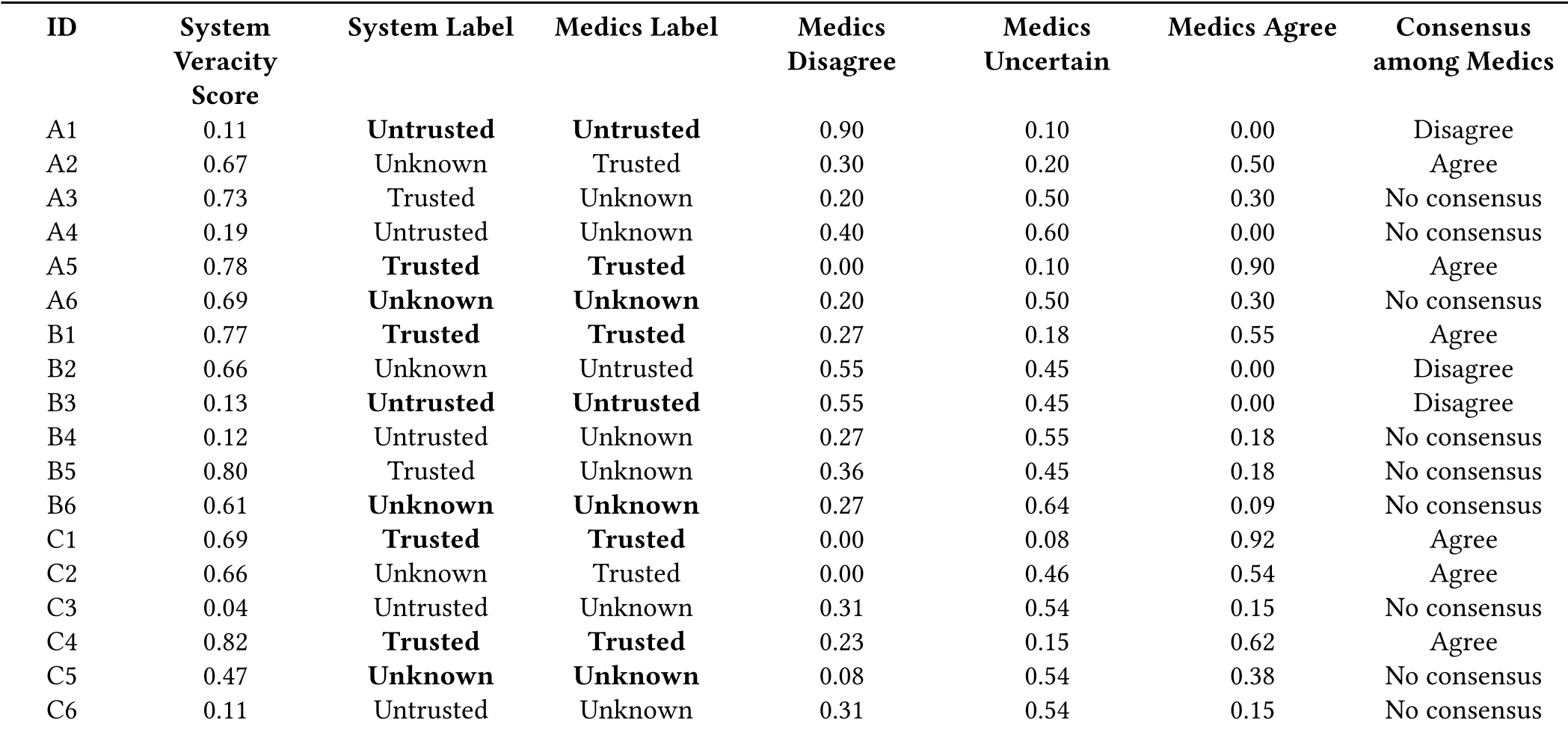 Comparative performance: Note the high alignment (A1, A5, B3) between the automated system and expert "Medic Labels."
Deep Insight: Why This Matters
This research moves the needle from subjective trust (who said it?) to objective trust (what does the data say?). Most contemporary LLMs (Large Language Models) struggle with "hallucinations" because they predict the next most likely word rather than the most scientifically accurate one.
By forcing the AI to "ground" its reasoning in a ranked database like TRIP, the authors provide a blueprint for safer medical AI. It’s an approach that values Inductive Bias toward quality over quantity.
Conclusion & Future Outlook
While the system is highly precise, its reliance on specialized databases means it is only as good as the underlying medical literature. The 50% "uncertainty" in expert opinions suggests that the next frontier for this tech is handling nuance and evolving scientific consensus in real-time.
For developers and product managers in the health-tech space, the takeaway is clear: building trust requires more than a "Report Misinformation" button; it requires an automated, evidence-backed verification layer that can speak both "doctor" and "patient."