
Modeling Cyber Rumors: A New Frontier in Mobile Social Network Dynamics
Applied Mathematics and Computation
This paper develops a novel compartmental dynamic system to model cyber rumor spreading over mobile social networks (MSNs). By categorizing nodes as Rumor-Neutral (U), Rumor-Received (R), Rumor-Believed (B), and Rumor-Denied (D), the authors establish a mathematical framework to analyze global stability and effective control strategies for suppressing misinformation.
TL;DR
Researchers have developed a sophisticated mathematical model (URBD) designed to simulate how rumors spread across mobile social networks. By accounting for the delay between receiving a message and believing it, and the active role of "rumor-refuters," the study provides a roadmap for governments and platforms to suppress misinformation through specific parameter adjustments like increasing user recognition and the speed of truth-telling.
Background Positioning
In an era of 5G and ubiquitous smartphones, rumors are no longer just "gossip" whispered from person to person; they are digital payloads moving through Social Network Services (SNS). This paper shifts the academic focus from traditional biological-analogy models to a hardware-software integrated view, treating the user-device pair as the fundamental unit of propagation.
Problem & Motivation: Why Old Models Fail
The classic Daley-Kendall (DK) and Maki-Thompson (MK) models assume direct contact and immediate awareness. However, mobile social networks introduce a "buffer" — your phone receives a notification, but you might not read it for hours. Furthermore, previous models often ignored the "Rumor-Deniers" (D-nodes), who don't just stop spreading the rumor but actively work to negate it.
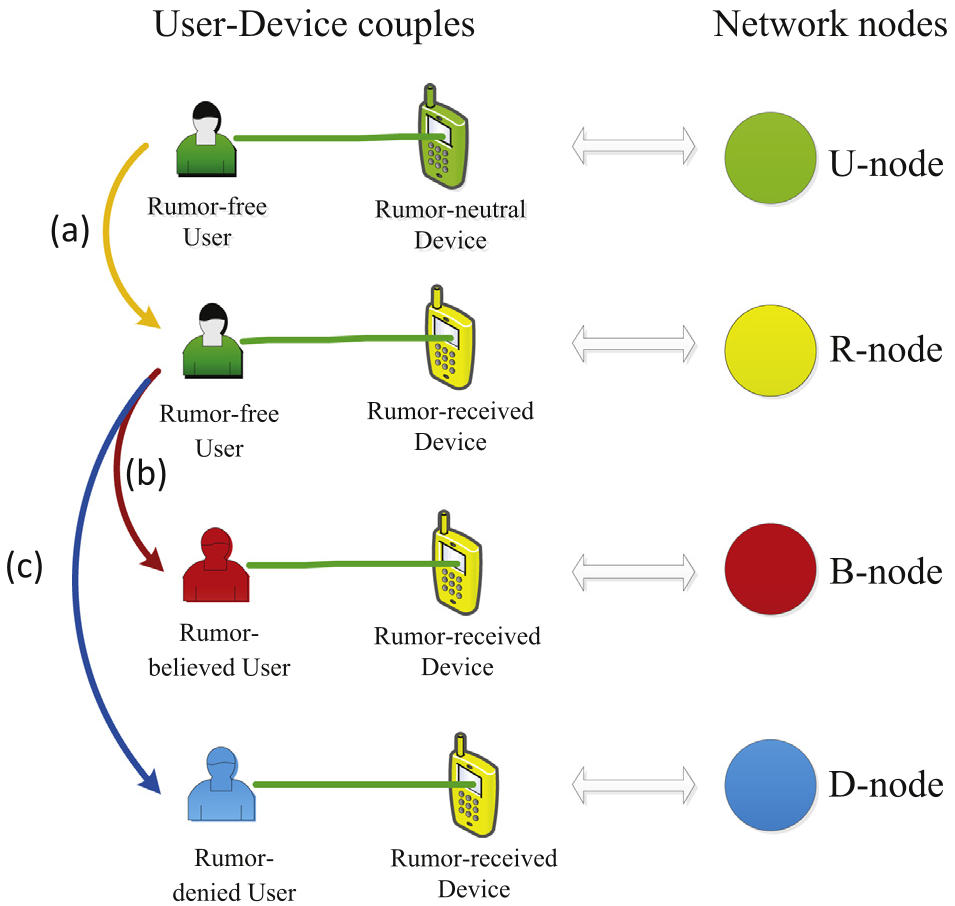
The authors' core insight is the introduction of the "Rumor-Received" (R) state, representing the technical memory/cache of a device before the user evaluates the content.
Methodology: The URBD Architecture
The model partitions the population into four distinct compartments:
- U (Neutral): Susceptible nodes that haven't received the rumor or have forgotten it.
- R (Received): The device has the rumor in its cache, but the user hasn't processed it yet.
- B (Believed): The user has read the rumor, believes it, and becomes a "spreader."
- D (Denied): The user recognizes the rumor as false and may refute it.
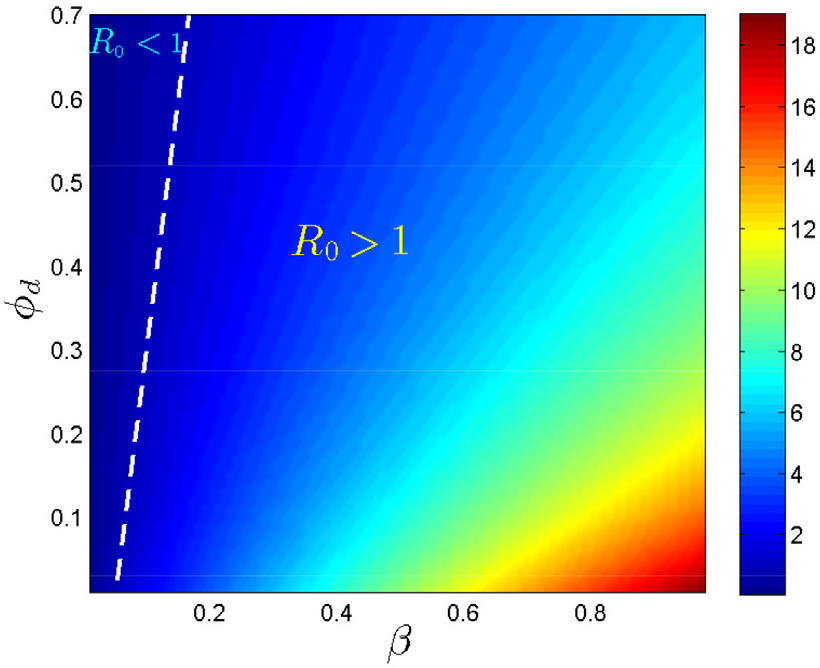
The dynamics are governed by a system of four ordinary differential equations (ODEs). A critical component is the Spreading Threshold (): If , the system returns to an equilibrium where the rumor is extinct. If , the rumor persists at a steady level.
Experiments & Results: How to Stop the Spread
The study utilizes numerical simulations to validate their stability theorems.
1. Global Stability of Extinction
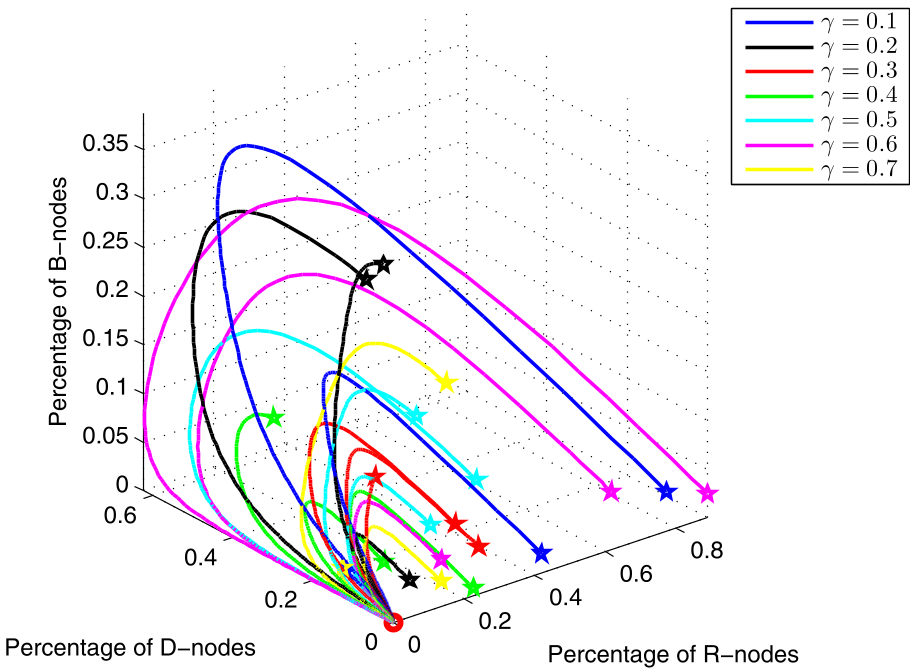
When parameters are set such that , regardless of how many people start believing the rumor, the system eventually clears itself. This is shown in simulations where curves for Believers () and Received () all trend back to zero over time.
2. The Power of Rumor Denial
One of the most impactful findings is the role of parameter (the rate at which Deniers convert Believers). While does not change the initial (the threshold for whether a rumor can spread), it significantly reduces the final percentage of the population that stays "Believing" in a steady-state rumor environment.
Deep Insight & Conclusion
Takeaway: To effectively battle cyber-misinformation, platform designers shouldn't just focus on deleting content. The model suggests that:
- Increasing (User's ability to distinguish rumors) via education is the most stable long-term solution.
- Decreasing (Probability of believing) through fact-check labels can tip below 1.
- Active Refutation () is essential for managing rumors that have already gained a foothold.
Limitations: The current model assumes a static, fully-connected network. In reality, social networks are highly "patchy" and dynamic. Future work should integrate Scale-Free network topologies where "influencers" have vastly higher values than average users.