
TIFIM: Reconciling Efficiency and Accuracy in Social Network Influence Maximization
Applied Mathematics and Computation
This paper introduces TIFIM, a Two-stage Iterative Framework for Influence Maximization in social networks. It combines an iterative candidate selection process with a redistribution strategy to identify top-k influential seeds, outperforming SOTA baselines like IMM and RIS in spread reach and computational efficiency.
Executive Summary
Influence Maximization (IM) is a cornerstone of social network analysis, tasked with identifying a small set of "seed" nodes to trigger the largest possible cascade of information or behavior. While the problem is theoretically NP-hard, the research community has vacillated between hyper-accurate but slow greedy methods and fast but "blind" heuristics.
The paper "TIFIM: A Two-stage Iterative Framework for Influence Maximization in Social Networks" disrupts this binary by introducing a two-stage iterative architecture. By leveraging a First-Last Allocating Strategy (FLAS) and a redundancy-eliminating mechanism called Removal of Apical Dominance (RAD), the authors achieve SOTA influence spread while significantly reducing the computational overhead compared to established benchmarks like IMM and RIS.
The Core Conflict: Accuracy vs. Scale
The fundamental challenge in IM is the submodularity of the influence function. As you add more seeds, their individual marginal utility decreases because their spheres of influence often overlap.
- Greedy Algorithms: Pick nodes one by one; highly accurate but requires complexity—unfeasible for modern social webs.
- Heuristics (e.g., Degree Centrality, PageRank): Fast, but they ignore the "overlapping influence" problem, often picking seeds that are too close together in the network topology.
Methodology: The Two-Stage Breakthrough
TIFIM operates in two distinct phases to solve the efficiency-accuracy dilemma.
Stage 1: Iterative Candidate Filtering (FLAS)
Instead of calculating the influence of every node against the entire graph, TIFIM focuses on a node's two-hop neighborhood. Based on the "Three-hop Influence Theory," most social contagion dissipates beyond three steps.
The authors propose the First-Last Allocating Strategy (FLAS). It ranks nodes in descending order and iteratively updates their "spread benefit" based on the results of the previous iteration. This ensures that the framework converges to a stable order of influential candidates rapidly.
 Figure 1: The overarching TIFIM architecture showing the transition from initial scoring to iterative refinement.
Stage 2: Breaking the Overlap (RAD)
Once candidates are selected, TIFIM addresses the "Overlapping Phenomenon." Borrowing the term Apical Dominance (a botanical concept where the main stem inhibits the growth of side buds), the authors define a mechanism where a dominant seed can "mask" the influence of a nearby candidate.
The Removal of Apical Dominance (RAD) algorithm identifies "minimum-gain" nodes in the seed set and replaces them with candidates that offer higher marginal gains. This iterative swapping ensures the final seed set is spatially distributed across the network to maximize reach.
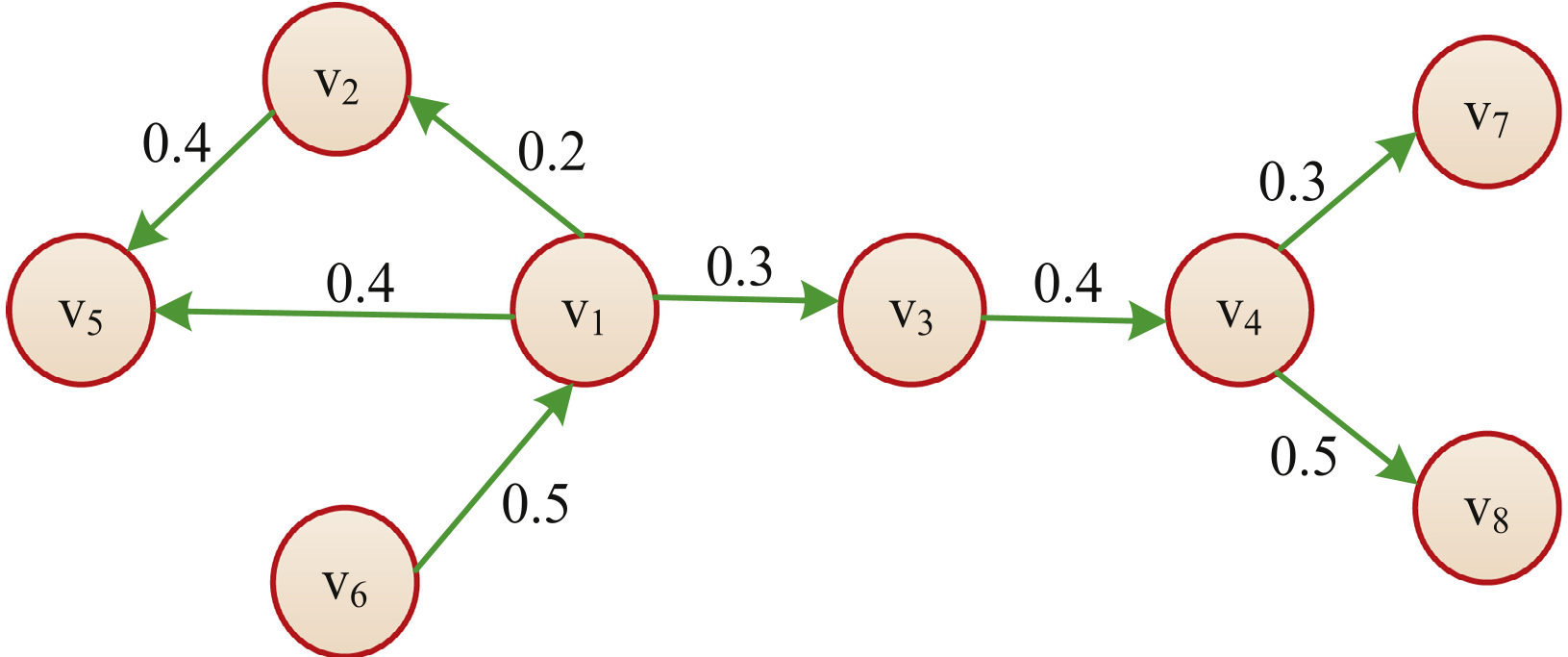 Figure 2: Example of calculating spread benefit and identifying overlapping influence zones.
Experimental Validation
TIFIM was tested against four heavyweights: IMM, RIS, CoFIM, and PageRank across eight real-world datasets (e.g., Email, Facebook, Bitcoin).
1. Superior Reach (Influence Spread)
Under both the Independent Cascade (IC) and Linear Threshold (LT) models, TIFIM consistently outperformed the baselines. Specifically, in networks like "Chess" and "Bitcoin," the gap between TIFIM and the next best algorithm (IMM) widened as the number of seed nodes increased, proving TIFIM's robustness in large-scale scenarios.
2. Radical Efficiency
Efficiency is where TIFIM truly shines. PageRank is technically the fastest but offers the poorest influence spread. Comparing TIFIM to the more accurate RIS and IMM models:
- TIFIM vs. IMM: ~22.6% faster on average.
- TIFIM vs. RIS: ~51.3% faster on average.
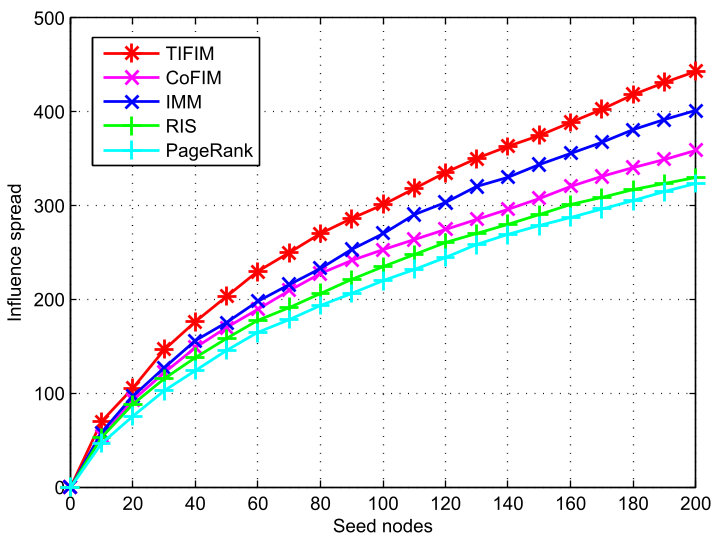 Figure 3: Influence spread comparison across different node sets, demonstrating TIFIM's dominance (top curve).
Conclusion and Deep Insight
TIFIM proves that we do not need to choose between speed and accuracy. The paper’s primary contribution is the realization that local iterative refinement (Stage 1) followed by global redundancy removal (Stage 2) is more effective than trying to solve the global optimization problem in a single pass.
Limitations: While TIFIM is highly effective on static graphs, future iterations will need to address dynamic social networks where edges appear and disappear in real-time, potentially requiring an "Online RAD" mechanism.
The Takeaway: For practitioners in viral marketing or opinion formation analysis, TIFIM offers a production-ready framework that scales linearly while maintaining the mathematical rigor of greedy-like accuracy.