
Facebook’s Last Stand? The birSIRS Mathematical Rebuttal
Applied Mathematics and Computation
The paper introduces the birSIRS model, an epidemiological framework designed to analyze the long-term population dynamics of Online Social Networks (OSNs) like Facebook, Twitter, and Myspace. By extending the classic SIR model with birth/death rates and regained susceptibility, the study refutes previous claims of Facebook's imminent "death" by 2017, predicting instead a stable persistent-member state.
TL;DR
In 2014, a viral study from Princeton predicted that Facebook would lose 80% of its users by 2017, using an epidemic model. This paper provides the mathematical "vaccine" to that claim. By introducing births, deaths, and re-entry into the equations—modeled as the birSIRS system—the authors demonstrate that Facebook isn't dying; it's simply reaching a stable biological equilibrium.
Problem & Motivation: The Flaws of Viral Decay
The original "Facebook is dying" claim relied on the irSIR model, which treats social network membership like a non-recurring plague. In that model, once you "recover" (leave Facebook), you are immune and never return. More importantly, it assumed a static population.
The authors argue this is a fundamental misunderstanding of social dynamics. People don't just leave; new generations reach the age of 13 and "birth" into the susceptible population, and former users often return when their social circles shift. The previous model was mathematically rigged to force every network to zero.
Methodology: The birSIRS Framework
To fix these issues, the authors developed the birSIRS model (Susceptible-Infected-Removed-Susceptible with Births).
1. The Core Equations
The system is defined by three differential equations:
- : The rate of change of people open to joining.
- : Active members ("infected" with the social network).
- : People who left or lack interest.
The critical addition is the term . This simple inequality represents the "survival threshold": if the product of the infection rate () and birth rate () exceeds the square of the death rate (), the network will never die out.
2. Differentiated Users (mbirSIRS)
The authors didn't stop at one type of user. They introduced the mbirSIRS model, which splits members into "Passive" () and "Active" ().
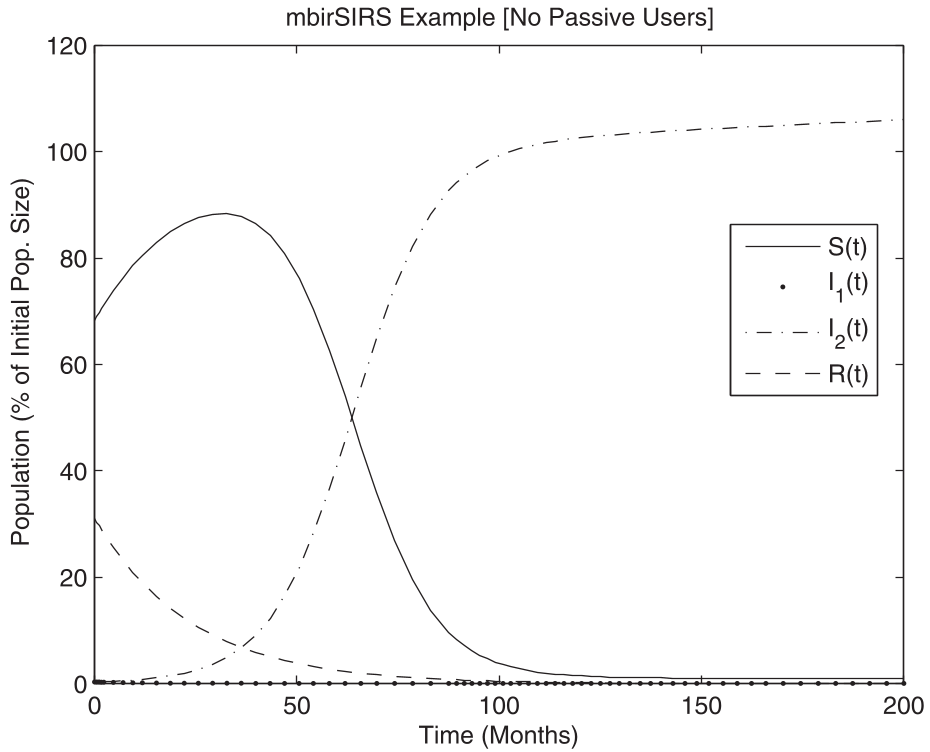 Figure: The dynamics of the mbirSIRS model where active users sustain the population even as passive interest wanes.
Experiments: Fitting the Ghost of Myspace
To validate the model, the authors used Google Trends data to fit curves for Myspace, Facebook, and Twitter.
- Myspace: The model successfully predicted its fall to obscurity by April 2013, closely matching reality.
- Facebook & Twitter: Unlike the previous study, the birSIRS model shows these platforms leveling off at a "permanent-member state."
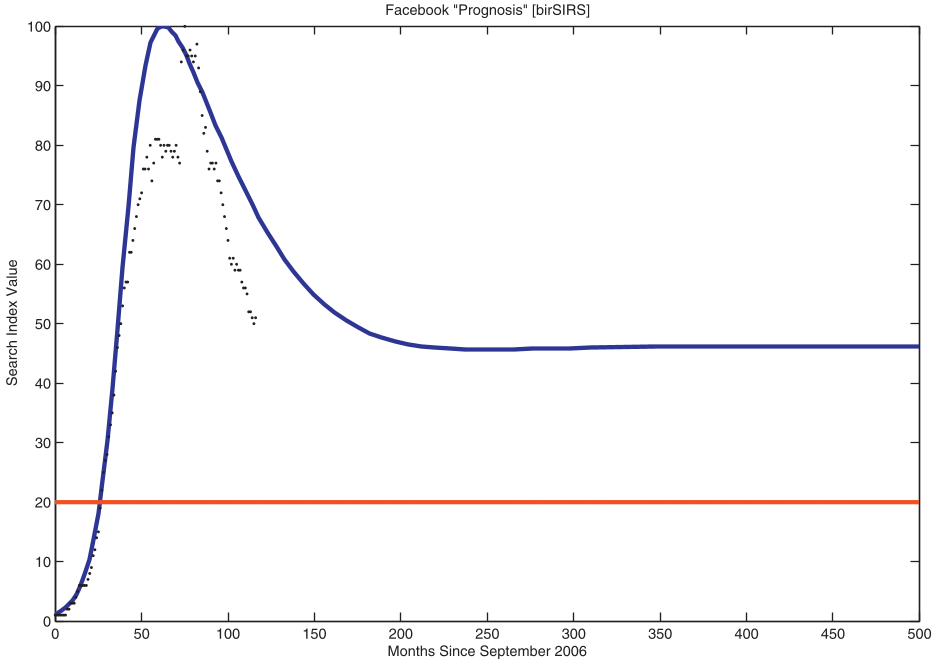 Figure: Curve-fitting results. Note how the "Infected" line (membership) levels out rather than crashing to zero.
Deep Insight: Why Success Satisifes Stability
The paper’s most profound takeaway is the mathematical proof of Stability Theorems.
- Theorem 1 proves that a network thrives if its recruitment is stronger than its "natural" death rate.
- Theorem 4 shows that even if "passive" users are fleeting, as long as "active" users have a higher recruitment rate, the network can survive indefinitely on a dedicated core.
Critical Analysis & Conclusion
While the birSIRS model is vastly superior to the static SIR model, it has one major limitation: Competition. The model assumes parameters remain constant. However, as we saw with Myspace vs. Facebook, a new "virus" (a new platform) can steal the recruitment capacity of the old one.
The Takeaway: Is it the end for Facebook? According to the math: "Not yet!" Facebook isn't an epidemic that burns itself out; it's an ecosystem that, through generational "births" and active user retention, has reached a stable state in the global digital population.
Ref: DeLegge, A., & Wangler, H. (2017). Is this the end for Facebook? A mathematical analysis.