
Beyond the 4,000-Node Limit: Scaling Provenance for the Era of Big Social Data
An Approach to Standalone Provenance Systems for Big Social Provenance Data
This paper presents a comprehensive benchmarking study and architectural proposal for social data provenance systems. By evaluating three existing standalone systems (Karma, Komadu, and PReServ), the authors identify a critical "scalability wall" at 4,000 social operations and propose a new decentralized, MapReduce-based architecture designed to handle "Big Social Provenance" while addressing data privacy and quality.
TL;DR
In the world of social media, tracking the "lineage" of a tweet or a post—known as Social Provenance—is vital for fighting misinformation. However, current systems are hitting a hard ceiling. This paper benchmarks three industry-standard provenance tools (Karma, Komadu, PReServ) and finds they break down after just 4,000 social operations. To solve this, the authors propose a new decentralized architecture that leverages Big Data frameworks like Hadoop and MapReduce to handle the massive scale of social interaction.
Problem & Motivation: The Provenance Bottleneck
Data provenance is essentially a "biography" of a piece of data: who created it, who shared it, and who modified it. While this is well-established in scientific computing (e-science), social media introduces three unique challenges that break existing tools:
- Volume & Velocity: Thousands of interactions per second.
- Graph Complexity: Social workflows aren't linear; they are massive, interconnected webs.
- Governance: Issues like data ownership and privacy are often ignored by current "log-everything" scientific tools.
Existing systems like PReServ, Karma, and Komadu rely on centralized relational databases (like MySQL). The authors set out to find exactly where these systems fail when faced with social-scale data.
Benchmarking the State-of-the-Art
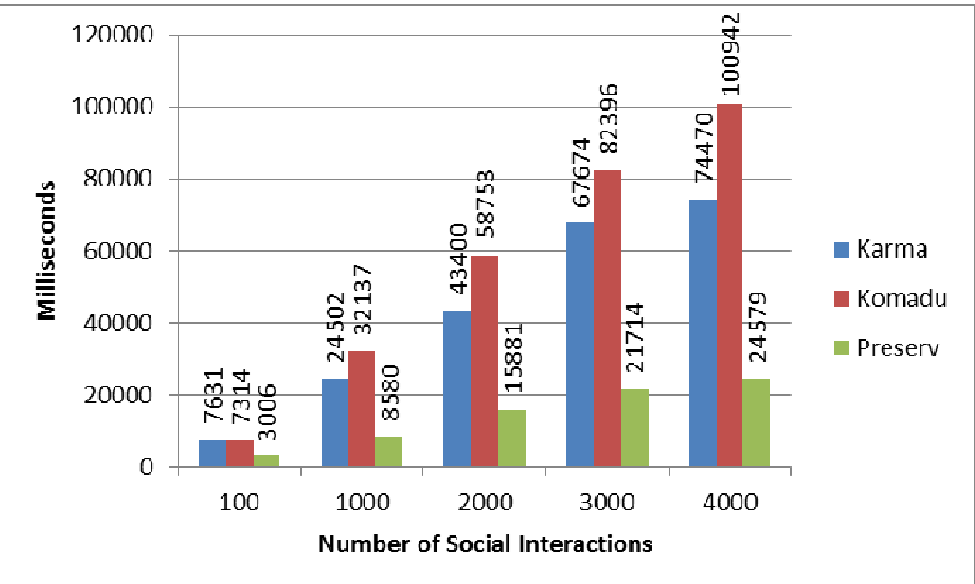
The researchers built a custom test suite to measure responsiveness and scalability. They simulated social actions like "tweet," "like," "retweet," and "reply."
Ingestion Performance
As seen in the figure below, all systems show a linear increase in ingestion time as the workflow size grows. PReServ is the fastest at saving data but, as we will see, pays a heavy price during retrieval.
The "Search" Struggle
When it comes to querying specific nodes (e.g., "Where did this specific entity come from?"), the centralized systems started to crumble. PReServ, which uses XQuery without indexing, showed dramatically higher latency compared to the SQL-indexed Karma and Komadu.
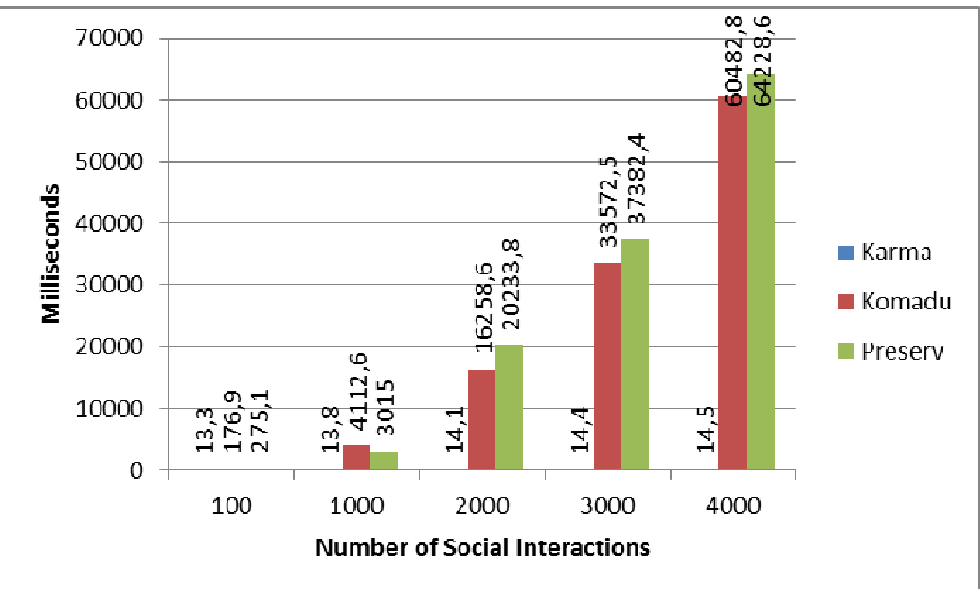
The Critical Failure: When workflows reached 4,000 social operations, the systems triggered memory errors and HTTP timeouts. This "4,000-node wall" proves that current standalone systems cannot handle even a fraction of a single day's traffic on a platform like Twitter.
Methodology: A New Decentralized Architecture
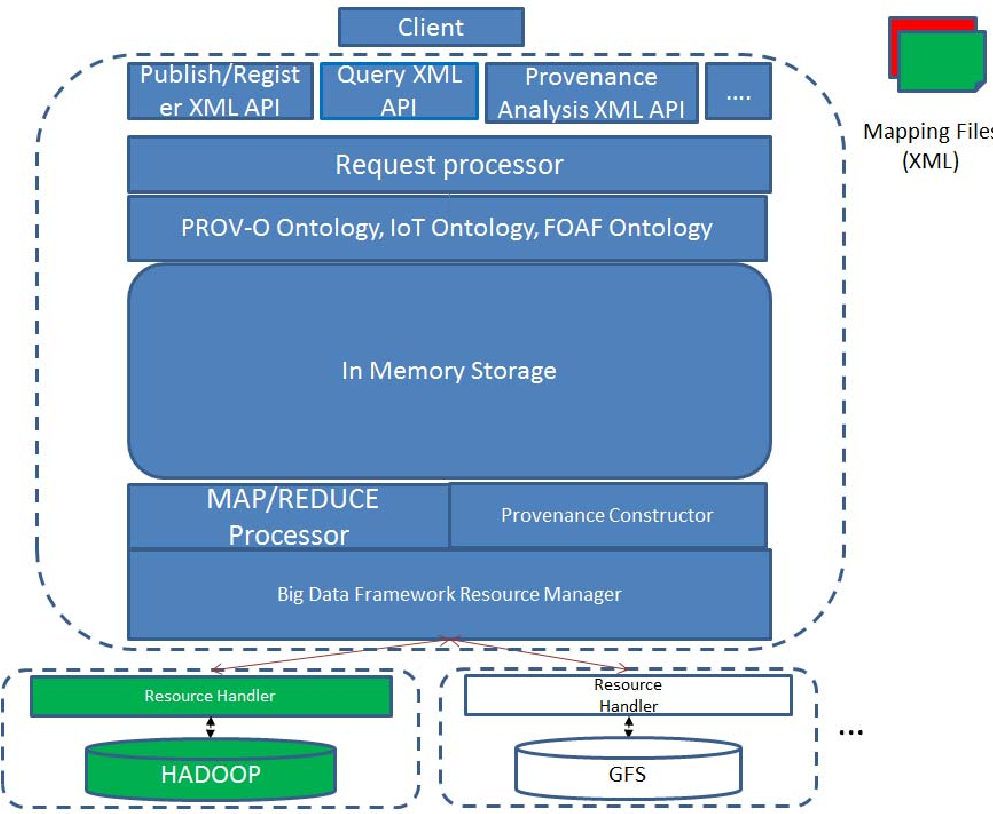
To overcome these limits, the authors propose a transition from centralized SQL storage to a Decentralized Provenance Management Service.
Key Components:
- PROV-O Extension: Moving beyond standard graph nodes to include metadata for Data Quality and Privacy.
- Tiered Storage Strategy:
- In-Memory Cache: For ultra-fast key-value lookups of small metadata.
- Map/Reduce Processor: Running on top of Hadoop/GFS to handle bulk processing and complex reasoning across massive graphs.
- Event-Driven Capture: A Publish-Subscribe mechanism that listens to social streams in real-time, rather than waiting for batch uploads.
Deep Insight: Why Centralized Systems Fail
The authors provide a nuanced discussion on the "Why." Centralized systems fail not just because of storage limits, but because of Query Optimization. In PReServ, the lack of indexing forces a full scan of the provenance records. In Karma and Komadu, while indexing helps, the overhead of maintaining ACID compliance in a relational database during high-frequency social updates creates a massive bottleneck. The move to a MapReduce/NoSQL approach allows for horizontal scaling that simply isn't possible in the standalone models tested.
Conclusion & Future Outlook
This study serves as a wake-up call for provenance researchers. The transition from scientific workflows to social data requires a fundamental architectural shift.
- The Good: Modern tools are fine for small-scale tracking.
- The Bad: We hit a hard ceiling at 4,000 nodes—far too small for real-world impact.
- The Future: The proposed decentralized, MapReduce-integrated system offers a roadmap toward trustworthy, privacy-aware social media analysis at scale.
The next step for the research community? Implementing the metrics for "Information Pollution" and "Privacy Violations" directly into the provenance graph schema.