
Harmonizing the Crowd: Intelligent Co-worker Recommendation for Complex Tasks
Appropriate Co-worker Recommendation in Crowdsourcing
This paper introduces a task-specific co-worker recommendation model for competitive crowdsourcing, specifically targeting decomposable tasks that require diverse skill sets. By matching workers based on skill complementarity and similarity, the approach aims to foster collaboration and improve task success rates.
TL;DR
Crowdsourcing is evolving from simple micro-tasks to complex, decomposable projects. This paper addresses the "skill gap" problem by proposing a recommendation system that suggests specific co-workers to a lead worker. By calculating Collaboration and Similarity scores, the system encourages workers to form teams, leading to a measurable increase in task acceptance rates.
Background & Motivation: The Loneliness of the Expert
In platforms like Topcoder, the complexity of software development often outpaces the skill set of any single individual. The current paradigm focuses heavily on Task Recommendation—telling a worker "you might like this job." However, if the job requires five skills and the worker only has three, they are likely to pass.
The author identifies a critical gap: Co-worker Recommendation. If the system instead said, "You have skills A and B; if you partner with Worker X who has skill C, you can successfully bid for this project," the dynamics of crowdsourcing would shift from isolation to synergy.
Methodology: The Math of Collaboration
The core of the paper lies in how to quantify the "perfect partner." The author defines two primary metrics to rank potential co-workers ((W_j)) for a primary worker ((W_i)) regarding a task ((T)):
- Collaboration Score: This focuses on Complementarity. It calculates the degree to which a co-worker's skills cover the specific skills required by the task that the primary worker lacks.
- Similarity Score: This focuses on Commonality. It measures the matching skills between collaborators. While diversity is needed for the task, a baseline of similar skills often ensures better communication and mutual understanding.
 Note: The system acts as a matchmaker, transforming individual skill vectors into collaborative potential.
Experimental Validation
To test this "matchmaking" logic, the author conducted simulations involving 20 workers and 10 tasks across 10 different skill domains.
The findings were conclusive: when co-workers were recommended, the Task Acceptance Rate saw a sharp increase. This suggests that workers feel more confident engaging with complex, decomposable tasks when they know they can rely on a partner who fills their technical gaps.
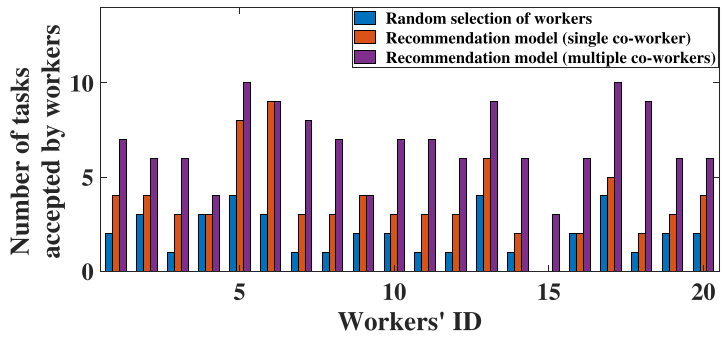 Figure 1: Comparison showing the impact of co-worker suggestions on task uptake.
Future Outlook and Critical Analysis
While the preliminary results are promising, the study is currently limited to a small-scale simulation. The real-world application of this model would need to account for:
- Incentive Design: How is the prize split between co-workers in a competitive environment?
- Trust and Reputation: Skill vectors are "self-proclaimed." Future iterations must incorporate historical performance data to ensure the recommended co-worker is not just skilled on paper, but reliable in practice.
Conclusion
This paper provides a foundational step toward Team-as-a-Service in crowdsourcing. By automating the formation of ad-hoc teams through skill-matching, platforms can tackle significantly more ambitious projects while increasing the winning rate for their workforce.