
Beyond Text: Mastering Sentiment Analysis through Approval Networks
Approval network: a novel approach for sentiment analysis in social networks
The paper introduces "Approval Network," a novel graph representation for sentiment analysis that models social interactions like 'likes' or 'retweets' rather than static friendship ties. It proposes two models: S2-LAN for semi-supervised user-level sentiment classification and NAS for unsupervised aspect-level sentiment extraction, both significantly outperforming text-only SOTA methods.
TL;DR
Most sentiment analysis tools treat every tweet or post as an island. This paper argues that's a mistake. By introducing Approval Networks, the authors demonstrate that who you agree with is often more important than what words you use. Their proposed models, S2-LAN and NAS, use social "contagion" to boost sentiment detection accuracy by up to 27%, even when the text itself is neutral or confusing.
The Motivation: Why Word-Clouds Fail
In the messy world of social media, words are deceptive. Someone might post, "The latest campaign is on fire: it's disgusting!" Are they being sarcastic? Is "fire" good or bad?
Current SOTA methods rely on ii.d. (independent and identically distributed) assumptions, processing text in a vacuum. Some try to fix this using "friendship" or "follower" graphs, but as we all know, being someone's friend doesn't mean you agree with their politics. The authors identify two missing links:
- Homophily: The tendency of similar people to interact.
- Constructuralism: How knowledge and agreement evolve through those interactions.
Instead of looking at who you follow, we should look at what you approve (retweets, likes, +1s).
Methodology: The Architecture of Approval
The core contribution is the Heterogeneous Directed Approval Graph (H-DAG). It links users to other users based on weighted approval actions and connects users to their specific messages.
1. User-Level Analysis (S2-LAN)
For classifying a user's overall stance, the authors propose S2-LAN, a semi-supervised framework. It treats sentiment like a virus spreading through the network. If you approve a positive user's message, your "polarity probability" shifts toward positive.
2. Aspect-Level Analysis (NAS)
For the more complex task of "Aspect-Level" analysis (e.g., figuring out someone likes an iPhone's screen but hates its battery), they created the Networked Aspect-Sentiment (NAS) model.
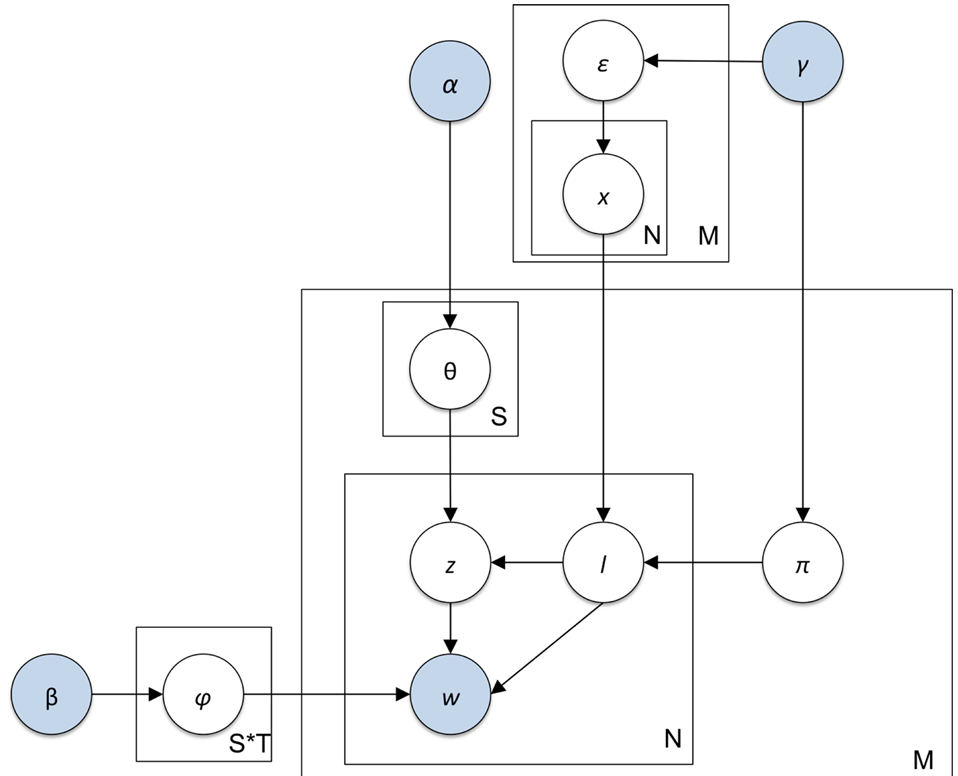
Unlike the standard JST (Joint Sentiment/Topic) model, NAS drops the independence assumption. Each word's sentiment label is conditioned not just on the message's topic, but on the sentiment of the adjoining users in the approval network.
Experiments: Real-World Combat
The models were tested on high-stakes datasets: Obama's presidency, the movie "Man of Steel", and iOS7.
Key Findings:
- The Density Effect: On the "Obama" dataset (high density, 7.1 neighbors per user), the model saw a massive 27% improvement in accuracy.
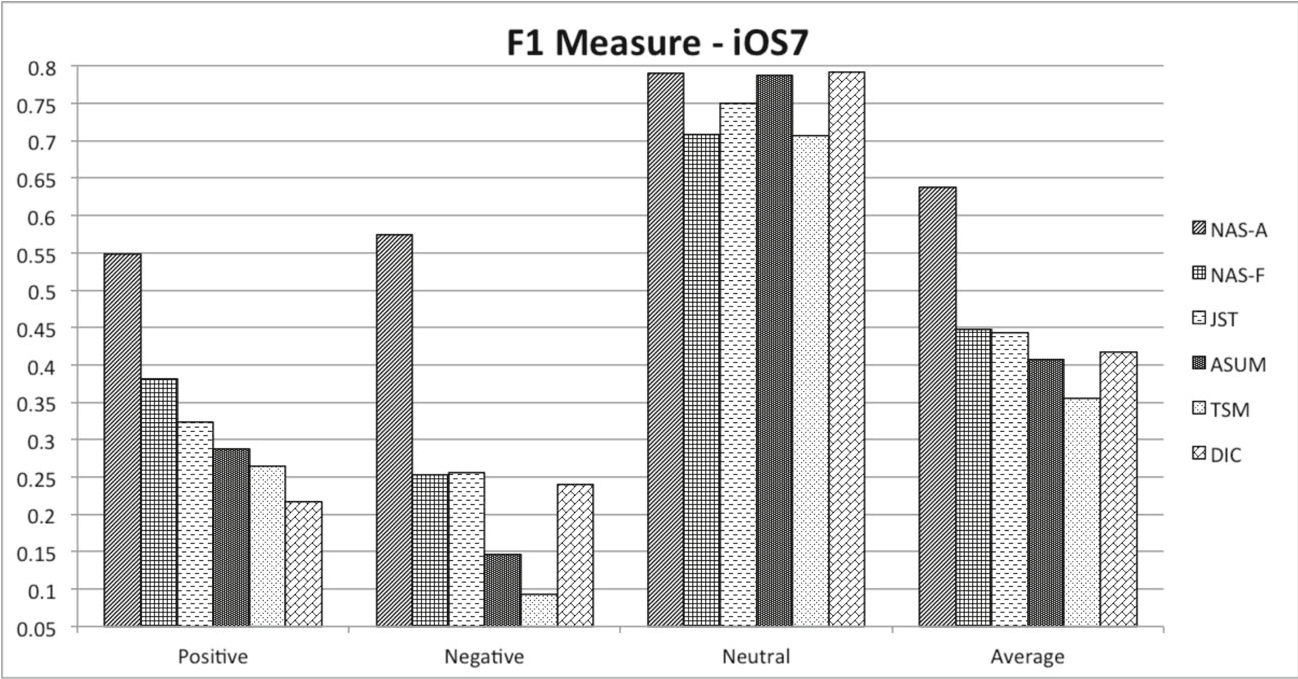
- Approval vs. Friendship: In every test, NAS-A (Approval-based) outperformed NAS-F (Friendship-based). This proves that an "active" approval is a much stronger signal of agreement than a "passive" follow.
- Implicit Sentiment Detection: NAS-A successfully classified tweets like "iOS 7 looks like a child’s coloring book!!" as negative, even though it contains no "negative" dictionary words, simply because it was part of a negative approval chain.
Deep Insight: Why Does This Work?
The genius of this approach lies in its ability to handle data sparsity. Social media posts are short. Topic models usually fail because there aren't enough word co-occurrences to build a statistical pattern. By "borrowing" sentiment from neighbors via the Approval Network, the model effectively increases its sample size for every single post.
Critical Analysis & Future Outlook
Strengths: This work bridges the gap between sociology and NLP, moving sentiment analysis from "lexical matching" to "social context understanding."
Limitations:
- Data Scarcity of Approvals: What happens if a user is active but never likes or retweets? The model might revert to a standard text-only baseline.
- Sarcastic Approvals: While rare for 'likes,' some people 'retweet' to mock. The model assumes approvals are always positive reinforcements.
Future Work: Integrating this graph-based approach with modern Transformers (like BERT or Llama) could create a powerhouse for real-time brand monitoring and political polling.
Conclusion
The Approval Network reminds us that in the age of social media, "you are who you applaud." By quantifying these digital nods of agreement, we can decode the silent sentiments that text-only models consistently miss.