
Accelerating Coordination: An Approximate Model of Common Knowledge on Facebook
Approximate Contagion Model of Common Knowledge on Facebook
The paper introduces an Approximate Contagion Model of Common Knowledge on Facebook (CKF) to simulate collective action and information diffusion. It addresses the computational bottleneck of identifying maximal bicliques—an NP-hard problem—by proposing a Star-Biclique approximation that achieves near-identical results to the full model with significantly lower complexity.
TL;DR
Understanding how groups coordinate on social media is often computationally expensive because it relies on "Common Knowledge" (CK)—the idea that everyone knows that everyone else knows a piece of information. On Facebook, this is modeled using biclique structures. This paper proposes an elegant shortcut: by focusing only on star-shaped bicliques, we can bypass NP-hard computations and achieve a 70x speedup in simulations with negligible loss in accuracy.
Background: The Cost of Knowing What Others Know
Traditional contagion models (like the SIR model or simple threshold models) assume "pure influence"—if of your friends adopt a behavior, you might too. However, collective action (e.g., a protest or a coordinated social movement) requires more: it requires coordination.
The CKF (Common Knowledge on Facebook) model accounts for the platform's unique "Wall" or "Timeline" architecture, where a post on a friend's wall is visible to friends-of-friends. In graph theory, the core unit that captures this mutual visibility is the biclique.
The problem? Finding all node-maximal bicliques in a graph is NP-hard. For a network with just a few tens of thousands of nodes, a standard serial algorithm can grind away for 120 hours just to identify these structures before the simulation even begins.
The "Star" Insight: Why Complexity Can Be Ignored
The authors suggest a radical simplification: Ignore all non-star bicliques.
- Star Biclique: A central node connected to several neighbors. Every node in a graph is the center of such a star.
- Non-Star Biclique: Complex bipartite structures where both sets have at least two nodes (e.g., ).
While it is mathematically possible to construct a graph where this approximation fails miserably (the "Worst Case" shown below), the authors argue that real social networks are different. Their "heavy-tailed" degree distributions mean that most coordination is naturally centered around high-connectivity hubs—the very stars the approximation preserves.
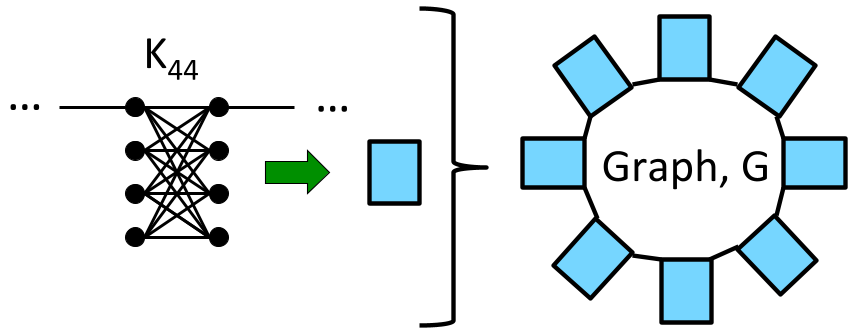 In this stylized ring graph, the star-only model fails to trigger a cascade because it cannot "see" the structure, but such structures are rare in messy, real-world data.
Methodology: Testing the Hypothesis
The researchers tested the full model against the approximate model on seven diverse networks, including real data from Facebook (FB) and Enron email logs. They varied two critical parameters:
- Threshold (): How many people must participate for an individual to join.
- Participation Probability (): The likelihood an agent is active at any given time.
Architectural Scalability
| Feature | Full Model (CKF) | Approximate Model (Star-only) |
|---|---|---|
| Computation Class | NP-Hard | Polynomial |
| Preprocessing Time | 30 - 120+ Hours | Near Instant |
| Data Traversal | Scans millions of bicliques | Scans stars |
Results: Performance without the Penalty
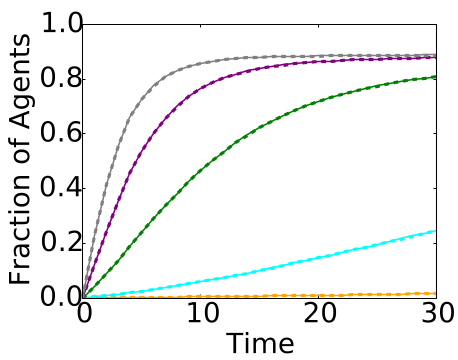
The most striking finding is the overlap in results. In almost every test case, the contagion curves (Epidemic/Cumulative) for the full model and the star-approximation are indistinguishable.
 The charts above show the Cumulative (Cum) and Epidemic (Epi) curves for the Facebook network. The solid lines (Full) and dashed lines (Approximate) overlap perfectly, proving the model's validity.
Beyond accuracy, the efficiency gains are massive. For the Enron network, which contains over 50 million CK sets, the approximate model reduced simulation time by nearly two orders of magnitude.
 The ratio demonstrates that for complex networks, the approximate model is up to 70x faster in raw simulation time.
Critical Analysis & Conclusion
Takeaway
This work demonstrates that for social network dynamics, computational complexity is often a choice, not a requirement. By understanding the structural properties of social graphs (the prevalence of star-like connectivity), we can simplify our models to handle the millions of nodes found in modern datasets.
Limitations & Future Work
While the star approximation works for Facebook-style communication, it might not hold in environments where coordination requires "tightly-knit" groups like small professional committees or secret societies where structures are more intentional. The authors suggest future work should use Mean Square Error (MSE) to more rigorously quantify the divergence between the models as networks scale even further.
By stripping away the NP-hard requirement of biclique enumeration, this research opens the door for real-time modeling of social unrest, rumor propagation, and coordinated marketing on a global scale.