
Scaling Social Influence: Why Sending Less Data is the Key to Big Data Analytics
An approximate framework for scaling social influence computation in large networks
The paper proposes an approximate framework for scaling social influence and trust aggregation in massive networks using parallel processing. By integrating Flajolet-Martin (FM) and Linear Counting (LC) synopses, it enables efficient computation with a tunable (ε, δ) accuracy guarantee, achieving significant reductions in network traffic.
TL;DR
Social influence analysis at the scale of billions of nodes is often strangled by the very thing meant to help it: parallel processing. This paper introduces an approximation framework that uses probabilistic sketches (FM and LC) to summarize network data. By trading a tiny sliver of accuracy for massive gains in efficiency, the authors reduced network traffic by over 99% and solved the scalability wall where traditional methods crashed.
The "Small-World" Bottleneck
In social network analysis, "Trust Aggregation" helps businesses identify influential nodes. If user trusts , and trusts , then holds a chain of trust to . When we try to calculate how many people a specific set of users can influence across steps, we hit a mathematical wall known as the Small-World Phenomenon.
In the Epinions dataset, a node has an average of 13 followers at 1-step (). By , that number explodes to 36,678. In a parallel system (like Hadoop), sending these tens of thousands of IDs from "Mappers" to "Reducers" creates a massive I/O traffic jam. The authors discovered that simply adding more processors actually slowed down the naive approach because the communication cost grew faster than the computation saved.
Methodology: The Power of Synopses
To break this bottleneck, the researchers moved away from sending raw data. Instead, they employed two primary approximate counting techniques:
1. The FM (Flajolet-Martin) Scheme
The FM technique hashes each follower into a bit vector. The position of the rightmost 1-bit in this "synopsis" acts as a logarithmic indicator of the number of distinct elements.
- The Magic: When two different processors have the same follower, the bitwise-OR operation ensures that the follower is effectively counted only once, preserving the "distinct count" logic required for influence analysis.
2. The LC (Linear Counting) Scheme
LC uses a simpler bit map. The number of followers is estimated based on the fraction of "zero bits" left in the map after hashing.
- Mathematical Intuition: , where is the fraction of empty slots. The more followers there are, the fewer zeros remain.
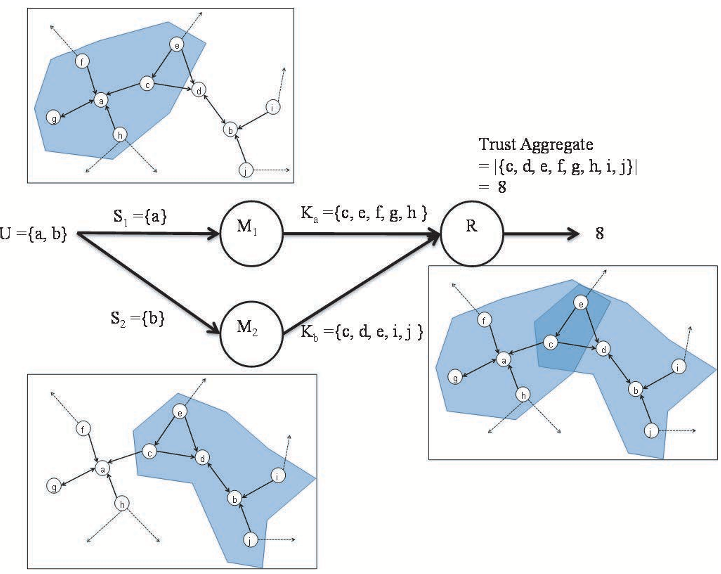 Figure: The transition from sending raw follower sets (left) to sending compact synopses (right).
Experimental Results: True Scalability
The authors tested their framework on a 16-machine cluster using the LiveJournal dataset (nearly 5 million nodes).
- Traffic Reduction: The Naive method (NA) generated 643MB of traffic. The FM and LC schemes generated only 43KB to 831KB.
- Execution Time: While the Naive method took 115 seconds, the FM scheme finished in 31 seconds.
- The Parallelism Paradox: As shown in the graph below, the Naive method's performance worsened as more cores were added (due to I/O contention), whereas the FM and LC schemes scaled perfectly.
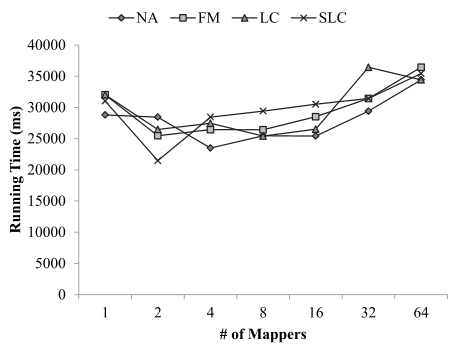 Figure: Running time vs. Number of Processors. Notice how the proposed schemes (bottom lines) remain flat while the naive approach (top line) spikes.
Critical Insight & Takeaway
This paper highlights a fundamental shift in Distributed Systems: Network I/O is the new Disk I/O. In the era of Cloud Computing, where providers charge for data transfer and processing time, being able to tune accuracy (e.g., 90% accuracy with 95% confidence) is a powerful tool for cost optimization.
Limitations
- Data Skew: While the paper addresses small-world effects, it doesn't deeply explore extremely skewed "celebrity" nodes that might saturate an LC synopsis earlier than expected.
- Fixed : The propagation steps are treated as static parameters; dynamic adaptation could be an area for future work.
Conclusion: By replacing "exact data" with "smart summaries," we can perform social analytics on a billion-node scale that was previously impossible on standard hardware.