
The Non-Submodular Socialbot: Why Your "Mutual Friends" Are a Security Hole
An Approximately Optimal Bot for Non-Submodular Social Reconnaissance
The paper introduces an approximately optimal socialbot framework for "Social Reconnaissance" (stealing personal data via friending) using an adaptive greedy policy. It presents the first theoretical approximation guarantee for non-submodular adaptive maximization, specifically achieving a ratio of on OSN topologies.
TL;DR
Researchers from the University of Florida have cracked the code on how socialbots (fake accounts) can optimally infiltrate social networks like Facebook and Twitter. By moving away from the mathematically convenient but realistic assumption of submodularity, they developed a new "Primal Curvature" theory. Their findings reveal that an adaptive greedy bot can be approximately optimal, even when user behavior is unpredictable, and that targeting a user's friends is often more effective than targeting the user themselves.
Background: The Myth of Diminishing Returns
In classic optimization, we love the concept of Submodularity. It’s the "law of diminishing returns": adding the first friend gives you a lot of info; adding the 100th friend gives you less. However, human psychology ruins this math.
On social networks, Triadic Closure dominates: you are more likely to accept a request if you see mutual friends. This makes the "benefit" of a bot non-submodular; its effectiveness actually accelerates as it gains a foothold. Previous research ignored this because the math was too hard—until now.
Methodology: Mastering the Curve
The authors introduce Adaptive Primal Curvature ().
The Intuition
If submodularity says "things get harder as you go," curvature measures "how much easier (or weirder) things get." By quantifying this change, the authors proved that the standard Greedy Algorithm—which simply picks the next best request based on current info—doesn't fail. It just needs a new performance bound.
The Model
The bot operates in rounds:
- Selection: Pick a user to befriend to maximize marginal information gain.
- Probability: Acceptance depends on mutual friends: .
- Exploration: If accepted, the bot crawls 's friends list, revealing more of the hidden graph.
 Figure 1: The ETC Model showing how acceptance probability scales with mutual friends.
Experiments: The Mutual Friend Paradox
The researchers tested their bot on real-world data from DBLP and Slashdot.
Key Insight: The "Friend-of-Friend" Bonus
Intuitively, you'd think a bot should focus all its energy on its "Targets." However, the study found that rewarding the bot for becoming a friend-of-a-friend (FoF) of a target actually led to befriending more targets in the long run.
- Why? By befriending the target's circle first, the bot "warms up" the target's acceptance probability.
- The Trade-off: This strategy results in a lower initial acceptance rate (as you're talking to strangers), but a much higher "kill rate" once the bot approaches the inner circle.
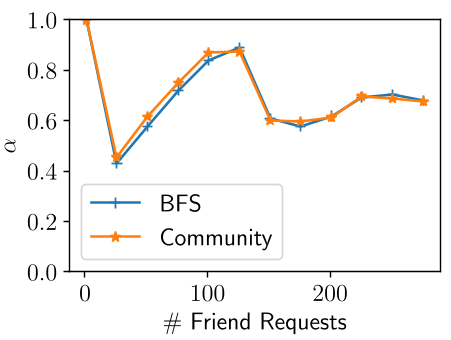 Figure 2: Traces of the bot's path. Note how FoF benefit (right) creates a more clustered, successful infiltration compared to target-only focus (left).
Critical Analysis
The most striking contribution here is the mathematical proof that finite curvature is a prerequisite for predictability. The authors showed that if the curvature is infinite, finding an optimal attack is NP-Hard (equivalent to the SAT problem). This creates a "Goldilocks zone" for attackers: as long as human behavior has some consistency ( is finite), the attack is mathematically guaranteed to work.
Limitations
While the topological model is robust, it lacks temporal and profile features. Real OSNs now use AI to detect "bot-like" patterns in how fast requests are sent and the content of the profile. A bot that is "topologically optimal" might still be "behaviorally obvious" to a modern fraud detection system.
Conclusion: The Future of Reconnaissance
The paper proves that social reconnaissance is not just a nuisance but a theoretically sound attack vector. For OSN providers, the takeaway is clear: privacy cannot rely on user discretion. Because the "Mutual Friends" metric can be gamed, it acts as a backdoor that bypasses traditional privacy settings.
Future research will likely merge this adaptive greedy approach with Reinforcement Learning, allowing bots to learn optimal curvature bounds on-the-fly without needing a pre-defined graph probability model.
Main Takeaway: Your friend's security is your security. If a bot gets to them, they are the bridge that helps the bot bypass your own privacy shields.