
Navigating Social Graphs via Geography: Beyond the Six Degrees of Separation
Approximating Shortest Paths in Spatial Social Networks
The paper evaluates a "Generalized Greedy Routing" algorithm for approximating shortest paths in large-scale spatial social networks (mobile and landline phone data). By expanding Kleinberg's greedy routing to explore the top-k nearest links at each step, the authors achieve efficient path discovery with low multiplicative stretch, leveraging the geographic component of social interactions.
TL;DR
Researchers from MIT have revisited Milgram's famous "small world" concept by applying a Generalized Greedy Routing algorithm to massive, real-world telecommunication datasets. By simply looking at the top-k geographically closest neighbors instead of just the closest one,他们 achieved a 100x speedup over standard shortest-path searches with only a minor loss in path accuracy.
Context: The Navigability of Our World
In 1967, Stanley Milgram discovered the "Six Degrees of Separation." However, the real mystery wasn't just that short paths exist, but that individuals could find them using only local information (e.g., "I'll send this to my friend in Boston because the target lives there").
Jon Kleinberg later formalized this as Greedy Routing: always moving to the neighbor geographically closest to the target. While elegant, pure greedy routing often hits dead ends in the messy topology of real social networks. This paper asks: can we make this robust enough for modern big data?
Methodology: The k-Step Envelope
The authors propose a simple yet effective extension to Kleinberg's model. Instead of a "greedy" choice of 1, they explore a width of k.
- Spatial Heuristic: At each node, calculate the Euclidean distance of all neighbors to the destination.
- Breadth Expansion: Follow the top-k candidates.
- Phase Shift: As soon as the search reaches the target's geographic cell (e.g., a specific cell tower), it switches to a local Breadth-First Search (BFS) to pinpoint the exact individual.
This creates a search "envelope" that is far narrower than a global BFS but much more resilient than a single-path greedy search.
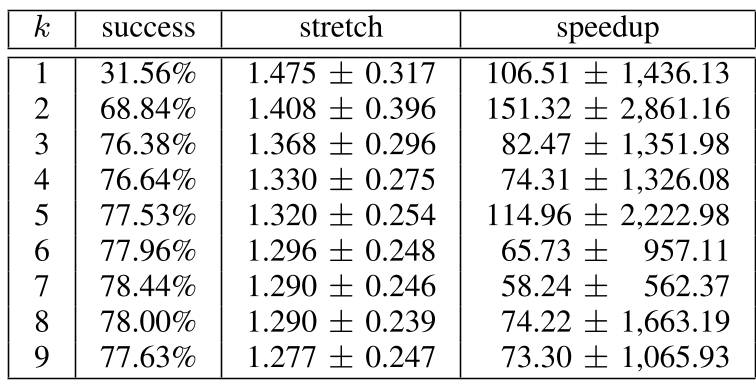 Table III: Accuracy (Stretch) vs. Speedup on the Portugal Mobile Network. Note how success rate jumps from 31% to 90% as k increases.
Experimental Insights
The study utilized two massive datasets:
- Mobile Portugal: 1.8 Million users connected via mobile towers.
- Landline UK: 20.7 Million nodes based on regional switching facilities.
Key Findings:
- The Power of k: Moving from to more than doubles the success rate (from ~34% to over 74%). It turns out that having just one "backup" geographic route solves most local-minimum problems.
- Efficiency: The speedups are massive. In many cases, the algorithm is 95x to 150x faster than a standard unidirectional BFS.
- Path Quality: The "Stretch" (the ratio of the found path to the absolute shortest path) stayed consistently low, mostly between 1.2 and 1.6. In plain English: the paths found were only about 30% longer than the theoretical minimum.
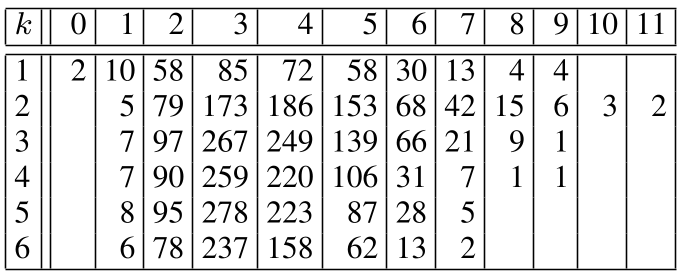 Table V: Distance distributions for the Mobile Portugal network. Most targets are found within 4 to 6 hops using k-greedy routing.
Critical Analysis: Why Geography Matters
The fundamental "Insight" here is that social links aren't random; they have a strong Spatial Inductive Bias. We are far more likely to communicate with people near us. This geographic structure acts as a "map" that algorithms can follow.
Limitations:
- The "Popular Location" Problem: In areas with high population density (e.g., a single cell tower serving 6,000+ people), the algorithm slows down because the local BFS phase becomes expensive.
- Data Quality: The authors noted that location data for users is often coarse or missing, which can confuse a purely distance-based heuristic.
Conclusion
This work demonstrates that for massive social graphs, we don't always need complex, pre-computed indexing for shortest-path queries. By leveraging the physical reality of where users live and work, Generalized Greedy Routing provides a "good enough" path almost instantaneously. It bridges the gap between Milgram’s human-centric experiment and the computational demands of modern network science.