
RAF: Bridging the Gap in Active Friending with Approximation Algorithms
An Approximation Algorithm for Active Friending in Online Social Networks
This paper introduces the RAF (Realization-based Active Friending) algorithm to address the active friending problem in online social networks under the Linear Threshold (LT) model. By mapping the friending process to a randomized realization framework and leveraging a reduction to the Minimum Subset Cover (MSC) problem, the authors achieve a data-independent approximation ratio of for general graphs.
TL;DR
Building a friendship with a celebrity or an influential stranger in a social network isn't just about sending an invitation; it's about building social capital through mutual friends. This paper presents RAF, the first randomized algorithm for the "Active Friending" problem that works on general graphs with a provable approximation ratio, significantly outperforming standard heuristics in both efficiency and success rate.
The "Connotative" Expansion Problem
While "denotative expansion" focuses on getting new users to sign up, connotative expansion focuses on thickening the web of existing interactions. Specifically, how can a user () systematically friend a target () who might otherwise ignore them?
The authors adopt the Linear Threshold (LT) Model, where a user accepts an invitation only if the sum of weights (familiarity) from their mutual friends exceeds a random threshold. The challenge? Finding the minimum set of intermediate invitations to make successful is NP-hard, and calculating the success probability itself is #P-hard.
Methodology: The Power of Realizations
The core innovation lies in the concept of a Realization. A realization simplifies the stochastic nature of thresholds into a static mapping where each user "chooses" one influential neighbor.
1. The Mapping Insight
The friending process can be viewed as a path-searching problem in these realizations. If an initiator can reach target through a path where every node is "invited," the friending succeeds for that specific realization.
 Figure 1: The logic flows from the initiator to the target. If the path reaches the initiator's neighborhood (Case c), the realization is "covered" by the invitation set.
2. Solving the Combined Hardness
To solve this, the authors propose a two-step framework:
- Overcoming #P-hardness: Use massive Monte Carlo sampling (Reverse Sampling) to estimate the maximum possible acceptance probability .
- Overcoming NP-hardness: Convert the problem into a Minimum Subset Cover (MSC) problem. By selecting nodes that cover at least fraction of successful realizations, they use the Chlamtác algorithm to find a near-optimal invitation set.
Experimental Results: Precision vs. Brute Force
The authors tested RAF against Shortest Path (SP) and High Degree (HD) heuristics on datasets ranging from Wiki to Youtube.
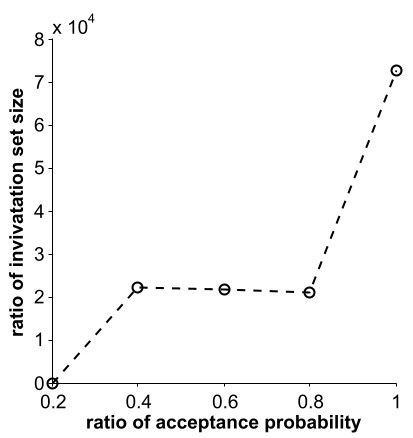 Figure 2: Acceptance probability vs. Invitation Size. RAF (Red line) consistently reaches the performance ceiling faster than structural heuristics.
Key Findings:
- Large-Scale Dominance: On the Youtube dataset (1.1M nodes), path-based heuristics (SP) fail because they don't account for the "multiplexer" effect of mutual friends. RAF manages to identify the critical "bridge" users effectively.
- Efficiency: Compared to (the set of all potentially useful nodes), RAF produces solutions that are 32 times smaller on average while maintaining equivalent success rates.
Critical Analysis & Future Outlook
The beauty of RAF is its theoretical robustness. Most social network expansion strategies are "black-box" heuristics provided by platform algorithms. RAF provides a mathematical guarantee, making it a valuable tool for "Active Friending" where invitation budgets are limited.
Limitations: The algorithm's runtime is polynomial but depends on a high number of realizations (often ) to guarantee the approximation ratio. While practically faster than brute force, it still requires significant computational overhead for billion-scale graphs.
Conclusion: This paper moves active friending from the realm of "social engineering" into "combinatorial optimization." Future work tailored to specific platform constraints (like Facebook's mutual friend display laws) could turn this theory into a potent feature for professional networking platforms like LinkedIn.