
Synergizing Matching and Scheduling: The First Constant-Ratio Approximation for Spatial Crowdsourcing
An Approximation Algorithm for Bounded Task Assignment Problem in Spatial Crowdsourcing
2020-04-02
Summary
Problem
Method
Results
Takeaways
Abstract
This paper investigates the Bounded and Heterogeneous Task Assignment (BHTA) problem in spatial crowdsourcing, proposing a novel approximation algorithm that synergizes task matching and scheduling. The authors develop a "Partition and Shifting (PS)" framework and a greedy strategy that achieves the first constant-ratio approximation for this NP-hard problem.
## TL;DR
Task assignment in spatial crowdsourcing is often a messy trade-off between matching (who does what) and scheduling (in what order). This paper presents a breakthrough by formalizing the **Bounded and Heterogeneous Task Assignment (BHTA)** problem and providing the first algorithm with a **constant-ratio approximation guarantee**. By slicing time into manageable windows, the proposed **Partition and Shifting (PS)** scheme ensures that worker rewards are maximized even under strict deadline and skill constraints.
## The Core Challenge: Why Heuristics Aren't Enough
Most existing Spatial Crowdsourcing (SC) platforms treat matching and scheduling as orthogonal problems. However, in heterogeneous environments—where a worker's initial location, travel speed, and skill level vary—matching a task without a feasible schedule often results in missed deadlines.
The authors argue that global optimization in SC is inherently **NP-hard** (reducible from the Hamiltonian Circuit Problem). While simple heuristics like "Nearest Neighbor" or "Earliest Deadline" work in static cases, they fall apart when worker availability becomes dynamic or tasks have specific "service times" (e.g., a delivery taking 15 minutes to hand over).
## Methodology: The "Partition and Shifting" Insight
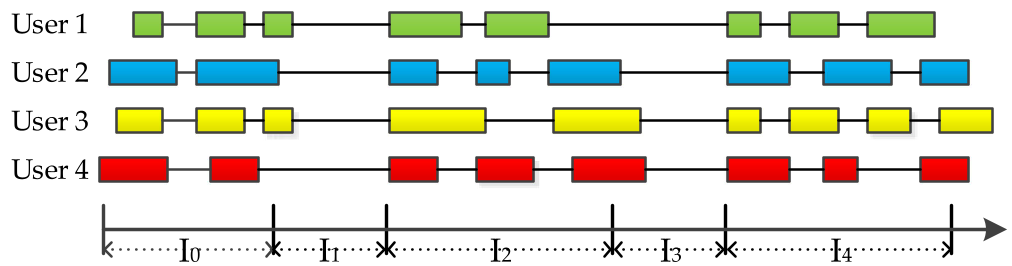
The technical heart of the paper is the **Partition and Shifting (PS)** scheme. Instead of partitioning space (the usual approach), the authors partition **time**.
### 1. Working vs. Moving Intervals
The timeline is divided into:
* **Working Intervals (WI)**: Where tasks can be started or performed.
* **Moving Intervals (MI)**: Buffer periods reserved for workers to travel to the next starting position.
### 2. The Shifting Mechanism
To avoid losing optimal solutions that might span across a fixed partition boundary, the algorithm "shifts" the starting point of these intervals multiple times and picks the best-performing configuration.
### 3. The Greedy Multi-Worker Strategy
Inside each interval, the system employs a greedy strategy: it selects a worker and finds their local optimal path using a polynomial-time search (feasible because the number of tasks in a small time window is bounded). The authors prove this greedy approach maintains a **2-approximation ratio**.
## Experimental Evidence: SOTA Comparison
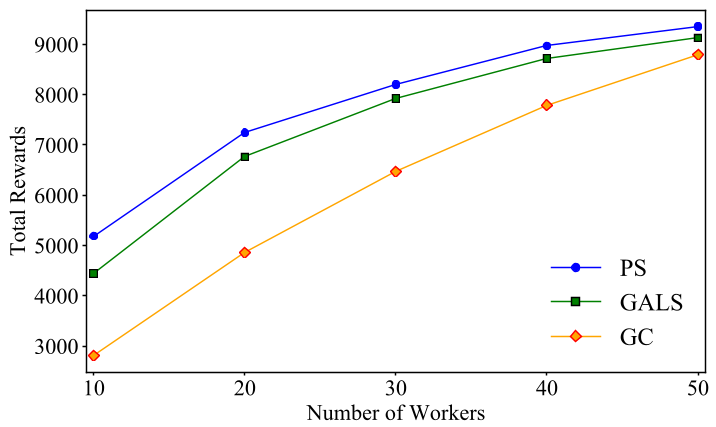
The PS scheme was tested against two heavyweights:
1. **GC (Greedy Centralized)**: Focuses on expensive tasks.
2. **GALS (Global Assignment Local Scheduling)**: A sequential three-phase framework.
### Performance Metrics
* **Total Rewards**: PS consistently achieved higher cumulative rewards across varying numbers of workers.
* **Task Coverage**: For large-scale scenarios (U > 40), PS pushed task coverage toward 100%, outperforming GALS by effectively utilizing "gap" times between tasks.
## Real-World Implications: From Uber to GrubHub
The study used real data from the **Multi-Depot Vehicle Routing Problem (MDVRP)**. The results showed that the PS algorithm generates much longer moving paths for workers compared to GALS.
**Critical Insight**: While PS is highly efficient at maximizing rewards, it creates "power workers" who handle significantly more tasks than others. This suggests a potential trade-off between **system efficiency** and **worker fairness** that the authors recommend exploring in future work.
## Conclusion & Future Outlook
This research moves the field of spatial crowdsourcing from "educated guesses" (heuristics) to "provable performance" (approximation algorithms). By introducing the BHTA model, the paper provides a robust mathematical foundation for platforms dealing with complex, time-sensitive services like on-site appliance repair or specialized medical deliveries.
The main limitation remains computational overhead. As shown in the runtime experiments, the PS algorithm's complexity grows faster than simpler heuristics. Future iterations likely need to incorporate distributed or parallel processing to handle the millisecond-latency requirements of modern gig-economy apps.