
AQuA: Recursive Quant Research Where the Agent Improves Hypotheses but Cannot Touch the Evaluator
AQuA: Recursively Self-Improving Quantitative Trading Research Agents
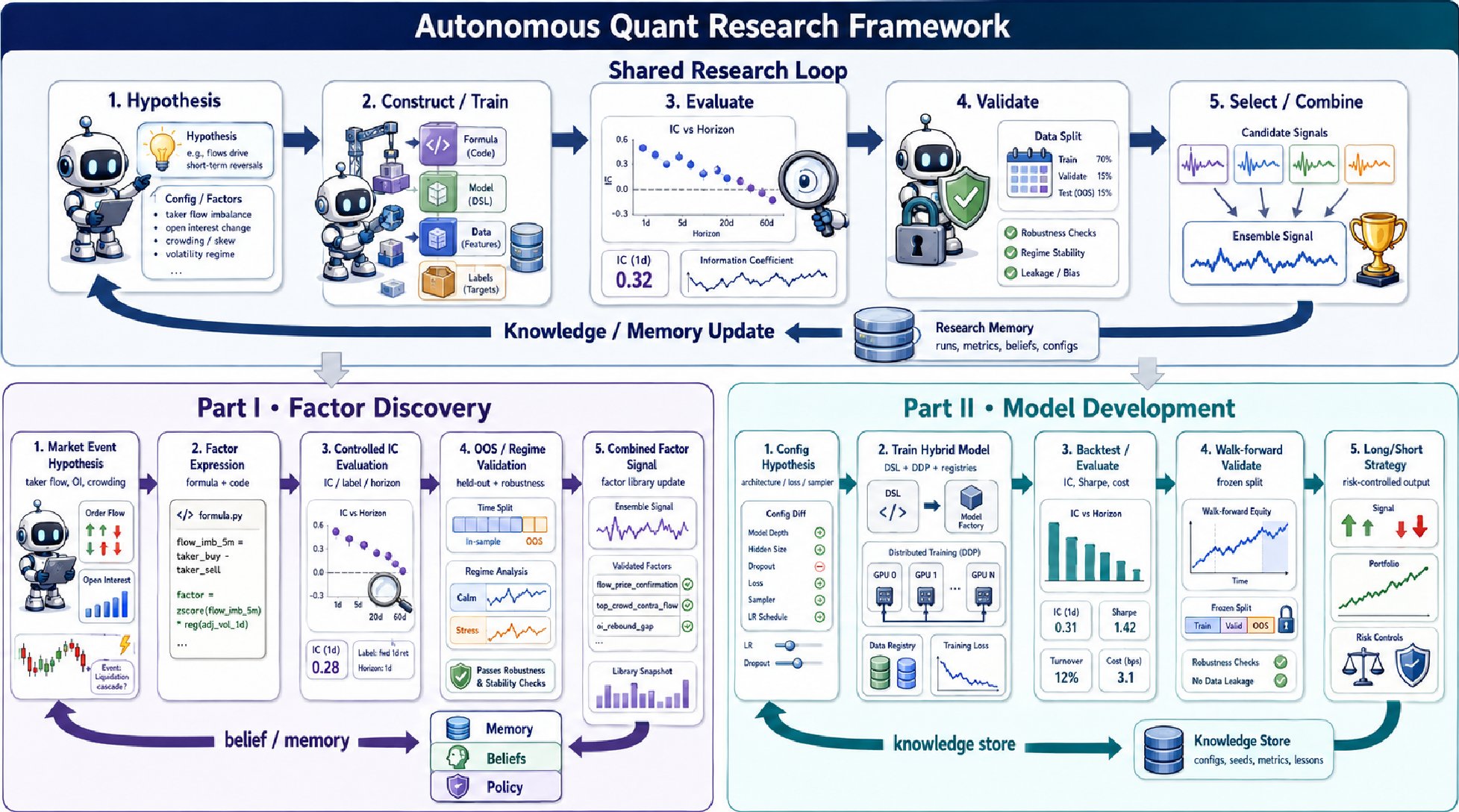
AQuA presents two separate language-model-driven research systems for quantitative investment, one for symbolic factor discovery and one for model development. Each system recursively updates a persistent research state from validated experiments while acting only through constrained expressions or configuration diffs inside a sealed evaluation sandbox. Part I reports a combined information coefficient of about 0.190 on a crypto universe, and Part II reports a per-stock information coefficient of plus 0.0843 on US equities with a held-out Sharpe of up to plus 2.50 at 2 basis points of two-leg cost.
TL;DR
AQuA asks a sharper question than most LLM quant papers: can an autonomous research loop improve future proposals from validated evidence without corrupting the evidence itself? The paper answers by constructing two separate systems, one for symbolic factor discovery and one for trainable model development, and by sealing the data path and evaluator before any iteration begins. Part I reaches a combined signal information coefficient of about 0.190 on a crypto five-minute universe, while Part II reaches a per-stock information coefficient of plus 0.0843 on US equities and converts that signal into a threshold long/short strategy with a held-out Sharpe of up to plus 2.50 at 2 basis points of two-leg cost. The paper's real contribution is not a single new primitive, but an integrity boundary: the agent can explore within a constrained space, while the definition of success remains outside its adaptive surface.
Positioning
This work is better read as a systems-and-methods paper than as a pure factor-mining or deep-modeling paper. It sits inside the recent wave of LLM agents for formulaic alpha discovery, which already includes evolutionary search, tree search, multi-agent proposal and selection, and experience memory. AQuA's distinct move is to refuse the usual assumption that a reviewing agent can reliably audit another agent's code or feature logic. Instead, it makes leakage unavailable by construction and treats recursive self-improvement as a property of the research process, not of the language model weights. The paper also avoids a common trap in agent papers by declaring that the evaluator is frozen and never updated by the loop, which keeps the reported improvement bounded and interpretable.
Problem and Motivation
Quantitative research is unusually vulnerable to quiet errors because a backtest can look excellent even when it depends on a single temporal-alignment bug or a normalization that uses information unavailable at prediction time. The paper names this explicitly: features, labels, or preprocessing steps can read future data, and a language model reviewing code may accept them because the economic story sounds plausible. Appendix B gives a concrete example: an agent wrote an intraday volume-participation feature whose numerator used past volume but whose denominator used the full current day's volume, leaking end-of-day information into every intraday timestamp. A reviewing agent approved it because it reasoned about the intended ratio rather than the exact bars touched by the implementation.
The deeper problem is that recursive agents can propagate such errors through memory. If a leaked experiment produces a high score and is stored as a successful precedent, the next iteration may imitate or condition on it. Prompt-level instructions do not solve this, because the failure occurs in the generated object itself, and model-based review does not provide a structural guarantee when the reviewer shares the same reasoning blind spot as the author. Selection pressure creates a second channel: if the search loop can read the metric that will later be reported, then with enough iterations it can learn to select for that metric, producing adaptive overfitting even when each individual candidate is locally honest.
The authors' intuition is therefore to separate two things that many agent frameworks conflate: what the agent is allowed to change, and how we decide that a change succeeded. They freeze the data splits, feature definitions, labels, and evaluator, and allow the agent to act only through a domain-specific expression language or a configuration diff. This makes the research loop recursively self-improving in a bounded sense because validated evidence still changes the next proposal, but the scoring environment remains outside the agent's editing surface.
Core Mechanism: Research State Recursion plus Sealed Evaluation
The object that improves is a part-specific research state
The shared recursion is written in the paper for part :
Here is the persistent research state belonging to Part before iteration , is the proposed hypothesis, is the constructed artifact such as a symbolic factor or trained model, and is the validated evidence returned by evaluation. The update operator writes evidence back into state, and the proposal distribution draws the next hypothesis and artifact from that state. This equation is central because it separates self-improvement from parameter learning: the model weights are not the only thing accumulating knowledge, and the evaluator is not part of the update. If were replaced by a no-op, the system would collapse into a one-shot pipeline that restarts from a blank prompt; if or were allowed into , the loop would start optimizing its own definition of success rather than the market phenomenon it claims to measure.
The sandbox converts anti-leakage from judgment to construction
The paper's action interface can be summarized as:
In this notation, is the only object the agent may produce, compiles that specification into a concrete factor or model, contains the fixed data splits , feature definitions , label definitions , and evaluator , and is the returned score. The crucial role of the equation is to make the agent's action space structurally narrow while leaving evaluation external. If allowed arbitrary Python, the sandbox would be advisory rather than structural; if the same metric were used for search ranking and final reporting, selection leakage would return through the loop. The paper addresses this by returning only validation scores during search and, where a final test window exists, scoring it once after the configuration is frozen, so the reported test number is out of sample with respect to the research process.
Part I: falsifiable symbolic factors and causal operator closure
Part I operates in the formulaic-alpha space of price-volume fields and causal operators. A representative factor expression given in the paper is:
In this expression, is a one-day return series, is a one-day volume series, is a trailing window length, is rolling correlation, is rolling standard deviation, and is a cross-sectional rank transform. The formula shows how a factor is assembled from a fixed operator vocabulary: a momentum-like relation between return and volume, minus a volatility penalty, all under cross-sectional ranking. Its role in the argument is to make the agent's search space explicit and causal by construction, because time-series operators read only trailing windows and cross-sectional operators read only the current timestamp. If any operator could read a full-day aggregate at an intraday timestamp, the same kind of bug from Appendix B could reappear; under the paper's registry, such a full-day normalizer is not expressible at all.
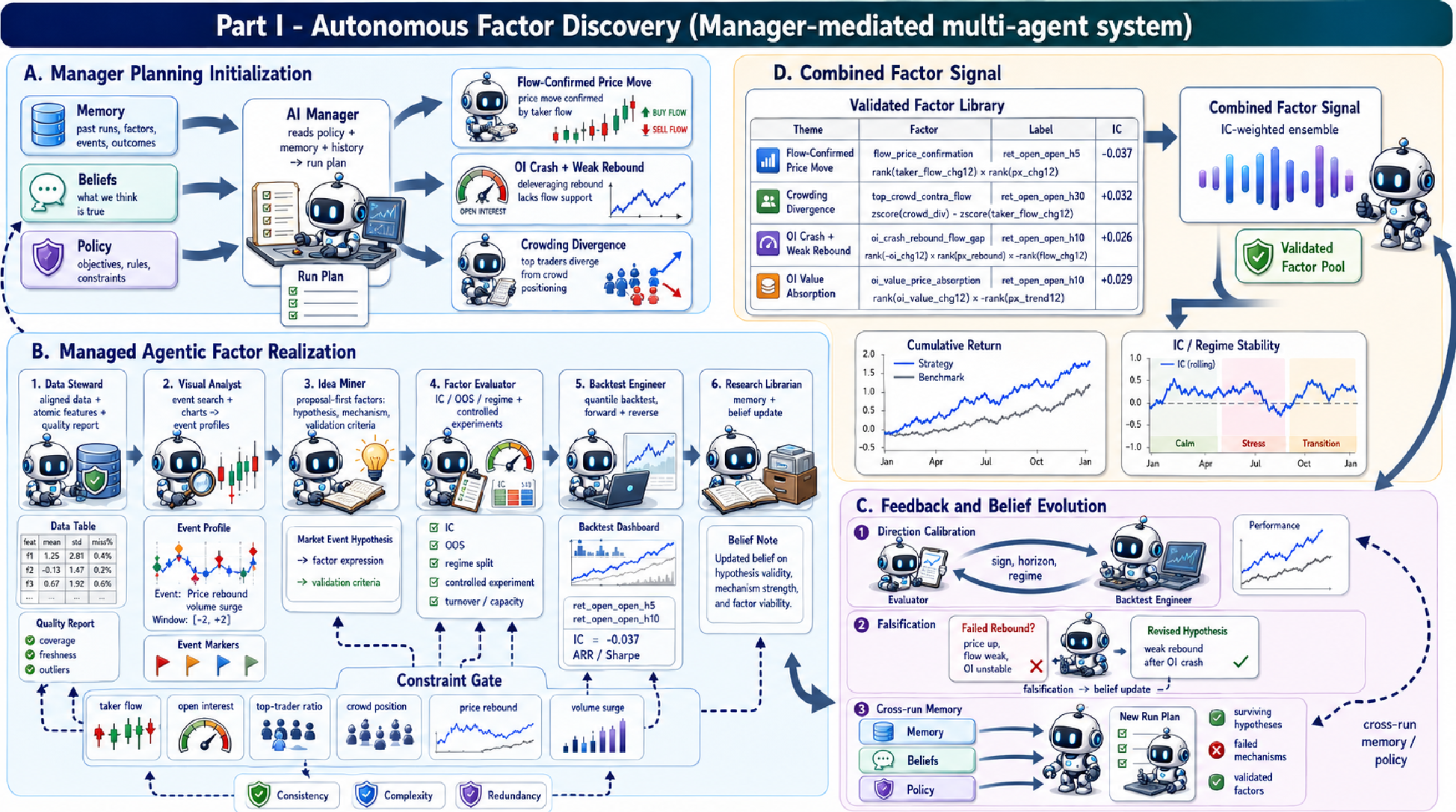
The deployed Part I pipeline is manager mediated. Six agents run in sequence: Data Steward, Visual Analyst, Idea Miner, Factor Evaluator, Backtest Engineer, and Research Librarian. The proposal stage requires a falsifiable hypothesis, a mechanism, an expected direction, target labels, refutation conditions, and failure modes before a symbolic expression is built. The Factor Evaluator then scores candidates across forward-return labels, monthly stability, held-out split behavior, market-regime behavior, turnover, complexity, and correlation with existing factors, and the Backtest Engineer can calibrate the signal direction because an economically grounded formula may still be proposed with the wrong sign. The persistent state consists of structured records and beliefs, so later runs inherit event definitions, rejected mechanisms, and refined hypotheses rather than starting from scratch.
Part II: one configuration diff equals one comparable model variant
Part II replaces symbolic factor search with autonomous model development. The specification space is a configuration in a DSL whose registry covers the full experiment:
The split is chosen from the frozen dataset and cannot be redefined, while the sampler, architecture, loss, and optimizer are selected from registries. This set defines the model's only interface to the world: the agent can propose a new architecture stack, loss mixture, optimizer schedule, or sampler, but it cannot write the data loader, leakage-critical normalization, or evaluator. The advantage is comparability. One config diff produces exactly one model variant under the same sealed data contract, so differences in held-out performance are more plausibly attributable to the knob that changed rather than to inconsistent feature engineering. The paper's hybrid model combines a multi-scale convolutional front end, a temporal backbone instantiated from recurrent, state-space, or attention blocks, a cross-sectional mixer, and a gated fusion readout. The contribution is not any single primitive, but the loop that lets an agent compose these primitives and accumulate evidence across variants.
Experimental Evidence
Part I evidence: aggregate factor discovery over iterations
The strongest direct evidence for Part I is Figure 3, which reports the combined validation information coefficient across autonomous research iterations rising to approximately 0.190 on a crypto five-minute universe. The paper also explains that individual discovered mechanisms are usually much weaker, with the worked open-interest-crash example producing single-factor information coefficients on the order of 0.026 to 0.037 depending on label and event context. This pattern matters: the result is not presented as a claim that one magical expression was found, but as evidence that a memory-bearing research harness can repeatedly turn economic hypotheses into tested factors and combine them into a stronger aggregate signal. The evidence is nonetheless partial because the deployed expressions are withheld, and the paper does not report a clean controlled ablation that removes persistent memory while holding proposal budget, evaluator, and data fixed. Therefore the rising IC is suggestive of cross-run learning, but it is not isolated as a causal ablation result.
Part II task design and weak single-feature baselines
Part II is instantiated on intraday US equity prediction with a next-thirty-minute forward-return target. Section 5.3 states that training uses 2010 through 2019, 2020 is left as an embargo gap, and evaluation reports on the untouched 2021 through 2025 test window. Model selection uses only an inner-validation slice from the end of training, and the final test window is scored only after configuration is frozen. Table 1 makes the difficulty of the task clear by showing that no representative single price-volume feature is strong enough on its own over the held-out window.
Table 1 reports the single-feature information coefficients for the representative price-volume set.
| Price-volume feature | Held-out single-feature IC |
|---|---|
| return, 5 min | -0.031 |
| return, 15 min | -0.021 |
| return, 30 min | -0.013 |
| return, 60 min | -0.001 |
| return, 4 h | +0.002 |
| volatility, 30 min | +0.006 |
| volatility, 1 h | +0.004 |
| momentum / volatility | +0.007 |
These values support the paper's modeling thesis: the predictable signal is not hiding in one engineered scalar, but in the joint, nonlinear, and temporal structure of short-horizon return, volatility, and momentum features. The ridge linear combination reaches only about plus 0.025 in Table 1, which is a modest upper bound for what a linear model can extract from the same feature set. That result makes the subsequent model-family comparison meaningful rather than a mere competition of arbitrary deep architectures.
Part II model-family comparison
Table 2 compares model families on the same held-out window using the raw per-stock information coefficient.
| Model | Family | Held-out raw IC |
|---|---|---|
| Linear ridge | linear | +0.0251 |
| LGB | gradient boosting | +0.0397 |
| xLSTM | recurrent | +0.0434 |
| LSTM | recurrent | +0.0535 |
| GRU | recurrent | +0.0613 |
| AQuA hybrid | hybrid | +0.0843 |
The headline gap is between AQuA's hybrid model and the strongest recurrent baseline, a GRU. The paper reports plus 0.0843 versus plus 0.0613, which corresponds to an absolute improvement of 0.0230 and a relative improvement of 37.5 percent under the same evaluator. The ordering in Table 2 also fits the task: linear and tree models capture part of the signal, recurrent networks capture more temporal structure, and the hybrid model improves further by combining convolutional feature extraction, a configurable sequence backbone, and cross-sectional mixing. The evidence is strong for a model-family comparison, but it is not a full architecture ablation because the paper does not disclose the exact feature set, normalization, label construction, or all component removal tests needed to isolate which piece of the hybrid stack matters most.
Held-out trading performance
Figure 6 and Table 3 connect the model signal to a tradable strategy. The strategy is a dollar-neutral threshold long/short book constructed by holding stocks above an upper threshold and shorting stocks below a lower threshold, with a two-leg turnover cost of 2 basis points.
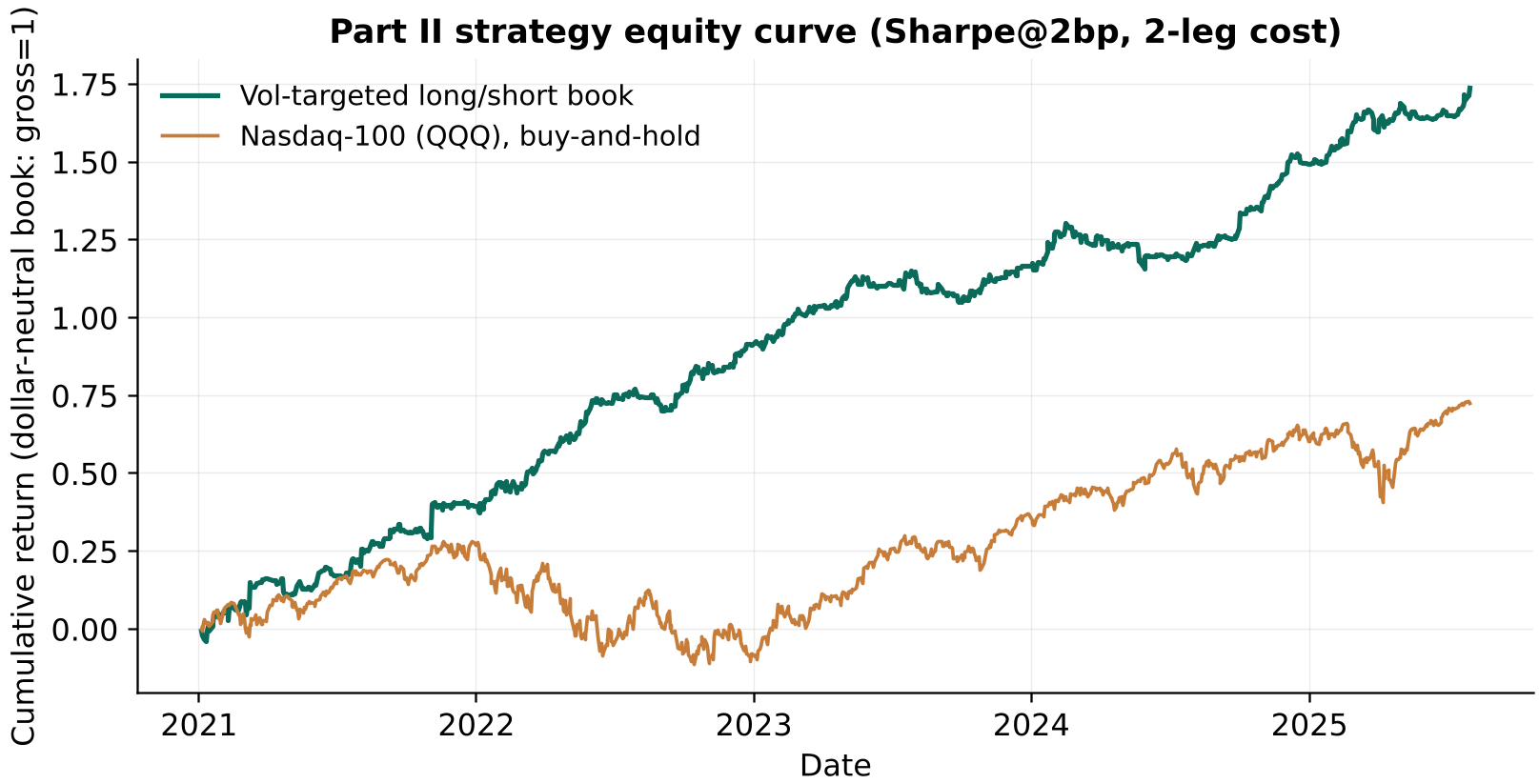
Table 3 reports the held-out metrics summarized by the paper for the 2021 through 2025 evaluation window.
| Metric | Held-out value |
|---|---|
| Per-stock raw IC | +0.0843 |
| Per-stock R squared, mean squared IC | 1.20 percent |
| Sharpe at 2 basis points, sector-neutral book | +2.15 |
| Sharpe after causal volatility targeting | +2.50 |
| Fully causal walk-forward Sharpe | +2.00 |
The progression from raw signal to strategy is important. The paper reports that sector neutralization alone raises held-out Sharpe to plus 2.15, and that a causal volatility-targeting overlay raises it further to plus 2.50. The fully causal walk-forward number, plus 2.00, is arguably the most diagnostic result in the paper because it re-estimates or selects every parameter using only data available before the next test segment. This does not eliminate all selection risk, but it makes the strategy result harder to dismiss as a single favorable backtest chosen after the fact. The R squared value is reported as the mean of squared IC under Part II's convention, so it should be interpreted as a nonlinear predictive-strength summary for per-stock time-series forecasts, not as a conventional regression fit statistic.
Regime breakdown
Table 4 decomposes the held-out Sharpe by calendar year.
| Year | 2021 | 2022 | 2023 | 2024 | 2025 |
|---|---|---|---|---|---|
| Sharpe at 2 basis points | +1.7 | +3.5 | +1.9 | +1.8 | +2.7 |
The yearly result is evidence against a single-regime explanation, because the strategy is positive in every year including 2022, when long-only equity indices faced a severe drawdown. The paper also notes that the dollar-neutral book sidesteps the 2022 QQQ drawdown, and the benchmark comparison is explicitly not risk matched because QQQ is long-only. This is a reasonable framing: a market-neutral strategy should be judged against other neutral construction choices, not only against an equity beta-heavy index. Still, the yearly table does not establish live tradability, because all Sharpe values are simulated under the paper's cost model and not validated in production execution.
Evidence Quality and Interpretation
The Part I and Part II metrics should not be read as a single apples-to-apples benchmark. Section 3 and Figure 3 state that Part I uses a combined-factor Spearman information coefficient on a crypto five-minute universe, while Part II reports a per-stock time-series information coefficient on US equities. An IC of 0.190 in Part I is therefore not directly comparable to an IC of plus 0.0843 in Part II, even though both are called information coefficients. This convention separation is a strength of the paper because it reduces misleading headline comparisons, but it also limits how much can be inferred across systems. The crypto result is conceptually rich but less transparent because the deployed factor expressions and full factor pool are withheld.
The Part II result is quantitatively stronger in its reported evaluation hygiene. The 2010 through 2019 train, 2020 embargo, and 2021 through 2025 untouched test design, together with inner-validation-only selection, addresses the common problem of repeated holdout access. The fully causal walk-forward Sharpe of plus 2.00 and the yearly positive Sharpe from Table 4 provide useful stress tests against single-regime luck. However, the paper does not report statistical significance tests, variance-reduction estimates, slippage sensitivity beyond the stated 2 basis point two-leg cost model, or an ablation of the sealed sandbox itself under adversarial attempts. It also does not report how large the hyperparameter search space was or how many configuration diffs were rejected before the best variant survived, which makes it difficult to estimate how much adaptive selection pressure occurred even within validation-only search.
Limitations and Scope
The most concrete limitations are named in Section 7. Each system is demonstrated on one market and one horizon: Part I on crypto five-minute data and Part II on US equity thirty-minute predictions. The authors do not claim that the reported numbers transfer without re-tuning to other markets or frequencies. Another boundary is autonomy level: a human operator sets the research goal, owns the sandbox, and supervises promotion, so the systems are autonomous within a human-defined contract rather than fully unattended. The reported performance is also simulated under a cost model and has not been validated in live trading, which leaves execution impact, queue position, borrow constraints, and capacity outside the empirical claim.
The leakage guarantees are structurally uneven. Closing generation leakage is strong because the agent cannot write arbitrary feature or data-pipeline code. Test isolation is weaker because it depends on sealed protocol and operator discipline; the harness returns validation scores during search, but if an operator can consult the stored final result during iteration, the reported test window could in principle be contaminated. The paper is candid about this by treating final-test isolation as a governance property to be audited over a run rather than a cryptographic guarantee. This honesty improves credibility, because it avoids the common agent-paper illusion that a prompt saying "do not overfit" is equivalent to a system where overfitting the reported metric is impossible.
What Should Follow
The natural next step is exactly what the authors suggest: coupling Part I to Part II by feeding discovered factors into the model loop. That step is not trivial because it introduces a new leakage channel between two systems that were intentionally isolated. If Part I selects factors using in-sample validation, and Part II trains on those factors without first sealing the discovered factor set as another frozen component, the model may inherit subtle overfitting through its inputs. A credible coupled version would freeze the factor library before model search begins, track the factor library's generation lineage, and report the marginal contribution of factor discovery versus model architecture. The broader transferable lesson is that autonomous research agents need two different protections: one against generating evidence from unavailable information, and one against selecting for the metric that defines final success. AQuA's contribution is a worked example of separating those two failure modes and making them structurally distinct.