
Mastering the Dance of Fluids and Solids: A Deep Dive into ALE and FSI Stability
Arbitrary_Lagrangian-Eulerian_and_Fluid-Structure Interaction Numerical Simulation (Benson)
This comprehensive work systematically explores numerical simulations of Fluid-Structure Interaction (FSI) using Arbitrary Lagrangian-Eulerian (ALE) formulations. It details state-of-the-art coupling algorithms, ranging from implicit partitioned methods to monolithic approaches, achieving high-fidelity results in complex dynamic scenarios like sloshing tanks and aortic valves.
Executive Summary
TL;DR: This work addresses the fundamental challenge of simulating systems where fluids and structures interact dynamically, such as blood flowing through arteries or gas inflating an airbag. By refining the Arbitrary Lagrangian-Eulerian (ALE) formulation and introducing novel Interface Laplace Matrices, the authors resolve the notorious "added mass effect" that typically causes simulations to crash when fluid and solid densities are similar.
Background Academic Positioning: This represents a pivotal transition from purely theoretical FSI formulations to robust, industrial-grade numerical frameworks. It sits at the intersection of Computational Fluid Dynamics (CFD) and Structural Mechanics (CSM), providing a unified roadmap for monolithic and partitioned solvers.
1. The Core Conflict: Lagrangian vs. Eulerian
The fundamental struggle in computational physics is the choice of the coordinate system:
- Lagrangian (Solid domain): The mesh follows the material. Excellent for boundaries but dies under large deformations (mesh skewness).
- Eulerian (Fluid domain): The mesh is fixed. Great for swirling flows but "smears" the solid boundaries.
The Arbitrary Lagrangian-Eulerian (ALE) method serves as the mediator. It allows the mesh nodes to move with the structure at the interface while transitioning to a fixed grid in the fluid far-field.
2. The "Added Mass" Nightmare
Why do FSI simulations fail? When the fluid is incompressible and as heavy as the structure (e.g., blood in a heart valve), the fluid acts as an "added mass" to the solid. In Partitioned Schemes (where you solve fluid and solid sequentially), the lagged pressure from the previous step creates a non-physical force that leads to divergence.
The Insight: Pressure Segregation
The authors demonstrate that the instability isn't just a physical property but a numerical artifact of pressure segregation. By applying Static Condensation to the monolithic system, they derive an exact way to decouple pressure without losing the structural stiffness information at the interface.
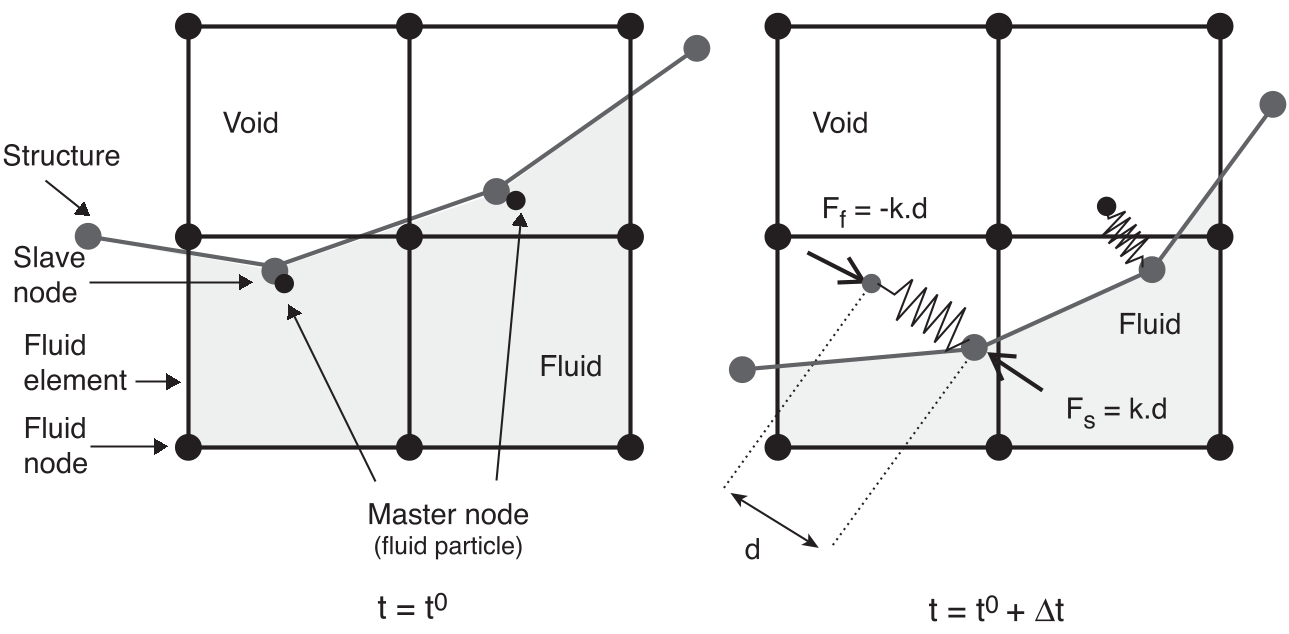 Figure 1: Conceptual coupling between Lagrangian structure and Eulerian fluid via penalty springs.
3. Methodology: The Interface Laplace Matrix
The breakthrough component is the approximation of the Schur complement. Instead of a simple Laplacian used in standard Projection Methods (like Chorin-Temam), the authors propose a modified operator:
Where is a scaling factor dependent on the time step , the structural Lamé parameters, and mesh size . This term effectively "preps" the pressure solver to recognize that it is pushing against a deformable wall rather than a rigid one.
Stabilizing the Penalty Coupling
In explicit dynamics, the authors use a Penalty Method (treating the interface as a system of springs). To kill high-frequency "noise" caused by stiff springs, they introduce an Optimal Damping Factor (), which allows for smooth pressure histories without sacrificing physical accuracy.
4. Experimental Validation: From Pistons to Heart Valves
The efficacy of the method was validated across diverse scales:
- Slamming Problems: A rigid wedge impacting water. Without damping, the pressure spikes are jagged; with the proposed enhancements, the results perfectly track Wagner’s analytical solution.
- Sloshing Tanks: High-precision tracking of free-surface waves under seismic loading, maintaining energy conservation over long durations.
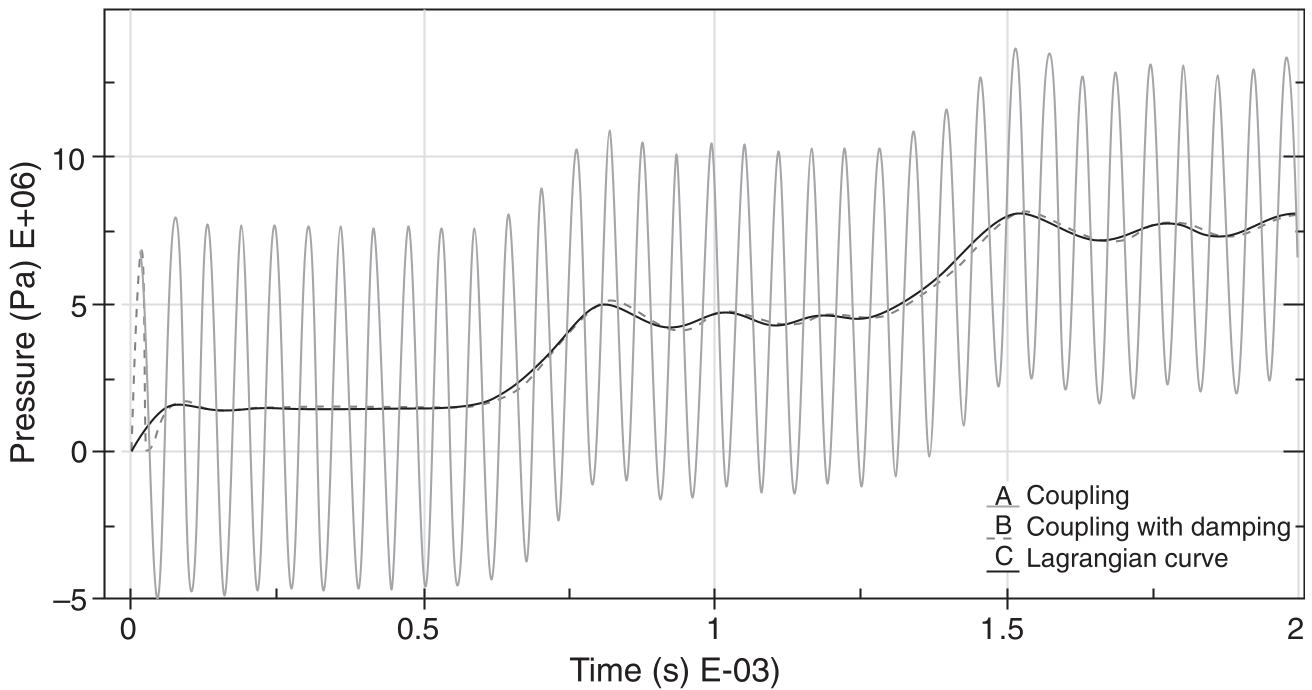 Figure 2: Comparison of fluid pressure histories: (a) without damping, (b) with damping, and (c) the reference curve.
Biomedical Impact: Aortic Valve Scaling
The most complex test involved a flexible valve in pulsatile flow. By leveraging the Interface Laplace Matrix, the staggered solver remained stable even as the time step was reduced—a scenario where traditional solvers typically diverge.
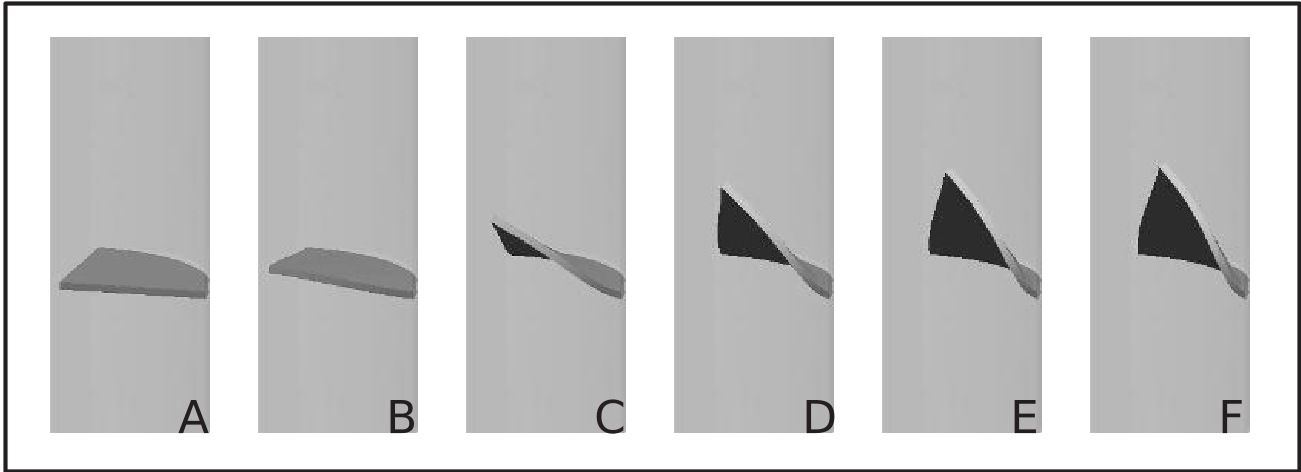 Figure 3: Simulated valve deflection across a full cardiac cycle.
5. Critical Analysis & Future Directions
Takeaway
The "Added Mass Effect" is effectively a failure of the numerical preconditioner. By including structural stiffness in the pressure equation through the matrix, we can use efficient partitioned solvers for problems once thought to require expensive monolithic approaches.
Limitations
- Mesh Sensitivity: While the algorithm is robust, the choice of the parameter still shows some dependence on the local mesh quality.
- Topological Shifts: The ALE framework still struggles with "tearing" or "joining" interfaces (e.g., a valve fully closing/sealing).
Future Work
The research points toward quadratic interface reconstruction and autonomous mesh smoothing algorithms that can handle 3D topological changes without user intervention.
Editor's Note: This work is an essential read for engineers in the automotive and biomedical sectors. It transforms FSI from a "dark art" of tuning parameters into a rigorous mathematical framework.