
Hybrid Intelligence: Bridging Knowledge Graphs and ML for Legal Permit Analysis
An Architecture for Extracting Key Elements from Legal Permits
The paper introduces a hybrid system architecture for extracting key elements from heterogeneous legal permits in the environmental domain. It combines Machine Learning (ML) with Knowledge Graphs (KG) to assist laypersons in processing complex, semi-structured documents while ensuring system auditability.
TL;DR
Processing environmental legal permits is a nightmare for non-experts due to complex legal jargon and implicit cross-references. This paper proposes a system that combines Machine Learning with Knowledge Graphs to automate data extraction while maintaining a strict audit trail. By leveraging external legal databases, the system can "read between the lines" to identify legal procedures that aren't explicitly named.
Problem & Motivation: The "Layperson's Wall" in Legal Tech
In Austria, production facilities are governed by a labyrinth of environmental laws. Every permit issued must be structured and indexed for stakeholders. However, the personnel tasked with this data management often lack deep legal expertise.
The authors identify three primary hurdles:
- Implicit Information: A document won't say "this is an ordinal procedure"; it will cite a specific paragraph in a waste management law, requiring the reader to know what that paragraph implies.
- Entity Overload: The same law or entity might appear in multiple roles (e.g., a supporting legal basis vs. the primary legal basis).
- Heterogeneity: Different authorities use different templates and terminology, making hard-coded rules useless.
Methodology: The Integrated Pipeline
The core of the proposed solution is a hybrid pipeline that moves from raw unstructured text to a structured, auditable Knowledge Graph.
The Extraction Workflow
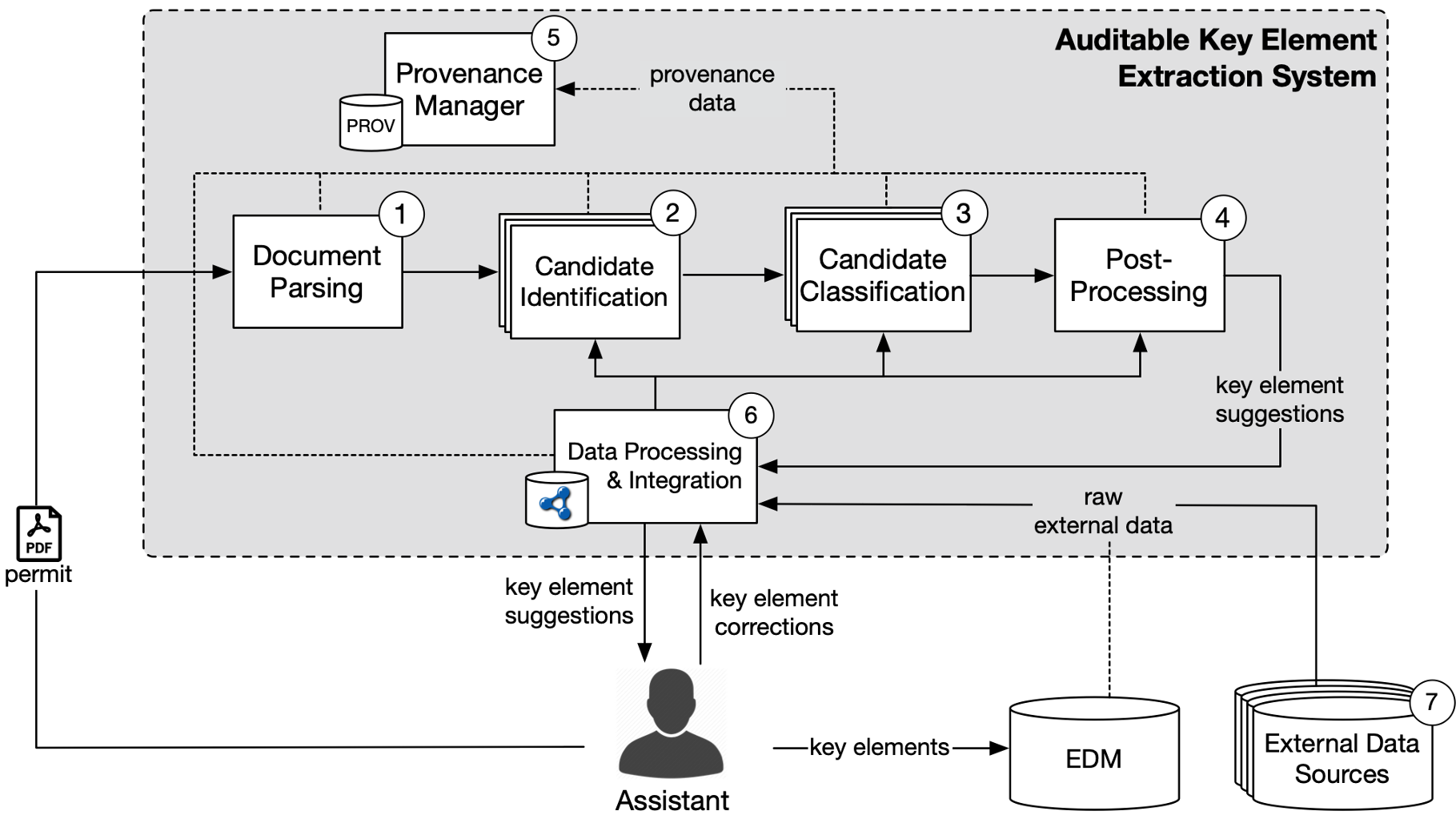
As shown in the architecture, the process is divided into four functional stages:
- Document Parsing: Converting PDFs to plain text while preserving structural anchors like letterheads and preambles.
- Candidate Identification: Using NLP (NER, chunking) and regex to find "potential" dates, authorities, and site numbers.
- Candidate Classification: The "brain" of the system. This stage combines ML models with symbolical rules to distinguish, for example, the permit date from other dates mentioned in the text.
- Post-processing: Verification logic (e.g., ensuring a permit date isn't in the future).
The Auditability Layer
Unlike typical "black-box" NLP systems, this architecture includes a Provenance Manager. This is critical for legal applications where a decision must be justified. The system tracks:
- Which data version was used for training?
- Which external database (EDM or RIS) provided a synonym?
- What specific transformation logic led to the final classification?
Experiments & Results: Mapping Key Elements
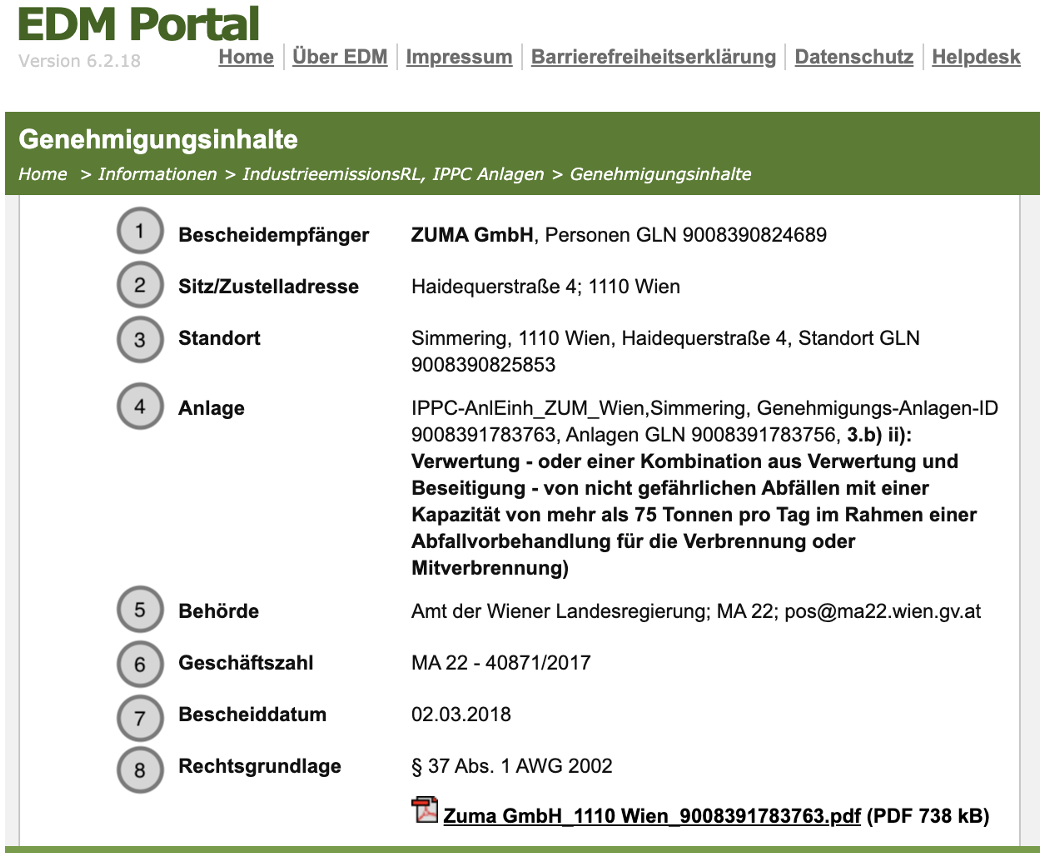
The researchers mapped the extraction process against the Austrian EDM (Electronic Data Management) system. They identified a set of "Key Elements" divided into explicit and implicit categories.
| Element | Nature | Challenge |
|---|---|---|
| Operator/Site | Explicit/Semi-Explicit | Standardizing "cadastral commune" vs actual names. |
| Legal Basis | Explicit | Distinguishing the "Main Law" from supporting citations. |
| Type of Procedure | Implicit | Requires mapping law paragraphs to procedure types via external knowledge. |
While the paper focuses on the architectural design rather than a benchmark score, it provides a blueprint for handling "messy data" where labels are provided by non-experts.
Critical Analysis & Conclusion
The significance of this work lies in its Neuro-symbolic approach. Pure Machine Learning often fails in legal domains because it lacks the "logical rigging" to connect a cited paragraph to an abstract legal concept. By using Knowledge Graphs to store external legal truths (from RIS), the authors ensure the AI acts as a "Legal Assistant" rather than just a pattern matcher.
Limitations: The current scope excludes image-based scans (OCR) with stamps and artifacts, which remain a major hurdle in real-world legal archiving.
Takeaway: If you are building AI for highly regulated industries, don't just rely on more data. Build a "Search-and-Justify" architecture where Knowledge Graphs provide the facts and ML provides the flexibility.