
ArchVelo: Disentangling Cellular Trajectories via Archetypal Multi-omic Modeling
ArchVelo: archetypal velocity modeling for single-cell multi-omic trajectories
ArchVelo is a novel computational framework designed for single-cell multi-omic trajectory inference by integrating paired scATAC-seq and scRNA-seq data. It utilizes archetypal analysis to represent chromatin accessibility as shared regulatory programs, outperforming current SOTA methods like MultiVelo and scVelo in trajectory accuracy and latent time consistency.
TL;DR
ArchVelo is a new computational framework that redefines trajectory inference by using "archetypes"—characteristic regulatory programs—to bridge the gap between chromatin accessibility (scATAC-seq) and gene expression (scRNA-seq). By decomposing cellular dynamics into these archetypal components, it provides unprecedented resolution in identifying divergent biological processes, such as the simultaneous proliferation and differentiation of immune cells.
The "Averaging" Problem in Multi-omics
The fundamental goal of RNA velocity is to predict the future state of a cell based on the ratio of unspliced to spliced mRNA. While multi-omic technologies provide a "look ahead" into the regulatory layer (chromatin accessibility), previous methods often fell into the trap of information dilution. By averaging accessibility across all genomic peaks near a gene, these models ignored the reality that different enhancers might be firing at different times to drive distinct cellular outcomes.
Methodology: The Power of Archetypes
The core innovation of ArchVelo lies in its use of Archetypal Analysis (AA). Instead of treating every ATAC-seq peak as an independent variable (which leads to extreme sparsity) or averaging them (which leads to loss of signal), ArchVelo identifies a fixed number of "extreme" profiles—archetypes—that represent discrete regulatory programs.
1. Archetypal Featurization
As shown in the architecture, the scATAC-seq matrix is decomposed such that every peak summit is approximated by a convex combination of archetypes. This low-rank representation acts as a powerful "denoiser," capturing the physical intuition that groups of regulatory elements often operate in coordination.
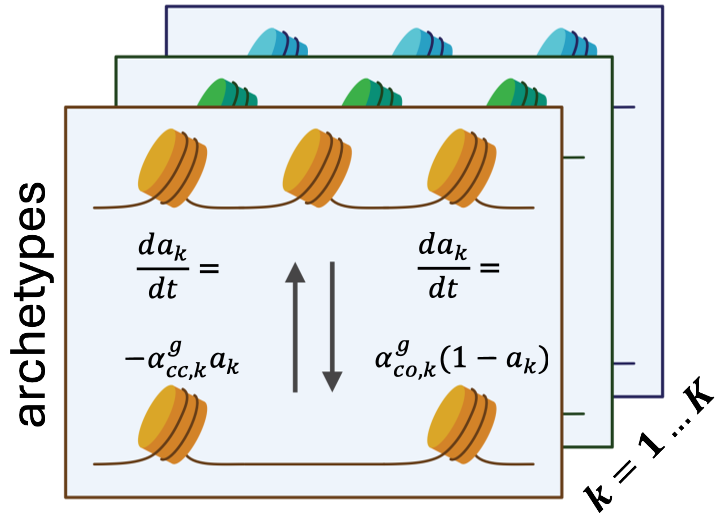 Figure 1: Schematic of the ArchVelo model integrating chromatin archetypes into the transcriptional kinetic cascade.
2. Kinetic Decomposition
ArchVelo models the transcription rate as a sum of contributions from these archetypes. Because the underlying ODE system is linear, the final RNA velocity vector can be mathematically "unpacked" into archetype-specific velocities. This allows researchers to see not just where a cell is going, but which regulatory program is pushing it there.
Experimental Results & SOTA Comparison
In rigorous benchmarking against models like scVelo, MultiVelo, and VeloVI, ArchVelo consistently showed:
- Higher Robustness: Better alignment of latent time across different genes.
- Greater Accuracy: Higher Cross-Boundary Direction Correctness (CBDir) scores in recovery of known developmental paths in the mouse brain and human hematopoiesis.
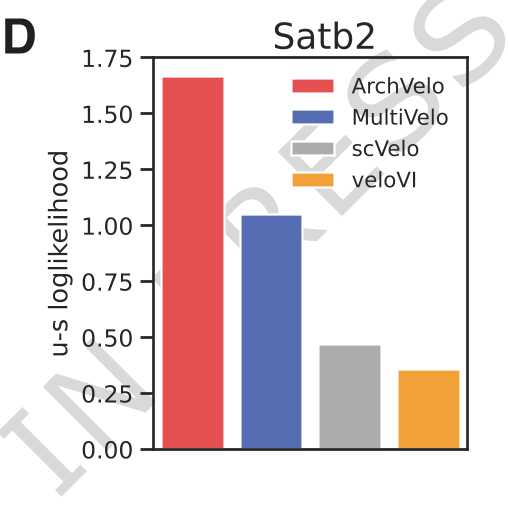 Figure 2: ArchVelo outperforming existing methods in mouse brain trajectory inference metrics.
Biological Discovery: CD8 T Cell Dynamics
The authors applied ArchVelo to CD8 T cells during viral infection (LCMV). While standard methods struggled to separate the "noise" of cell division from the signal of functional maturation, ArchVelo’s decomposition clearly isolated:
- Proliferation program: Driven by archetypes associated with the cell cycle ().
- Differentiation program: Uncovered a transition from to progenitors, identifying the specific transcription factors (e.g., , ) driving these divergent fates.
Conclusion and Future Outlook
ArchVelo represents a shift in trajectory inference from "observation" to "mechanistic decomposition." By grounding velocity in the archetypal structure of the epigenome, it provides a stable and interpretable map of cell fate.
Limitations: The model assumes a linear mapping between accessibility and transcription. While this prevents overfitting, future versions might need to incorporate the non-linear "logic-gate" nature of enhancer-promoter interactions.
Takeaway: For any researcher working with scATAC+RNA-seq data, ArchVelo is now the SOTA standard for extracting directional, regulatory-aware trajectories.