
Are Forum Networks Social Networks? Unmasking the "Social" in Learning Analytics
Are forum networks social networks? A methodological perspective
This paper presents a methodological critique and empirical study on whether online forum interactions in educational settings constitute genuine social networks. By employing null models that control for individual posting activity and post popularity across twenty courses, the authors determine that common metrics like degree centrality are often mere derivatives of individual behavior rather than social dynamics.
TL;DR
In the world of Learning Analytics, we often see spider-web diagrams of students "interacting" on forums. We measure their "influence" via Degree Centrality and assume we are seeing social dynamics. This paper by Poquet et al. delivers a sobering reality check: most of what we call "social" is just a byproduct of how many times a student clicks "post." By using Null Models, the researchers demonstrate that while Degree is mostly an activity metric, Clustering remains a potential signal for genuine social structures.
The "Social" Illusion: Problem & Motivation
Traditionally, Learning Analytics (LA) researchers transform forum logs into student-to-student networks. If Student A replies to Student B, a link is drawn. We then conclude that a student with many links is "socially central."
However, the authors argue this is a methodological leap of faith. Is that high degree a result of social prestige (Social Logic), or did the student simply post 50 times because it was 10% of their grade (Activity Logic)? Without a baseline—a Null Model—we cannot tell if the network we see is a "bona fide" social network or just a mathematical artifact of individual posting heterogeneity.
Methodology: The Power of Randomness
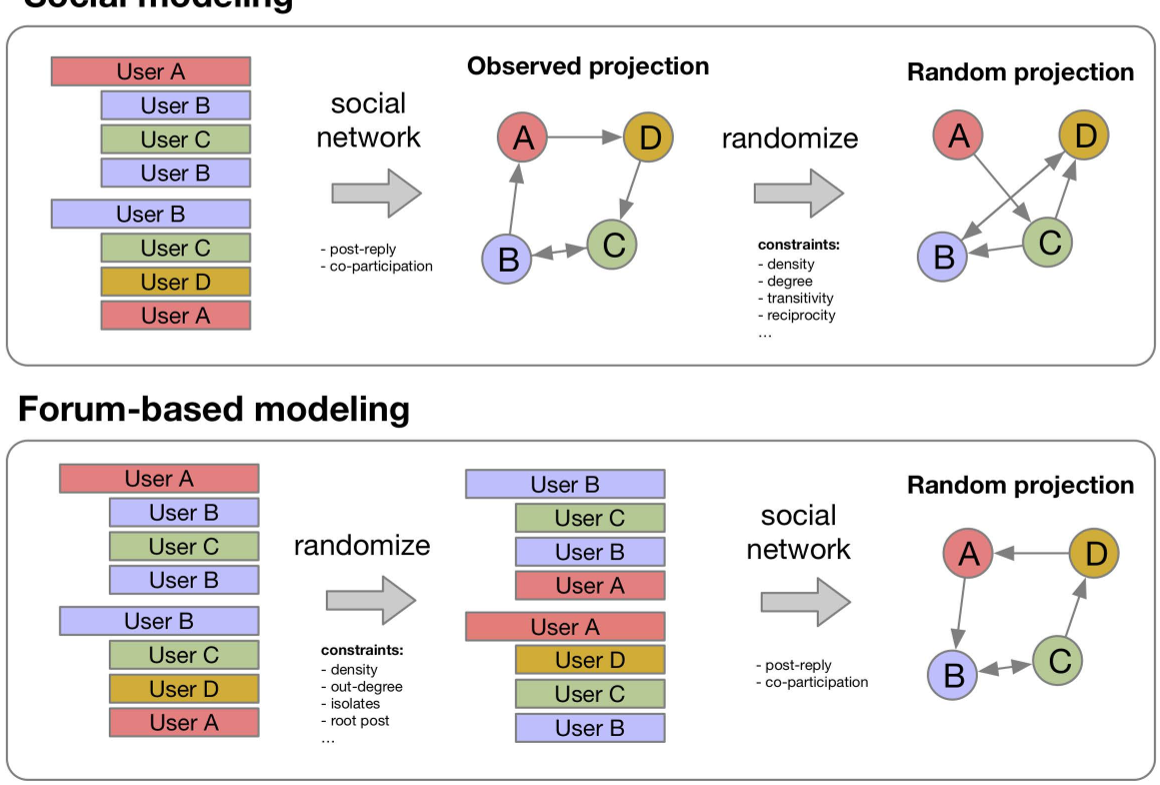
To peel back the layers of the forum "social" onion, the authors constructed six types of null models based on two primary representations:
- Post-Tree Networks: Modeling threads as hierarchical trees where posts are nodes.
- Student-to-Thread Bipartite Networks: Modeling students as participants in "discussion containers."
The core of the methodology lies in Fixed Constraints. They generated random networks where the number of posts per student was kept identical to the real data, but the target of those posts was randomized. If the "social" properties of the real network survived this randomization, those properties are likely truly social. If the random network looked just like the real one, the property is just a derivative of activity.
Experiments & Results: What is "Real"?
The researchers tested their models across 20 diverse courses. The results were striking:
- The Randomness of Density: Global features like Network Density and the Gini Coefficient of Degree were often indistinguishable from random graphs. In many courses, the "centralization" seen was exactly what you'd expect from a few students posting more than others by chance.
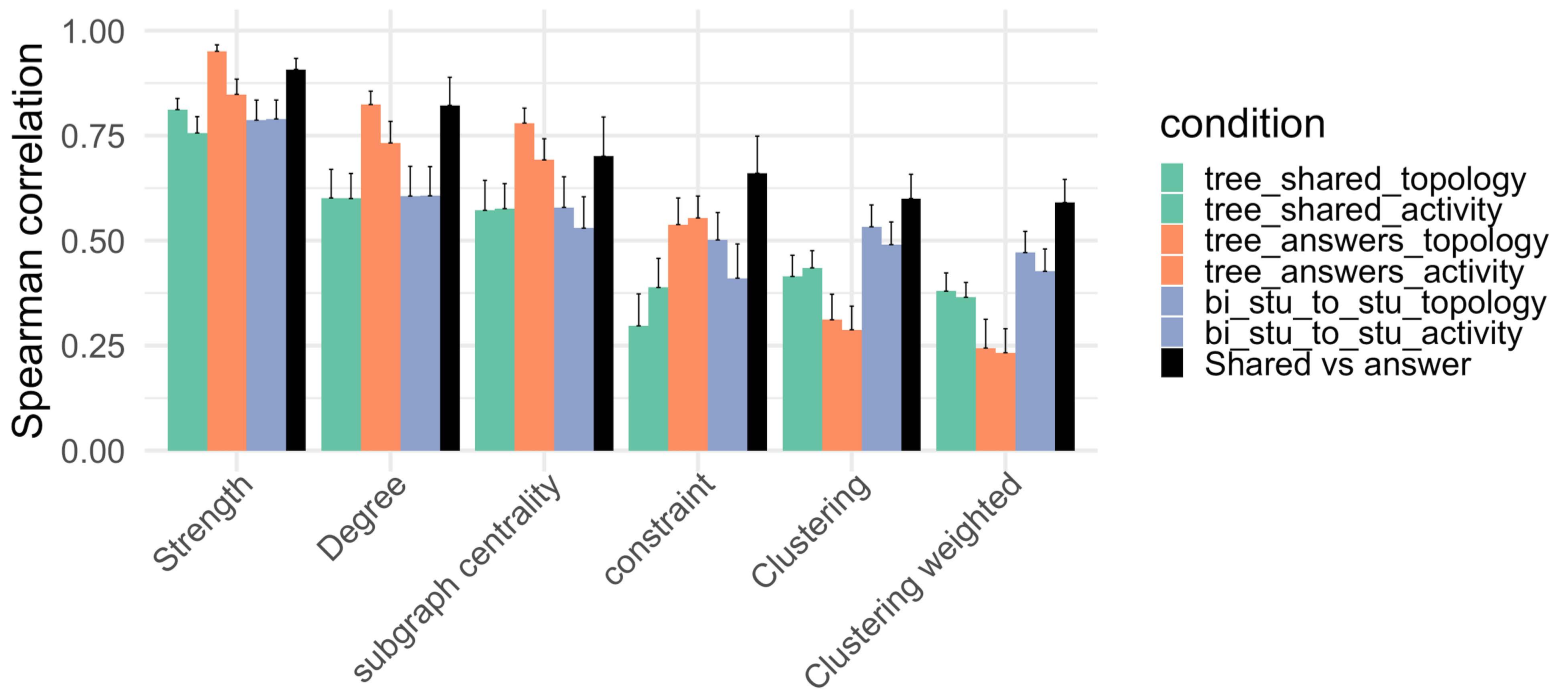
- Centrality = Activity: At the node level, Degree and Strength (weighted degree) showed extremely high correlation with the null models. This means these metrics are poor indicators of social influence; they are essentially just "post counts" in disguise.
- The Resilience of Clustering: Unlike degree, the Clustering Coefficient (the tendency of your friends to be friends with each other) was not well-replicated by the random models. This suggests that triadic closure—forming small communities—is a genuine social process that cannot be explained away by simple posting frequency.
Critical Insight & Conclusion
The primary takeaway for the LA community is a call for methodological rigor. We must stop using centrality measures as a shorthand for social engagement.
Key Insights:
- Stop Confusing Participation with Interaction: A high degree in a forum network tells you a student is active, not necessarily that they are a social leader.
- Focus on Local Topology: If you want to find social effects, look at Clustering and Burt's Constraint. These higher-order structures capture the arrangement of ties, which remains distinct from the mere volume of activity.
- Null Models as Standard Practice: Future LA dashboards should use null models to "filter" networks, showing instructors only the interactions that are statistically significant departures from random activity.
Limitations: The study notes it did not explicitly model community structures (using Stochastic Block Models). Future work should investigate if subgroup formation in large MOOCs is also a byproduct of course design or a result of emergent social affinity.