
Decoding Sectarian Clouds: Detecting Religious Hate Speech in the Arabic Twittersphere
Are they Our Brothers? Analysis and Detection of Religious Hate Speech in the Arabic Twittersphere
This paper presents the first systematic study and automated detection of religious hate speech in the Arabic Twittersphere. The authors introduce a novel dataset of 6,000 annotated tweets and three specialized lexicons, achieving state-of-the-art performance using a GRU-based Recurrent Neural Network with pre-trained AraVec embeddings.
TL;DR
Religious hate speech in the Arab world is a pressing social issue, yet automated detection tools have historically lagged behind. This paper bridges the gap by providing the first publicly available Arabic religious hate speech dataset and lexicon. By leveraging a GRU-based RNN architecture and specialized word embeddings, the authors achieved an AUROC of 0.84, identifying alarming levels of hostility targeting Jews, Atheists, and Shia Muslims.
The Challenge: A Linguistic Minefield
Most hate speech detection research is "English-centric," ignoring the specific nuances of the Arabic language. Arabic presents a unique "trilemma" for NLP researchers:
- Morphological Complexity: A single word can contain a root, prefixes, and suffixes, leading to millions of variations.
- Dialectal Diversity: Twitter users rarely use Modern Standard Arabic (MSA); they use regional dialects that lack standard spelling or grammar.
- Subtlety: Religious hate is often encoded in pejorative sectarian terms (e.g., Raafidah, Majus) that generic profanity filters completely miss.
Methodology: From Lexicons to Deep Learning
The authors didn't just build a model; they built the infrastructure for future research.
1. Data Collection & Lexicon Building
They collected 6,000 tweets and used crowdsourcing to label them. To extract features, they employed three statistical methods: PMI, Chi-square, and BNS. These methods helped identify "keywords of hate," categorized into offensive terms, religious/political labels used pejoratively, and war-related violence.
2. The GRU Architecture
The core of the detection system is a Gated Recurrent Unit (GRU) network. Unlike simpler n-gram models, the GRU can capture long-distance dependencies in text.
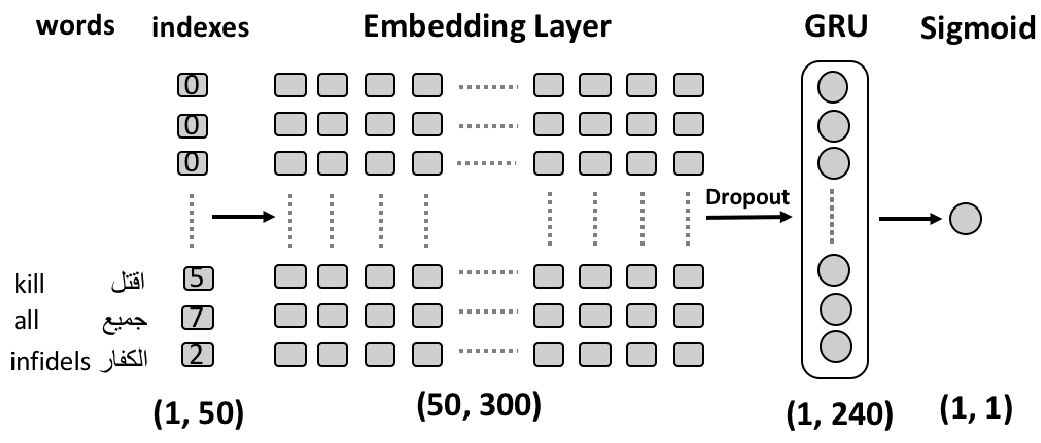 Fig 1: The GRU-based RNN architecture utilizing AraVec pre-trained embeddings.
The choice of AraVec (Twitter-CBOW) embeddings was crucial. By training on 67 million Arabic tweets, the model "understands" the slang and malformed spellings typical of social media, leading to a much higher word-match rate (80%) compared to models trained on Wikipedia or formal web text.
Experimental Results: Who is Targeted?
The study's findings are sobering. 42% of the collected tweets referring to religion contained hate speech. As shown in the data below, Jews and Atheists face the highest percentage of targeted hostility relative to their mention frequency.
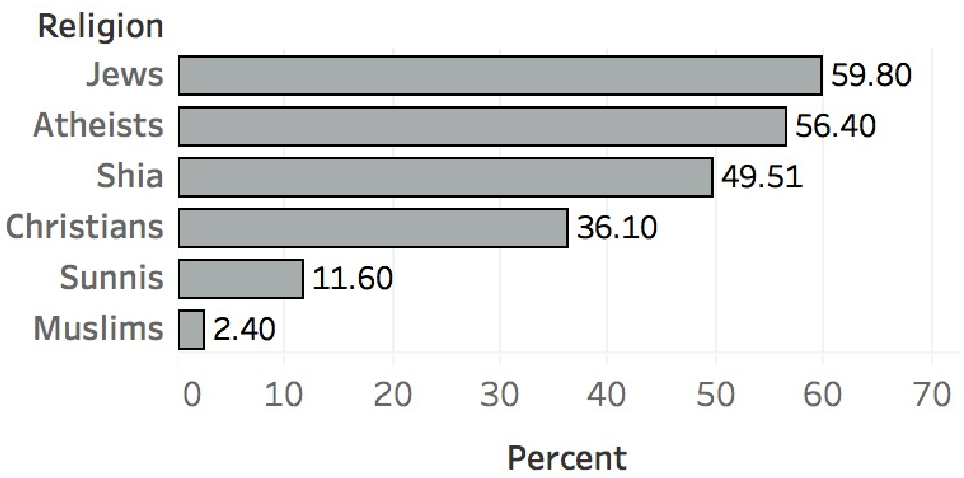 Fig 2: Percentage of hate speech targeting specific religious groups within their respective datasets.
In terms of model performance, the GRU-based RNN consistently beat traditional machine learning approaches (SVM and Logistic Regression) across all metrics:
| Model | F1 Score | Accuracy | AUROC |
|---|---|---|---|
| Lexicon (PMI) | 0.69 | 0.71 | 0.78 |
| SVM (N-grams) | 0.72 | 0.75 | 0.81 |
| GRU-based RNN | 0.77 | 0.79 | 0.84 |
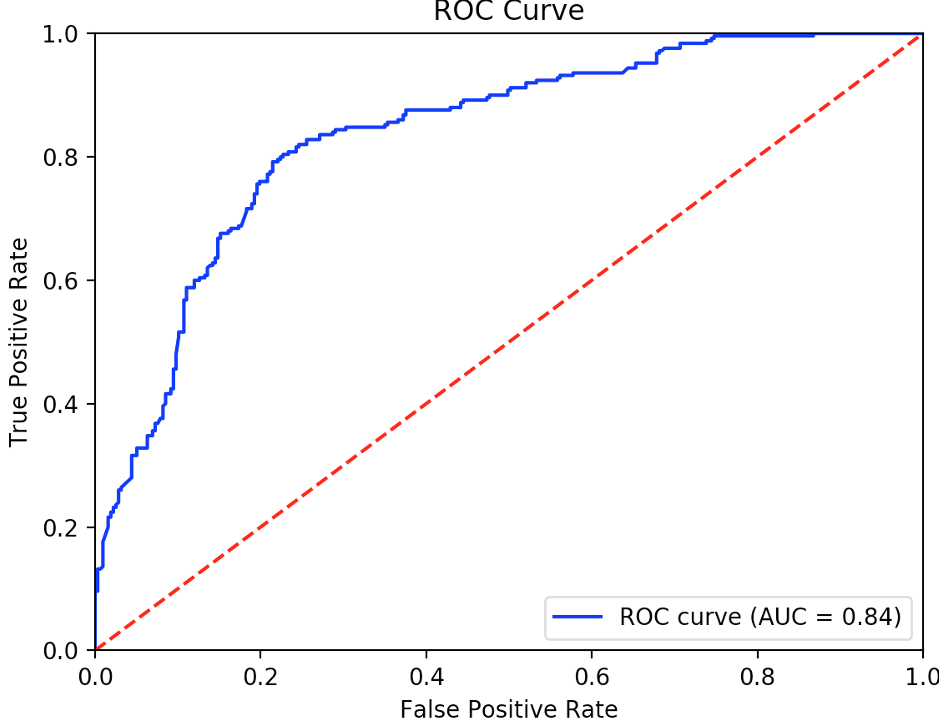 Fig 3: The ROC curve confirming the superior discriminative power of the GRU model.
Critical Insights & Takeaways
The effectiveness of this approach stems from the Inductive Bias of the GRU combined with domain-specific embeddings. While n-grams look for specific "bad words," the GRU identifies the "vibe" and structure of hateful rhetoric.
Future Outlook:
- Limitations: The model still struggles with extremely subtle sarcasm or hate speech that lacks explicit offensive terms.
- Expansion: Future research should leverage character-level CNNs to handle the "morphologically rich" nature of Arabic even better, potentially reducing the impact of misspelled words.
- Impact: This study provides the necessary toolkit (dataset + lexicons) for platforms like Twitter to begin cleaning up sectarian toxicity in the Middle East.
Conclusion
This paper serves as a seminal work for Arabic NLP. It highlights that hate speech is culturally and linguistically dependent. We cannot simply translate English models into Arabic; we must build systems that understand the specific historical and sectarian context of the region.