
[Stanford Research] ARES: Precision Evaluation for RAG Systems via Synthetic Judges and PPI
ARES: An Automated Evaluation Framework for Retrieval-Augmented Generation Systems
ARES (Automated RAG Evaluation System) is a novel framework for evaluating Retrieval-Augmented Generation systems across context relevance, answer faithfulness, and answer relevance. It utilizes synthetic data generation to fine-tune lightweight DeBERTa-v3-Large judges and employs Prediction-Powered Inference (PPI) to provide statistically sound confidence intervals with minimal human labeling.
TL;DR
ARES (Automated RAG Evaluation System) is a breakthrough framework that automates the evaluation of Retrieval-Augmented Generation (RAG) pipelines. By training lightweight LLM judges on synthetic data and "rectifying" their predictions with a tiny human-annotated set (~150 points), ARES achieves State-of-the-Art (SOTA) evaluation accuracy, significantly outperforming heuristic methods like RAGAS while saving 78% in annotation costs.
Problem & Motivation: The Evaluation Bottleneck
Building a RAG system is easy; evaluating it is hard. To truly optimize a pipeline, engineers must assess three distinct dimensions:
- Context Relevance: Did the retriever find the right information?
- Answer Faithfulness: Is the answer grounded in the retrieved text (no hallucinations)?
- Answer Relevance: Does the answer actually address the user's query?
Existing methods fall into two traps: they are either unscalably expensive (human experts) or unreliable and rigid (GPT-4 zero-shot prompting or heuristic frameworks like RAGAS). ARES was born from the need for an evaluation system that is as dynamic as the domains it tests, offering statistical rigor without the million-dollar price tag.
Methodology - The ARES Pipeline
ARES moves away from "one-size-fits-all" prompts. Instead, it builds a bespoke judge for your specific data.
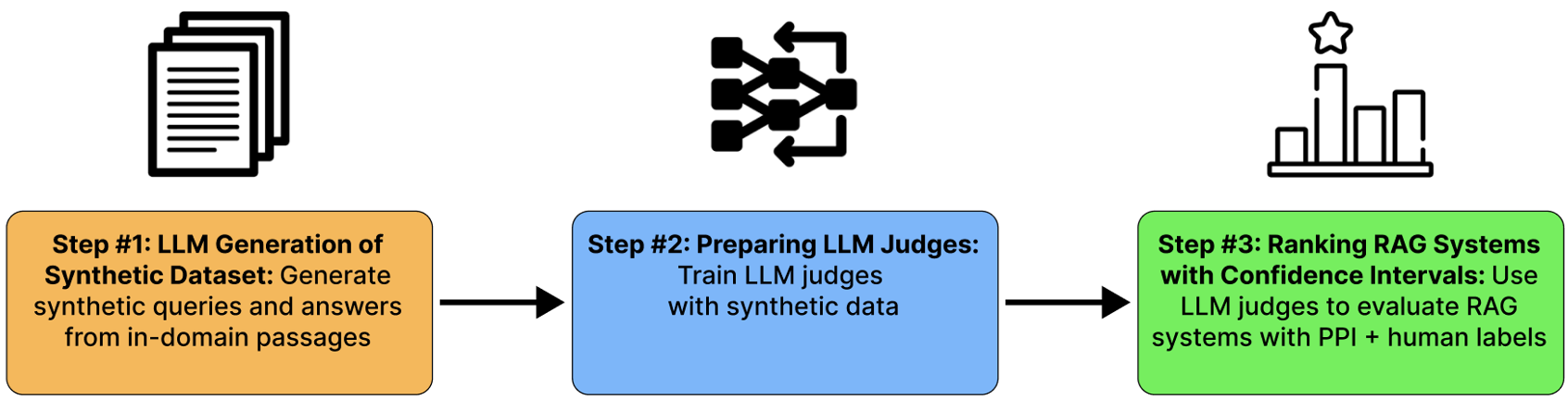
1. Synthetic Data Generation
ARES uses a generative LM (like FLAN-T5) to create synthetic questions and answers from your own document corpus. Crucially, it generates Strong Negatives—passages that are topically similar but factually insufficient—to teach the judge how to spot subtle failures.
2. Fine-tuning Lightweight Judges
Instead of calling expensive APIs, ARES fine-tunes DeBERTa-v3-Large models. These models act as binary classifiers, learning the nuances of relevance and faithfulness specific to your domain.
3. Statistical Grounding via PPI
This is the "secret sauce." Even a fine-tuned model makes mistakes. ARES employs Prediction-Powered Inference (PPI). By comparing model predictions against a small set of human-labeled data (the "validation set"), ARES calculates a "rectifier function." This allows the system to output scores with a 95% confidence interval, providing a mathematical guarantee often missing in AI-eval-AI workflows.
Experiments & Results
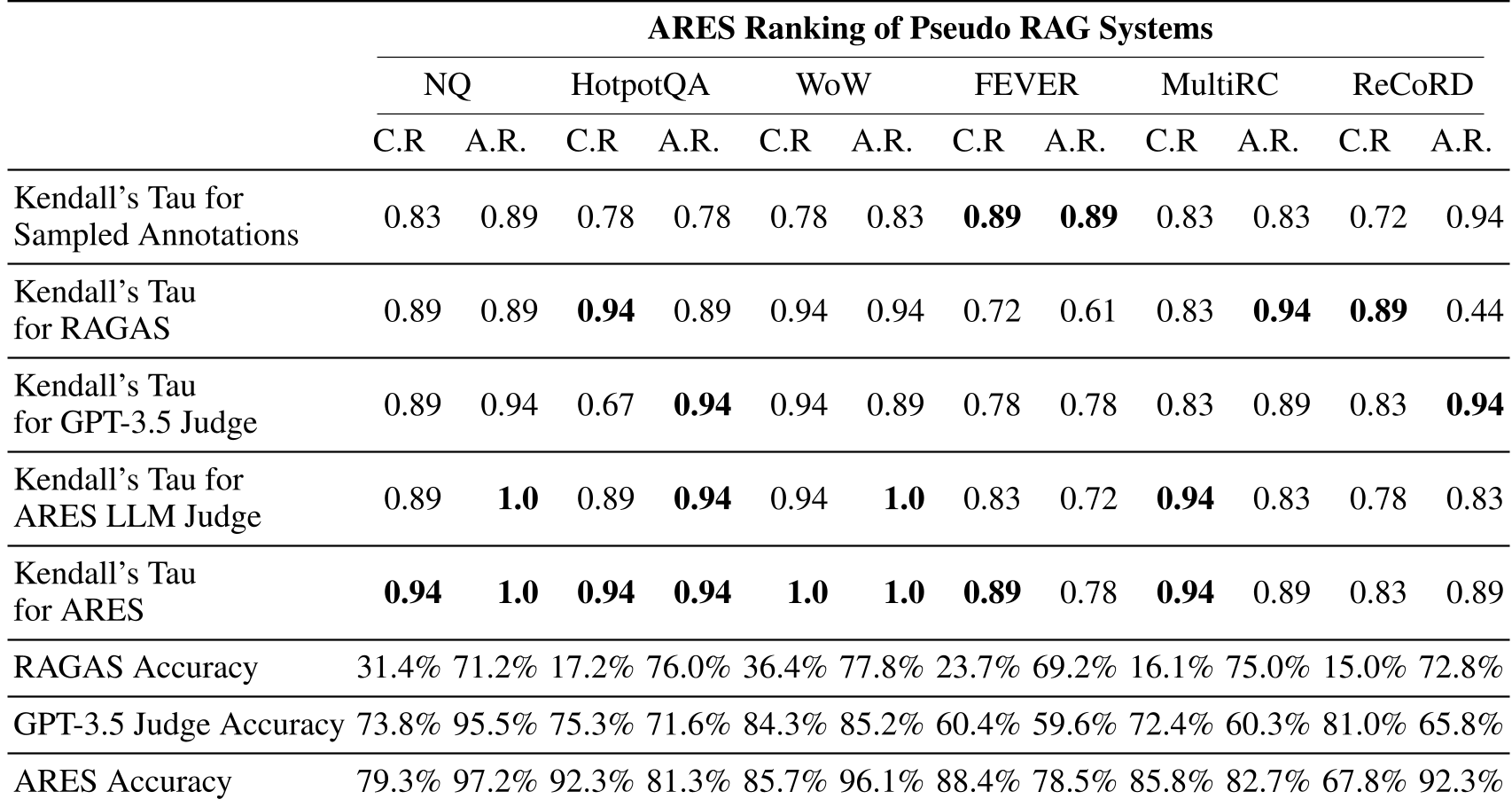
The researchers tested ARES against the KILT and SuperGLUE benchmarks, comparing it to RAGAS and GPT-3.5 judges.
- Ranking Precision: ARES consistently achieved a Kendall’s Tau of >0.90, meaning its ranking of which RAG system was "better" almost perfectly matched human judgment.
- Accuracy Leap: In context relevance tasks, ARES outperformed RAGAS by a staggering 59.9%.
- Data Efficiency: While traditional evaluation requires thousands of labels, ARES reached peak performance with only 150-300 human data points.
Deep Insight: Why PPI Matters
Most practitioners simply take an LLM's "Yes/No" score as truth. ARES acknowledges model fallibility. Through PPI, if the DeBERTa judge is consistently "over-optimistic" on a specific dataset, the rectifier function shifts the final score to compensate. This makes ARES robust even when the judge encounters Domain Shift (e.g., a judge trained on Wikipedia being used to evaluate News articles).
Conclusion & Limitations
ARES represents a shift toward principled automated evaluation. It proves that we don't need "larger" models to evaluate AI; we need "smarter" workflows that combine synthetic generation with classical statistical inference.
Limitations:
- Language: Current tests are limited to English.
- Domain Expertise: While ARES needs fewer labels, those labels still require high-quality human intervention, which might be costly in niche fields like Medicine or Law.
- Hardware: Fine-tuning the judges requires dedicated GPU resources (approx. 32GB VRAM).
ARES is a significant step toward making RAG systems production-ready by providing a "thermometer" that practitioners can actually trust.