
Argumentation Structures in Legal Dossiers: Beyond Simple Case Management
Argumentation structures in legal dossiers
This paper presents a systematic case study of a Dutch civil dispute to investigate how "Legal Argument Management Systems" (LAMS) should be designed. The authors analyze an entire legal dossier using the Araucaria software to map argumentation structures, focusing on the evolution of arguments over time and the strategic tactics employed by legal professionals.
TL;DR
This seminal paper moves away from the "computational inference" dream of early AI & Law and proposes a more pragmatic "Legal Argument Management System" (LAMS). By analyzing a Dutch civil case, the authors demonstrate how legal arguments evolve from private strategy to public litigation, advocating for tools that help lawyers navigate the complex web of claims, evidence, and tactics within a case dossier.
The Motivation: Escaping the Knowledge Engineering Bottleneck
For decades, AI and Law research focused on building "automated judges"—systems with heavy knowledge bases and inference engines. However, the knowledge engineering bottleneck (the sheer difficulty of formalizing every law and nuance) prevented these systems from reaching the desks of real lawyers.
The authors argue that legal professionals don't need a machine to tell them who wins; they need a system to help them maintain an overview of the chaotic narrative. Most current software treats a dossier as a folder of PDFs; it doesn't "understand" that Document A attacks a premise in Document B.
Methodology: Mapping the Anatomy of a Dispute
The authors performed a deep-dive analysis of a professional solicitor's dossier involving a ladder accident at a workplace. They used Araucaria, a tool designed for argument visualization, to map out the structure of the case across seven distinct phases.
Key Analytical Dimensions:
- Support and Attack Relations: Distinguishing between 'linked' arguments (where all premises must hold) and 'divergent' arguments (where one sufficient reason is provided).
- Argumentation Schemes: Identifying stereotypical patterns like Witness Testimony, Rule Application, and Analogy.
- Temporal Evolution: Tracking how the "tree" of arguments grows as parties respond to each other.
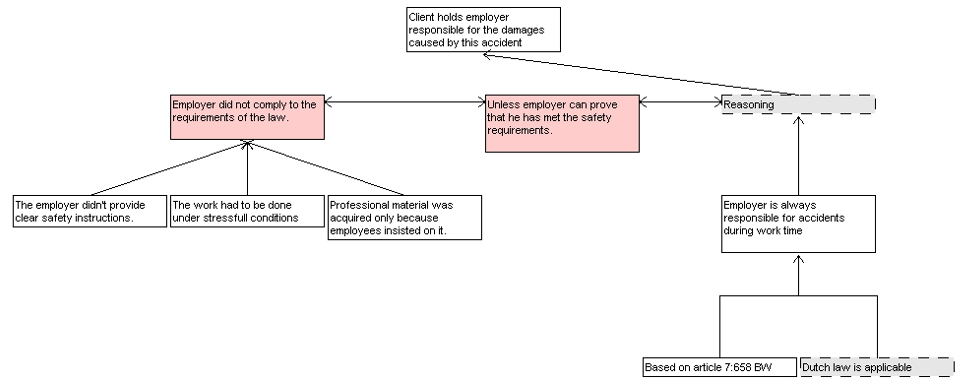 Figure 1: A visualization of the argumentation structure using Araucaria. Notice the use of implicit premises (dashed boxes) and the hierarchical support links.
Insights: Strategy and Silence
The study produced several "Aha!" moments regarding how law is actually practiced:
- Strategic Information Hiding: By comparing the lawyer's internal letter to the client with the external letter to the employer, the authors proved that lawyers intentionally withhold arguments. They keep "ammunition" for later stages so the opponent has less time to react—a dynamic a LAMS must be able to track.
- The Incrementality of Law: Arguments are rarely deleted or retracted; they are expanded. Lawyers prioritize stability in their positions to avoid looking weak to the judge.
- The "Case-Based" Core: Much of the dispute centered on two vague terms: "safe working situation" and "recklessness." To define these, both sides relied heavily on Analogy Schemes, comparing the current case to previous Supreme Court rulings.
Note: The paper highlights a stark difference in complexity between what a lawyer tells their client (full risk analysis) versus what they tell the court (selective advocacy).
Critical Analysis & The Future of LAMS
The authors conclude with a sobering but vital realization: Visualization is not enough. As cases grow, argument maps become "spaghetti charts" that are as hard to read as the original text.
The Takeaway for Future Tech:
- Beyond Pictures: Future systems should use the underlying logic (XML schemas/Ontologies) to enable Semantic Search. Imagine asking a system: "Show me all evidence that attacks the premise of 'employee recklessness' in this dossier."
- Collaborative Design: LAMS must support the "transfer costs" within a firm, allowing a new lawyer to get up to speed on a complex case in minutes rather than hours.
While this 2007 paper predates the LLM revolution, its focus on structure and strategy remains the blueprint for how AI might finally solve the legal "sensemaking" problem—not by replacing the lawyer's judgment, but by organizing the battlefield they operate on.