
ArnetMiner: Revolutionizing Academic Social Networks through Unified Probabilistic Modeling
ArnetMiner: Extraction and Mining of Academic Social Networks
This paper introduces ArnetMiner, a comprehensive system for academic social network extraction and mining. It utilizes a unified tagging approach for researcher profiling and proposes the Author-Conference-Topic (ACT) model to simultaneously analyze papers, authors, and venues, providing state-of-the-art expertise and association search services.
TL;DR
ArnetMiner is a pioneering system designed to extract and mine academic social networks automatically. By moving away from isolated data processing, it introduces a unified framework that combines CRF-based information extraction, HMRF-based name disambiguation, and novel Author-Conference-Topic (ACT) models. This holistic approach established a new benchmark for expertise search and researcher association discovery.
Problem & Motivation: The Silo Effect in Academic Data
Before ArnetMiner, academic search engines like Google Scholar or DBLP primarily functioned as digital libraries. They often suffered from two major flaws:
- Semantic Vacuity: Profiles were often incomplete or inconsistent because they relied on manual entry or simple heuristics.
- Fragmented Modeling: Information about authors, papers, and conferences was modeled separately. This meant the "hidden links"—such as how a specific conference influences an author's topic trajectory—were largely lost.
The authors' insight was simple yet powerful: the academic world is a unified network. To extract value from it, one must model the dependencies between entities directly.
Methodology: The Core Engine
ArnetMiner's architecture is built on three innovative pillars:
1. Unified Researcher Profiling (Extraction)
Instead of using ad-hoc rules, the system employs Conditional Random Fields (CRF) to tag web content. It treats researcher homepages as sequences, identifying positions, affiliations, and contact info by considering the global context of the page.
2. Name Disambiguation via HMRF (Integration)
One of the hardest problems in academic mining is distinguishing between two "John Smiths." ArnetMiner uses Hidden Markov Random Fields (HMRF) to integrate multiple relationships, such as:
- Co-authorship: Do these two candidates share collaborators?
- Venue Consistency: Do they publish in the same specialized conferences?
- Citation Links: Does paper A cite paper B?
3. The ACT Model (Modeling)
The "crown jewel" of the paper is the Author-Conference-Topic (ACT) model. The authors proposed three variants (ACT1, ACT2, and ACT3) to simulate how papers are written.
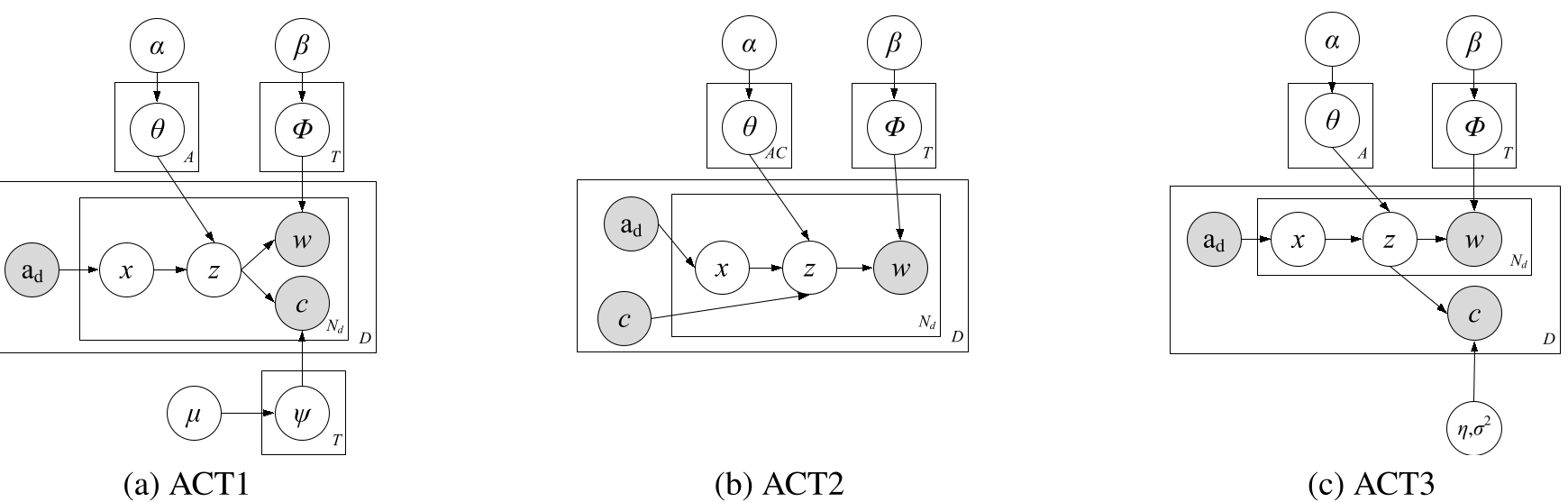
- ACT1: Every word in a paper is a sample from a distribution determined jointly by the authors and the conference venue.
- Physical Intuition: When specific authors target a specific conference, the resulting "topic" is a unique intersection of their expertise and the venue's scope.
Experiments & Results: Setting New SOTA
The researchers didn't just build a system; they proved its superiority through rigorous testing.
Expertise Search Performance
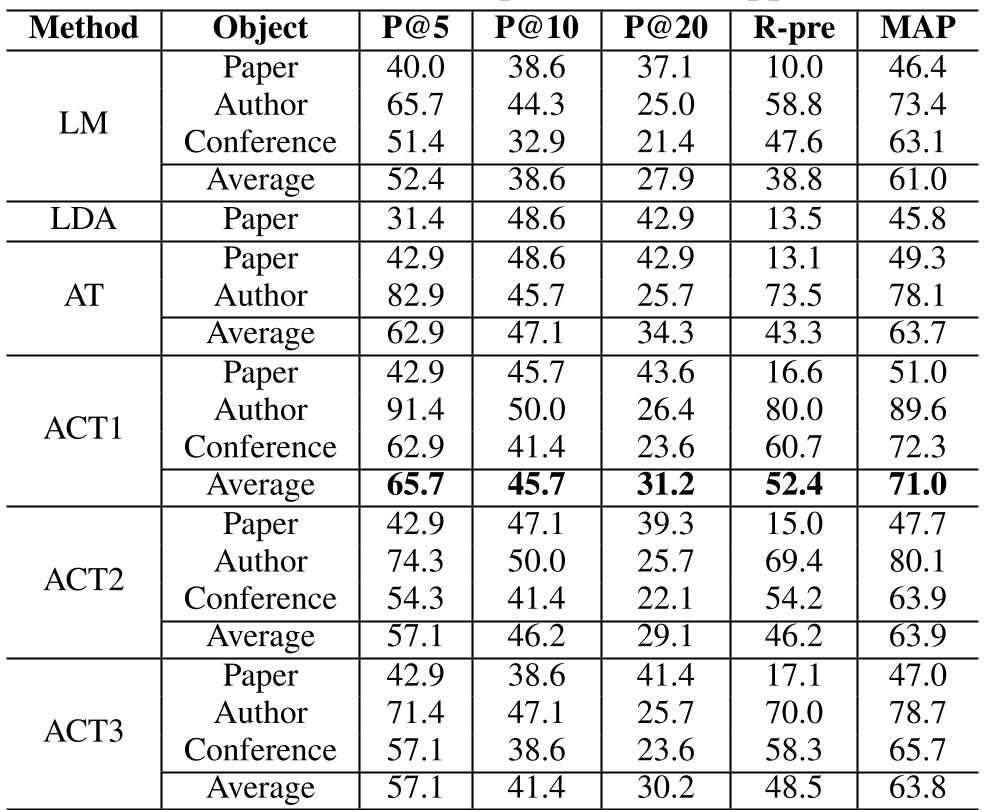
In the task of finding experts for specific queries (e.g., "Support Vector Machines"), ArnetMiner’s ACT1 model achieved a MAP of 71.0%, significantly outperforming the standard Language Model (LM) and Latent Dirichlet Allocation (LDA).
Feature Importance in Disambiguation
The ablation study for name disambiguation revealed that Co-authorship was the strongest indicator of identity, contributing to a 24.38% increase in F1-score when added to the base features.
Critical Analysis & Future Outlook
Takeaway
ArnetMiner demonstrated that holistic modeling—treating authors, venues, and papers as a tripartite graph—is far more effective than analyzing documents in isolation. It moved academic search from "keyword matching" to "semantic understanding."
Limitations
- Scalability of K: The number of actual persons () for a name must often be provided empirically, which is a bottleneck for fully autonomous systems.
- Dynamics: The 2008 model does not fully account for how an author's interests evolve over decades (temporal dynamics).
Future Directions
The authors suggested incorporating Link Mining (citation graphs) and Time Information into the topic models. Today, these ideas have evolved into Graph Neural Networks (GNNs) and Dynamic Embedding spaces, but the foundational principles of ArnetMiner remain central to modern scholarly search engines.
Editor’s Note: This work remains a classic in the field of Knowledge Discovery and Data Mining (KDD), serving as the technical bedrock for the modern AMiner.org platform.