
Arny: Bridging the "Affective Gap" in Human-AI Co-Creativity
Arny: A Study of a Co-creative Interaction Model Focused on Emotion Feedback
This paper introduces Arny, an AI-based co-creative drawing system that utilizes real-time facial expression analysis to modulate interaction dynamics. By integrating emotional feedback (valence and engagement) into the collaboration logic, the AI agent makes autonomous decisions to lead (diverge), follow (converge), or wait (pass) based on the human's perceived cognitive state.
TL;DR
Researchers have developed Arny, an AI drawing partner that "reads the room" by analyzing your facial expressions. Unlike most AI tools that wait for clicks or text prompts, Arny uses your emotional valence and engagement levels to decide whether it should mimic your style, push you toward a new idea, or simply give you space to work. The result is a more fluid, human-like creative partnership.
Background: When AI Lacks Social Intuition
In human-human collaboration, much of the negotiation happens through "consequential communication"—the subtle arch of an eyebrow, a frustrated sigh, or a lean Forward indicating engagement. Current co-creative AI systems are largely "deaf" to these signals. They typically rely on Functional Sense-making (what to draw next) but ignore Interactional Sense-making (how the interaction should evolve). This lack of social awareness often leads to a "break in flow," as users have to stop their creative work to manually rate or correct the AI's contributions.
Methodology: The Architecture of Empathy
The authors tackle this by introducing a dual-layered interaction model. Arny doesn't just process the drawing; it processes the creator.
1. Passive Feedback Loop
By using the Affectiva toolkit, Arny tracks facial landmarks to determine:
- Valence: Is the user feeling positive or negative about the last contribution?
- Engagement: Is the user focused and curious, or bored and distracted?
2. Convergence vs. Divergence
Using a Word2Vec model trained on Wikipedia, Arny calculates the semantic distance between objects. If the user draws a "laptop," a converging action might be a "keyboard" (high cosine similarity), while a diverging action might be a "printer" (lower similarity but still contextually relevant).
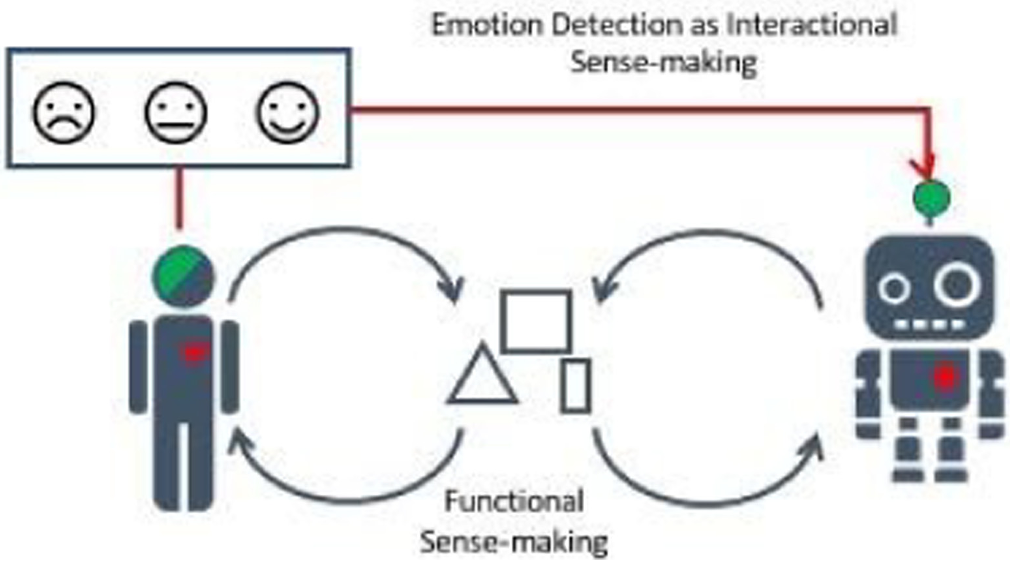 Figure 1: Comparison between standard functional collaboration and Arny’s interactional sense-making model.
3. The Decision Logic (Arny V2)
The system follows a sophisticated rule set (Table 2 in the paper) that dictates behavior:
- Positive + High Engagement: Arny converges to support the user's current flow.
- Positive + Low Engagement: Arny diverges to spark new interest and prevent boredom.
- Negative + High Engagement: Arny "passes" (does nothing) to give the user space to resolve their own dissatisfaction.
Experimental Insights: Does It Actually Feel Better?
The researchers conducted a Wizard of Oz study and a follow-up AI-driven study. The findings were stark:
- The "Human" Perception: Even though Arny was governed by simple rules, participants personified the agent. They used phrases like "Arny understood I didn't like that" or "It was giving me space."
- Inspiration vs. Annoyance: In the control group (where AI moves were random), users felt the AI was "annoying" and "irrelevant." In the emotional-feedback group, users reported that the AI provided timely ideation.
Figure 2: The interaction logic mapping valence and engagement to AI actions.
Critical Analysis: The Challenge of the "Stoic Face"
One of the most profound insights from the study was the "Stoic vs. Expressive" problem. Not everyone wears their heart on their sleeve. Participants with "stoic" faces provided fewer signals for the Affectiva toolkit, leading to missed opportunities for the AI to adapt. This highlights a critical limitation in affective computing: cultural and individual variance.
Conclusion & Future Work
Arny represents a shift from AI as a utility to AI as a partner. By prioritizing the "how" of interaction over just the "what," we can build systems that respect human creative flow. Future iterations will likely need to incorporate calibration phases to learn a specific user's facial baseline, ensuring that "resting stoic face" isn't mistaken for lack of engagement.
As we move further into the era of Generative AI, the "Arny" model suggests that the best tools won't just generate content—they'll know exactly when to step in and when to stay silent.