
The Party is Over: Decoding the Dynamics of Departure in Social Networks
Arrival and departure dynamics in social networks
This research investigates user arrival and departure dynamics in social networks using DBLP co-authorship and large-scale online social network (SN) data. It identifies that while arrival is driven by "join" viruses, departure is uniquely predicted by the fraction of inactive neighbors, leading to a "core-periphery" survival pattern.
TL;DR
Why do people leave social networks? This study reveals that social influence isn't just for joining; it significantly dictates leaving. Surprisingly, for seasoned users, the fraction of active friends matters more than the number. While the network's "fringe" tends to unravel, a dense core of active users often survives and even densifies, creating a resilient heart in a shifting ecosystem.
Problem & Motivation: The Asymmetry of Joining and Leaving
In the world of social computing, we are obsessed with growth—how "join" viruses spread and why groups form. However, what happens when the party starts to wind down? Historically, researchers treated "departure" as a random event or a simple reversal of adoption.
The authors argue that the decision to leave is fundamentally different from the decision to join. If you have 200 friends, losing 5 doesn't feel the same as having 5 friends join when you had none. The researchers set out to prove that departures are socially contagious and that the network's global topology changes in predictable, non-random ways as users tune out.
Methodology: The Local and Global Lens
The study utilizes two massive datasets: The DBLP co-authorship network (academic) and a major Online Social Network (SN).
1. Local Neighborhood Impact
The researchers tested four properties to predict departure:
- Raw count of active friends.
- Fraction of active friends.
- Raw count of inactive friends.
- Recent neighbor churn.
2. Global Structural Analysis
To see where the "holes" appear in the graph, they measured:
- Induced Density: The internal "tightness" of active vs. inactive subgraphs.
- Conductance: How well-connected a group is to the rest of the world.
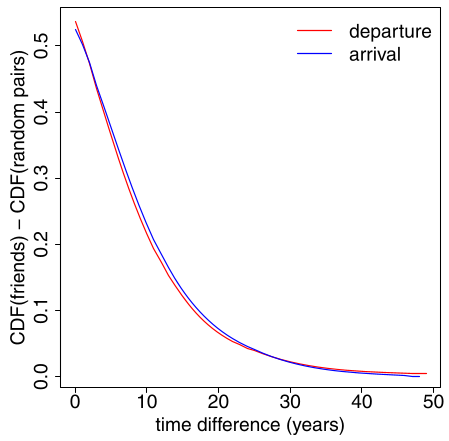 Figure 1: Comparison of temporal gaps between arrivals and departures for friends vs. random pairs.
Methodology Detail: The Linear Fraction Insight
The most striking finding is the "Step Function vs. Linear Decline." While joining follows a curve of diminishing returns (the first few friends matter most), leaving for established users is almost perfectly linear based on the fraction of active neighbors.
If 20% of your neighborhood leaves, your risk of departure increases by a set amount, whether you have 50 friends or 500. This suggests users stay for the "atmosphere"—when the neighborhood starts feeling like a ghost town, they move on.
Experiments & Results: Survival of the Core
The team found that departures are not distributed uniformly. They tend to happen at the "fringes"—regions of the graph with low connectivity.
Key Results:
- Prediction Accuracy: Using only neighborhood features, they could predict if a user would depart with ~70% accuracy; adding activity data bumped this to 75.5%.
- Densification Power: Despite users leaving, the core of active users actually becomes denser over time. This is validated by an extended Affiliation Network Model where preferential attachment and "copying" of interests keep the core alive even as the edges fray.
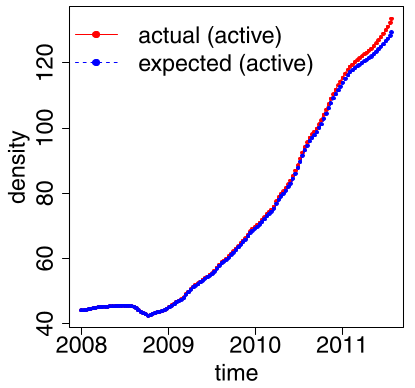 Figure 2: Distribution of edges, showing the ratio of actual vs. expected edges, highlighting how inactive nodes cluster together.
Critical Analysis & Conclusion
Takeaway
The study proves that "Inactivity is Contagious." However, the contagion isn't global; it's proportional within one's local neighborhood. For platforms, this means that losing a "bridge" user who connects many disparate groups is far more dangerous than losing a high-degree user whose remaining friends are all still active.
Limitations
- Visibility: In SN, "inactivity" is often silent. Unlike a phone network where a number is disconnected, online inactivity might not be immediateley visible to friends, potentially lagging the social influence effect.
- Exogenous Factors: The study cannot fully decouple social influence from external shocks (e.g., the launch of a competitor).
Future Outlook
This work lays the foundation for "Churn-Resistant" network design. By understanding that departure spreads from the fringes, developers can design interventions to stabilize small, tight-knit communities before the "neighborhood atmosphere" hits the critical tipping point of perceived emptiness.