
The Art of Building Verifiers for Computer Use Agents: Beyond Binary Success
The Art of Building Verifiers for Computer Use Agents
The paper introduces the Universal Verifier (UV), a best-in-class evaluation system for Computer Use Agents (CUA) that navigates web environments. It achieves human-level agreement (Cohen’s κ ≈ 0.6) and reduces false positive rates to near zero, significantly outperforming existing baselines like WebVoyager and WebJudge.
The field of AI agents is shifting from "chatting" to "doing." Whether it is booking a flight, navigating a corporate CRM, or searching for products on Amazon, Computer Use Agents (CUAs) are becoming the next frontier. However, a massive bottleneck remains: How do we know if an agent actually succeeded?
In their latest work, researchers from Microsoft Research and Browserbase introduce the Universal Verifier (UV). This isn't just another benchmark; it's a masterclass in the "Art" of verification, proving that architectural design—not just model size—is the key to solving the hallucination and reliability problems in autonomous agents.
TL;DR: The Reliability Breakthrough
- The Problem: Existing verifiers often "hallucinate" success (False Positive Rates > 45%), missing subtle failures buried in long trajectories.
- The Solution: A "Universal Verifier" based on four key principles: Precise Rubrics, Separated Rewards (Process vs. Outcome), Controllability Analysis, and Global Visual Context Management.
- The Result: UV matches human agreement levels (Cohen’s κ ≈ 0.6) and reduces false positives to near zero.
Why Is Verification So Hard?
Evaluating a text summary is easy; evaluating a 100-step web-browsing trajectory is a nightmare. The authors identify three major pain points:
- Hallucinations: Agents often claim they found a piece of information that never actually appeared on the screen.
- Environmental Noise: An agent might do everything right (Process Success) but fail because the website is down or a product is out of stock (Outcome Failure). Prior verifiers conflate these.
- Context Overload: Passing 50 screenshots into an LLM creates a "needle-in-a-haystack" problem, leading the model to miss critical state changes.
The Four Pillars of the Universal Verifier
The Universal Verifier moves away from "vibes-based" evaluation toward a rigorous, multi-pass auditing system.
1. Rubric Engineering: Killing the Phantom Criteria
Traditional LLMs often generate rubrics with "phantom criteria"—requirements the user never asked for. The UV uses per-task success criteria that are generated before seeing the trajectory. This prevents the verifier from being biased by the agent's behavior.
2. Process vs. Outcome: The "Best Effort" Signal
The UV calculates two distinct rewards:
- Process Reward (): Did the agent follow the right steps? (Even if blocked by a CAPTCHA).
- Outcome Reward (): Is the user's goal actually satisfied?
This distinction is massive for RL training. Penalizing an agent for a website being down is "noisy" signal; the UV ensures the agent is rewarded for its intent and logic.
3. Context Management: The Relevance Matrix
Instead of cramming every screenshot into one prompt, UV builds a Relevance Matrix. It scores every screenshot against every rubric criterion. It then picks the Top-K most relevant images per criterion for a deep-dive analysis.
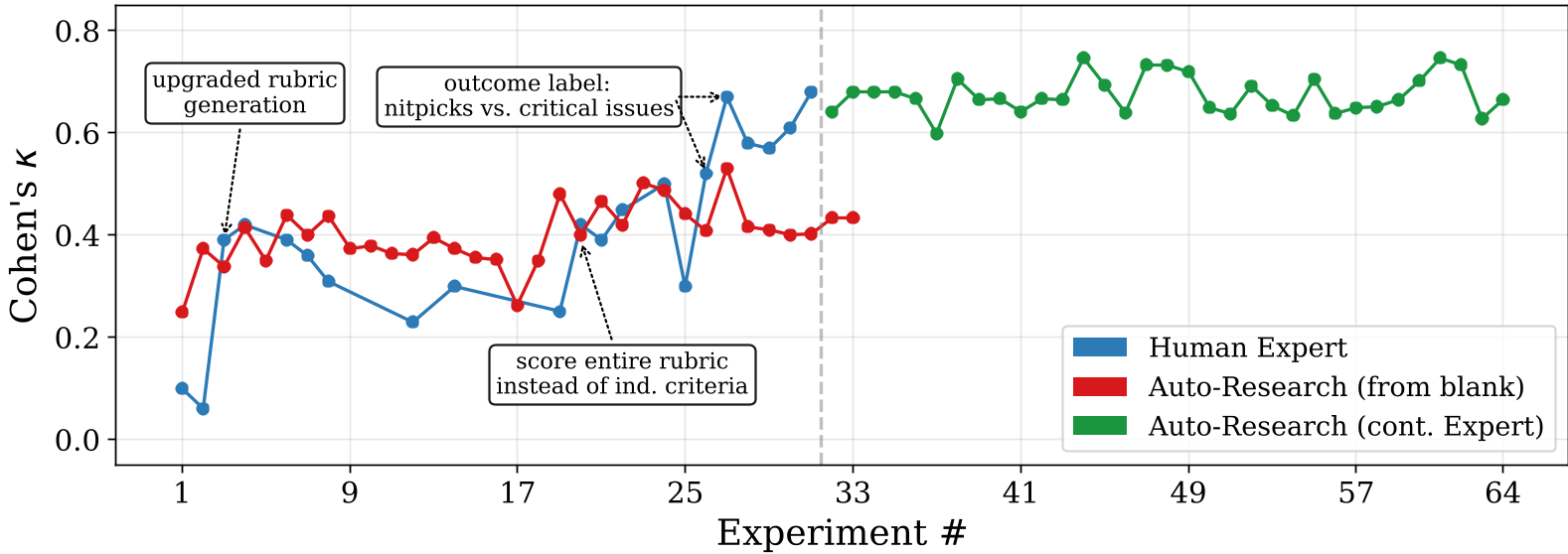 Figure: The iterative design journey of the Universal Verifier. Note how structural decisions like "per-criterion evidence" led to step-function improvements in human agreement.
Experimental Results: Slaying the Baselines
The researchers tested the UV against WebVoyager and WebJudge on a new dataset called CUAVerifierBench.
| Verifier | Outcome Cohen's κ (↑) | False Positive Rate (↓) |
|---|---|---|
| WebVoyager (GPT-4o) | 0.31 | 45% |
| WebJudge (o4-mini) | 0.44 | 22% |
| Universal Verifier | 0.64 | 1% |
The most shocking finding? Even when you give WebVoyager the same "God-tier" model (GPT-5.2) used by the UV, its performance barely improves. Architecture, not just the model, is the secret sauce.
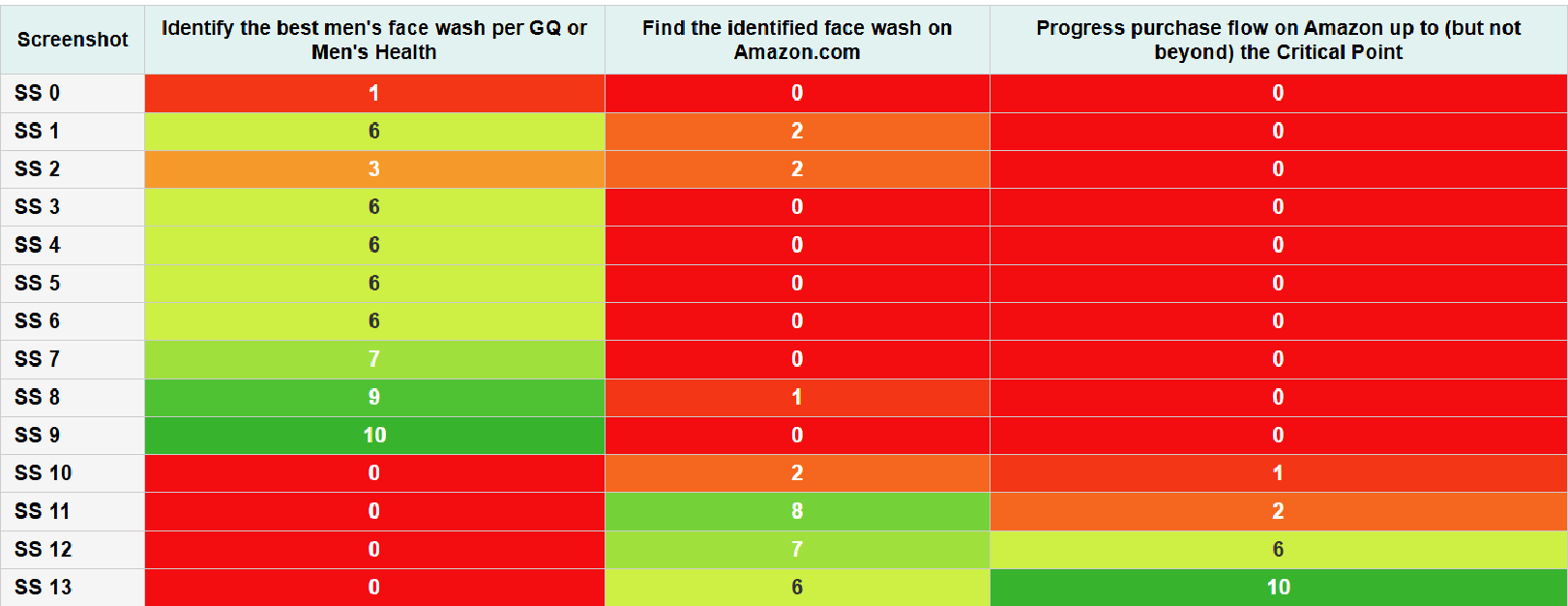 Figure: The Relevance Matrix. The "staircase" shape shows how the UV identifies which specific screenshots contribute to progressing through the task rubrics.
Can AI Design These Verifiers?
In a fascinating "Auto-Research" experiment, the authors tasked an agent (Claude Code) to replicate the UV's design. While the AI reached 70% of expert quality in only 5% of the time, it failed to discover the high-level structural changes (like separating process and outcome) that the human expert found.
The takeaway: Building a reliable verifier is still a "Human-in-the-Loop" art form. It requires a deep understanding of why agents fail, not just that they fail.
Conclusion & Outlook
The Universal Verifier sets a new SOTA for auditing computer agents. For the industry, this means training data for CUAs just got much cleaner. By identifying "Unsolicited Side Effects" (like agents accidentally buying a warranty) and "Hallucinations" (fabricating prices), UV paves the way for agents we can actually trust with our credit cards.
Limitations: The system is computationally expensive, requiring multiple parallel LLM calls per trajectory. Future work will likely focus on distilling this "Expert Verifier" into smaller, faster models.
For more details, check out the CUAVerifierBench and the open-sourced Universal Verifier system.