
ARTA: Orchestrating the Marketplace for Energy and Computing Resources
ARTA: An economic middleware to exchange pervasive energy and computing resources
This paper introduces ARTA (Agent-oriented Resource Trading Architecture), an economic middleware designed to integrate Smart Grid and Cloud Computing ecosystems. By utilizing a multi-agent system, ARTA enables the peer-to-peer exchange of energy and computing resources across a layered hierarchy, achieving high efficiency in localized "prosumer" networks.
TL;DR
As the frontiers of Smart Grids and Cloud Computing converge, the industry faces a critical challenge: how to trade resources as different as Kilowatts and FLOPS? ARTA (Agent-oriented Resource Trading Architecture) is an economic middleware that treats both as tradability assets. It uses a semi-decentralized multi-agent system to allow local "prosumers" to negotiate energy and compute trades, even using Bitcoin to "bank" excess green energy that would otherwise be wasted.
Background: The Convergence of Two Giants
Energy efficiency in ICT is no longer just about low-power chips; it is about energy source awareness. Simultaneously, Smart Grids require massive ICT infrastructure for control and communication. ARTA positions itself as the glue between these two domains, operating within the "Cloud of Energy" (CoE) framework to transform everything—from a neighbor's solar panel output to a data center's spare CPU cycles—into a unified, exchangeable service.
The Problem: Perishability and Uncertainty
Why is this difficult? Unlike physical goods, computing and energy are perishable. An idle CPU today cannot "save" its performance for tomorrow. Furthermore, edge environments are chaotic; prosumers join and leave at will, and renewable energy sources like wind and solar are inherently intermittent. Traditional centralized markets are too slow and rigid to handle this high-frequency volatility.
Methodology: The ARTA Middleware
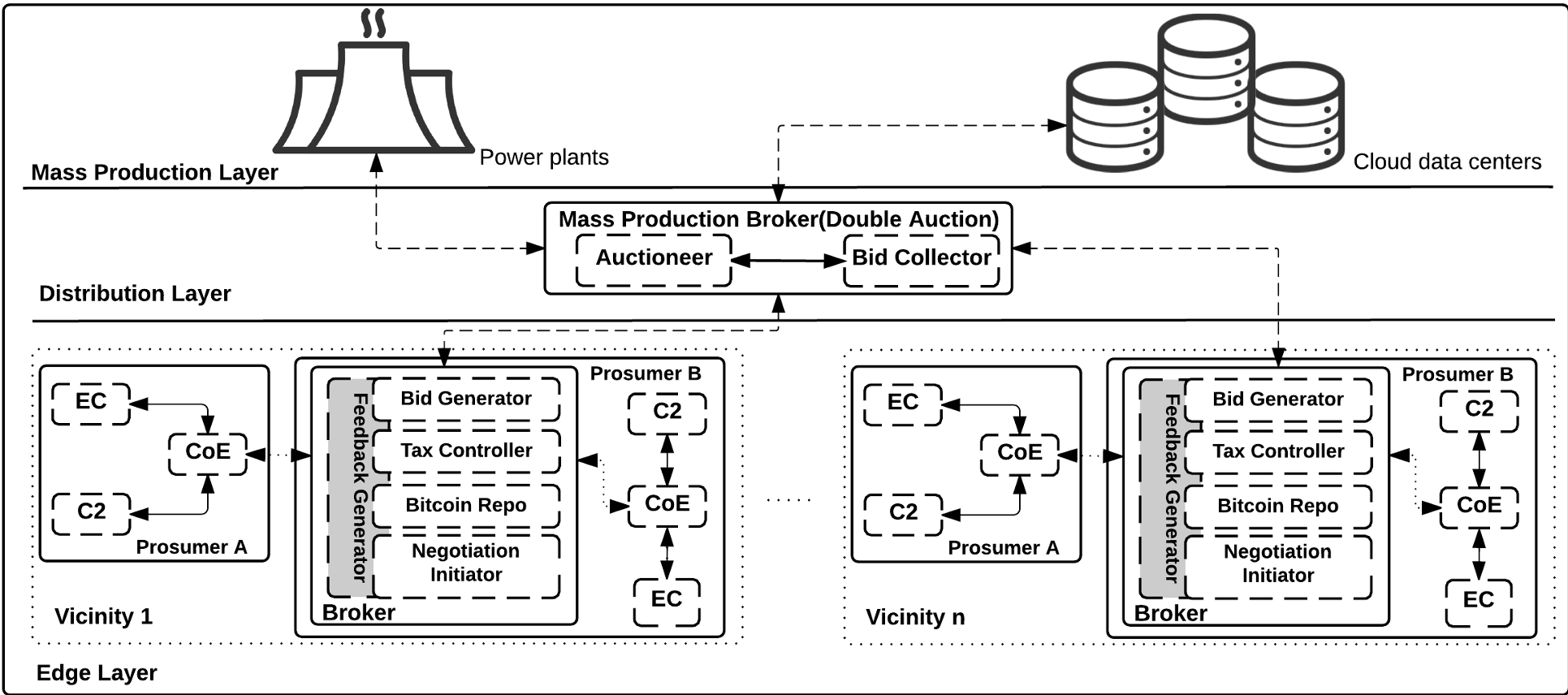
ARTA solves this through a layered, agent-oriented architecture. Every participant (a household with solar panels, a small office with a server) is an Autonomous Agent.
1. Horizontal Negotiation (P2P Edge)
In a local vicinity, agents engage in direct peer-to-peer negotiation. ARTA uses a sophisticated pricing formula that considers:
- Service Deadlines: Convergence to a "reserved price" accelerates as the deadline nears.
- System Dynamics (): A feedback loop that informs agents how stable the network is.
- Market Perception: Agents adjust their bids based on partial views of their competitors' behaviors.
2. The "Bitcoin" Reservoir
One of ARTA's most innovative features is its handling of idle resources. If local supply exceeds demand and the energy is "green," the system assigns agents to mine Bitcoin. This effectively converts physical, perishable energy into a digital, non-perishable currency that the local broker can later use to purchase "mass-market" energy during shortages.
3. Vertical Auction
For transactions that cannot be settled locally, ARTA switches to a Sealed-Price Double Auction. This connects the local edge layer to mass producers (giant power plants and mega data centers), ensuring scalability and integration with legacy utility models.
Experimental Insights
The researchers tested ARTA in vicinities ranging from 0 to 500 nodes.
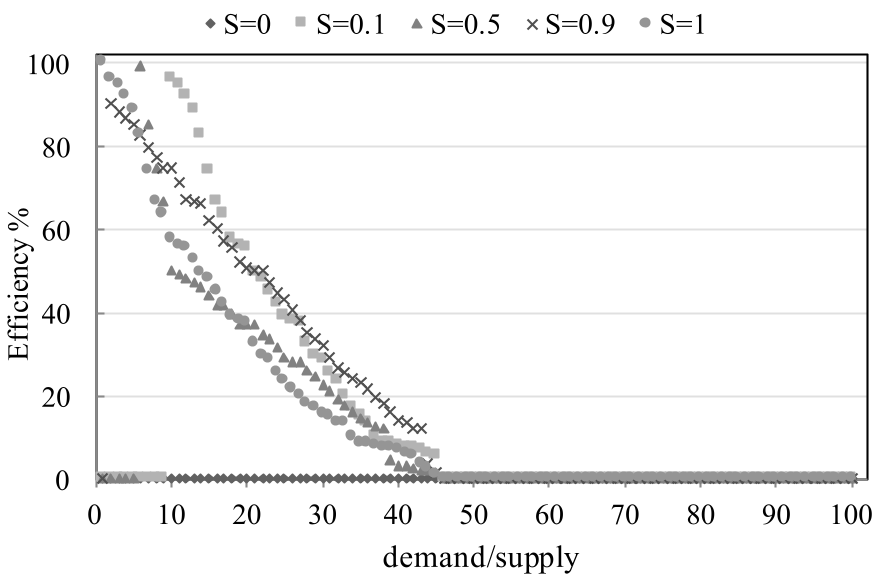
- Efficiency: The system excels when the market is balanced. With a demand-to-supply ratio of 10-45%, the negotiation success rate consistently stays above 90%.
- Overhead Control: Using a gossip protocol based on information entropy, ARTA only updates agents when the system state changes significantly. This keeps communication overhead linear and manageable—below 20% for a standard 100-node vicinity.
Critical Analysis & Conclusion
ARTA represents a significant shift from "centralized control" to "economic orchestration." By allowing agents to make decisions based on partial system views, it mirrors the real-world complexity of the Internet of Things (IoT).
Limitations: The reliance on Bitcoin mining as a value-storage mechanism, while clever, may face criticisms regarding the energy intensity of Proof-of-Work, though the authors specify its use for otherwise wasted green energy.
Future Outlook: The next step for this technology is Dynamic Vicinity Sizing. By automatically shrinking or expanding the local market size based on demand volatility, ARTA could further minimize "static power dissipation," paving the way for a truly self-organizing, green ICT-Energy ecosystem.