
Beyond Logic: Using Artificial Emotions for High-Performance Multi-Robot Coordination
A model of artificial emotions for behavior-modulation and implicit coordination in multi-robot systems
This paper introduces a bio-inspired unified control architecture that utilizes artificial emotions as compressed representations of a robot's internal state. These emotions serve two primary functions: modulating individual robot behavior and facilitating implicit social coordination through low-bandwidth information sharing, achieving SOTA-like efficiency in complex multi-robot glassneck scenarios.
TL;DR
Researchers have developed a control architecture where robots "feel" and "express" emotions like fear and frustration to solve navigation deadlocks. Unlike traditional complex communication, these robots share their emotional state as a compressed data packet, allowing the swarm to adapt to urgent tasks and sensor failures with up to a 54% boost in efficiency.
Academic Positioning: This work bridges Affective Computing and Swarm Robotics, transforming emotions from "human-interaction gimmicks" into functional, high-level control signals for implicit coordination.
Problem & Motivation: The Coordination Bottleneck
In dense multi-robot environments (like warehouses or emergency response), robots often suffer from "socially unaware" collisions or "deadlocks"—where everyone waits for everyone else.
Existing solutions are usually:
- Centralized: Too slow and fragile.
- Ad-hoc: Hardcoded rules (e.g., "If Battery < 10%, Go home") that don't scale.
- Heavy: Requiring high-bandwidth communication of raw sensor data.
The authors' insight? Emotions in animals are nature's compression algorithm. A dog's growl communicates a complex internal state (threat detection, territoriality, readiness to act) instantly. Why not give robots a similar "universal vocabulary"?
Methodology: From Micro-states to Macro-Emotions
The architecture operates on a three-tier hierarchy: Internal State → Emotional Macro-state → Behavior Modulation.
1. The Emotion Dynamics
The system tracks "micro-states" (e.g., progress toward goal, free space, neighbor frustration). These are compressed into four "Active Emotions":
- Fear: Triggered by lack of space. Result: Robot slows down and expands its sensing Field of View (FoV).
- Frustration: Triggered by lack of progress. Result: Triggers an "Escape" behavior to break deadlocks.
- Urgency: Triggered by time-critical deadlines. Result: Follows straighter paths; neighbors give way.
- Confusion: Triggered by high rotational noise. Result: Signals neighbors to provide "sensing help."
2. The Architecture
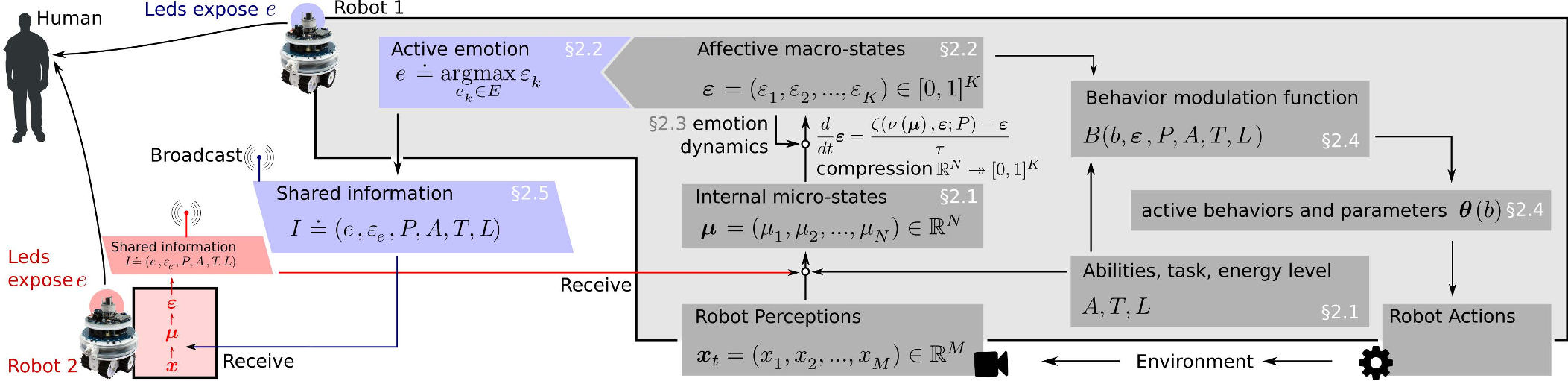 Figure 1: The flow from sensory input to emotional dynamics. Note how the "Personality" (P) acts as a filter on how quickly an agent gets "frustrated" or "fearful."
Experimental Results: Breaking the Deadlock
The authors tested the model using marXbot robots in challenging scenarios.
1. The Circle of Deadlocks
In a scenario where robots must cross a central point, a "baseline" swarm collapses into a permanent cluster at 30+ robots. With emotion-based modulation, the swarm handles 100 robots gracefully. Fearful robots perceive "frustration" in others and proactively slow down to let the cluster unravel.
2. Priority for Urgent Tasks
When some robots have "Urgency" due to deadlines, the swarm treats them like an ambulance. Neighbors perceive the urgency signal and increase their Social Margin, moving out of the way.
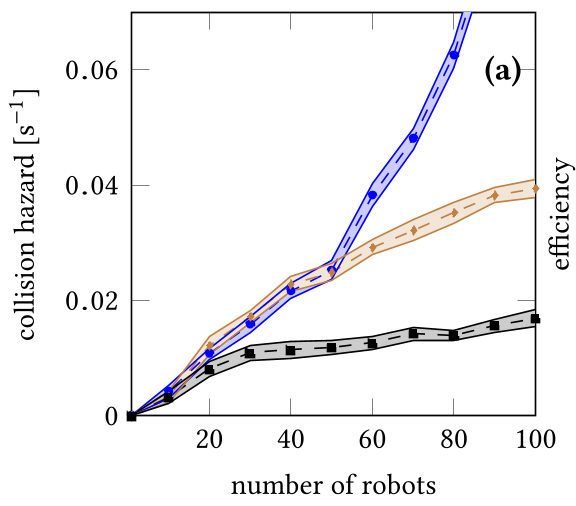 Figure 2: Performance metrics across three scenarios. The "Modulation & Communication" approach (green) consistently outperforms the baseline (blue).
Critical Analysis & Conclusion
Takeaway
The beauty of this model lies in its minimalism. It doesn't require robots to send their coordinates or plans; it only requires them to show their "current mood." This drastically reduces the complexity of multi-agent collision avoidance while making the robots' behavior more predictable and "legible" to humans.
Limitations
- Parameter Sensitivity: While the "winner-takes-all" strategy for active emotions adds robustness, the scaling factors () for micro-states still require domain knowledge.
- Homogeneity: The study assumes cooperative agents. In a competitive or adversarial setting, "faking" an urgency emotion could be a vector for selfish behavior.
Future Work
The next frontier is extending this to Human-Robot Interaction (HRI). If a robot turns red and looks "fearful" as a human approaches a dangerous area, the human can intuitively react without needing to read a status screen.
Main reference: Jérôme Guzzi, Alessandro Giusti, et al. "A Model of Artificial Emotions for Behavior-Modulation and Implicit Coordination in Multi-robot Systems," GECCO '18.