
To Centralise or Not? The Dilemma of Global AI Governance
Should Artificial Intelligence Governance be Centralised?: Design Lessons from History
This paper evaluates the historical trade-offs between centralized and fragmented international governance architectures to determine the optimal structure for AI oversight. It proposes a monitoring framework focused on conflict, coordination, and catalytic action to assess whether current nascent regimes (OECD, UN, G7) can effectively manage AI risks without a single global authority.
Executive Summary
TL;DR: As AI capabilities accelerate, policymakers face a critical structural choice: create a single "World AI Organization" or allow a decentralized patchwork of agencies to evolve. Drawing from decades of multilateral history in trade and environmental law, this paper argues that while centralization offers efficiency and power, a poorly designed global body could become a "brittle dinosaur" that stifles innovation and fails to respond to rapid technological shifts.
Background: Positioned at the intersection of international relations and technology policy, this work provides a foundational framework for evaluating current initiatives like the OECD AI Policy Observatory and the UN's various digital cooperation panels.
The Core Tension: Power vs. Agility
The central motivation behind this research is the "pacing problem." International law is notoriously slow—the Uruguay round of trade negotiations took nearly eight years. AI, conversely, evolves in months.
The authors identify a fundamental trade-off:
- Centralization creates a "linchpin" that prevents "forum shopping" (where states pick weak venues to avoid rules).
- Fragmentation allows for experimentation and "polycentric" resilience, where a failure in one area doesn't collapse the entire governance system.
Methodology: Lessons from the Rearview Mirror
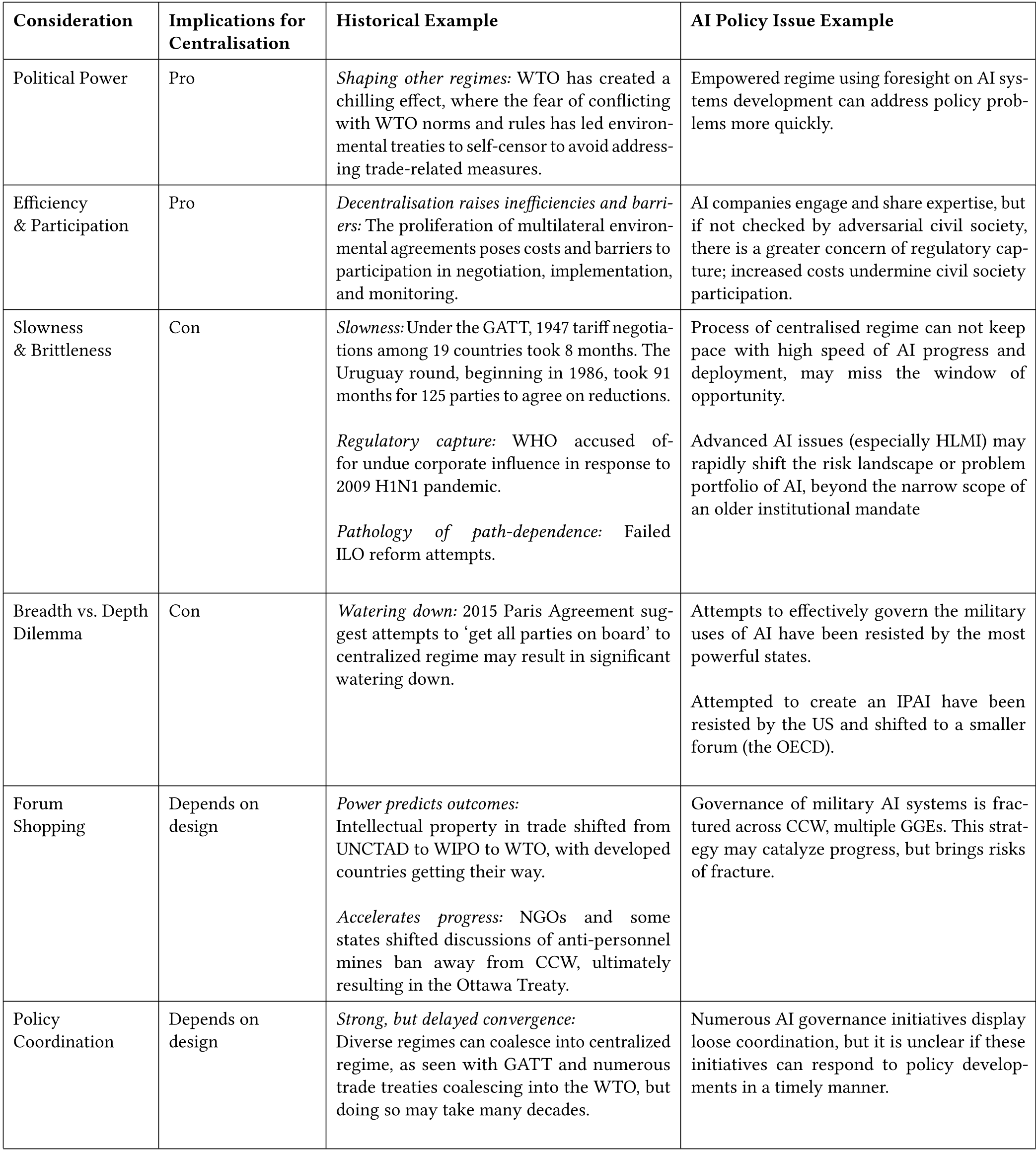
The paper utilizes a comparative historical lens to analyze six criteria: Political Power, Efficiency, Slowness/Brittleness, the Breadth vs. Depth Dilemma, Forum Shopping, and Policy Coordination.
The WTO vs. The Environment
A key insight is the "Chilling Effect". In trade, the WTO is so centralized and powerful that environmental treaties often self-censor their language to avoid conflicting with WTO trade rules. For AI, a centralized body could similarly force specialized domains (like health or military AI) to align under a single set of norms, but at the risk of ignoring sector-specific nuances.
Navigating the "Breadth vs. Depth" Trap
One of the most profound challenges identified is the Breadth vs. Depth Dilemma. To get every superpower (US, China, EU) to join a centralized body (Breadth), the rules usually have to be watered down until they are toothless. If the rules are made strict and meaningful (Depth), the leading AI powers are likely to opt-out.
The authors suggest a "critical mass" approach: instead of one massive treaty, we might need modular agreements that allow smaller groups of "like-minded" nations to move forward on high-risk issues like Lethal Autonomous Weapons (LAWS).
Monitoring: The Path Forward
Instead of rushing into a global AI constitution, the authors propose a structured monitoring framework to see if the current "fragmented" landscape is self-organizing effectively.

The methodology for this monitoring is surprisingly technical, suggesting the use of:
- Network Analysis: To map which organizations are actually coordinating.
- Natural Language Processing (NLP): To detect "contradictions" in AI principles issued by different nations or bodies.
Critical Insight & Conclusion
The paper’s ultimate takeaway is a warning: lock-in is dangerous. In the history of the ILO and the UN, once an institution is built, it is nearly impossible to reform. If we build a centralized AI regulator based on today’s Large Language Models (LLMs), it may be completely useless for governing tomorrow's High-Level Machine Intelligence (HLMI).
Future Outlook: For now, the world will remain fragmented. The challenge for 2026 and beyond is not necessarily to build a single giant agency, but to ensure that the many small agencies talking to each other are "self-organizing" rather than just creating "treaty congestion."