
Uncertainty, Not Gossip: How Scale-Free Social Networks Truly Emerge
Networks of Artificial Social Interactions
This paper explores the emergence of scale-free social interaction networks within agent-based simulations of the evolution of cooperation. Utilizing uncertain Prisoner’s Dilemma games, the author demonstrates that realistic scale-free structures can emerge naturally from environmental uncertainty rather than explicit encoding like preferential attachment.
TL;DR
Why do human social networks—from sexual partners to mobile phone logs—consistently follow a "scale-free" pattern where a few hubs have many connections and most have few? This paper by Peter Andras reveals that we don't need complex social traits like "gossip" or "memory" to build these structures. Instead, high environmental uncertainty in cooperation games is the primary engine that drives agents into forming realistic, scale-free interaction networks.
Background: Beyond Static Graphs
In the study of socio-biology, researchers have long known that cooperation is influenced by who you talk to. However, most simulations "cheat" by hardcoding the network: they either make everyone talk to everyone or place agents on a pre-designed grid. This paper takes a "bottom-up" approach, asking: If we just let agents move and play games under pressure, what kind of social map will they draw for themselves?
The Core Insight: Uncertainty as a Catalyst
The author posits that the "Small World" and "Scale-Free" features of human society aren't just accidents of history—they are functional responses to uncertainty.
In the simulation, uncertainty is modeled by replacing fixed rewards in a Prisoner's Dilemma with payoff distributions. When the variance (uncertainty) is high, the stakes of every interaction shift. This environmental pressure forces a structural change in how agents find and keep partners, leading to the emergence of "hubs" without any explicit "preferential attachment" rule being programmed into the code.
Methodology: The Simulation Setup
The study utilizes a rectangular world where agents:
- Interact: Play a one-shot uncertain Prisoner's Dilemma with neighbors.
- Move: Wander randomly across warped edges.
- Reproduce: Generate offspring based on accumulated wealth (resources).
- Communicate: Some scenarios allow agents to remember the last 10 partners or "gossip" about them to others.
Mathematizing the Network
To verify if the resulting networks were truly scale-free, the author used a power-law probability density function: By calculating the exponent and using Kolmogorov-Smirnov tests, the research identifies which conditions yield a "natural" social network.
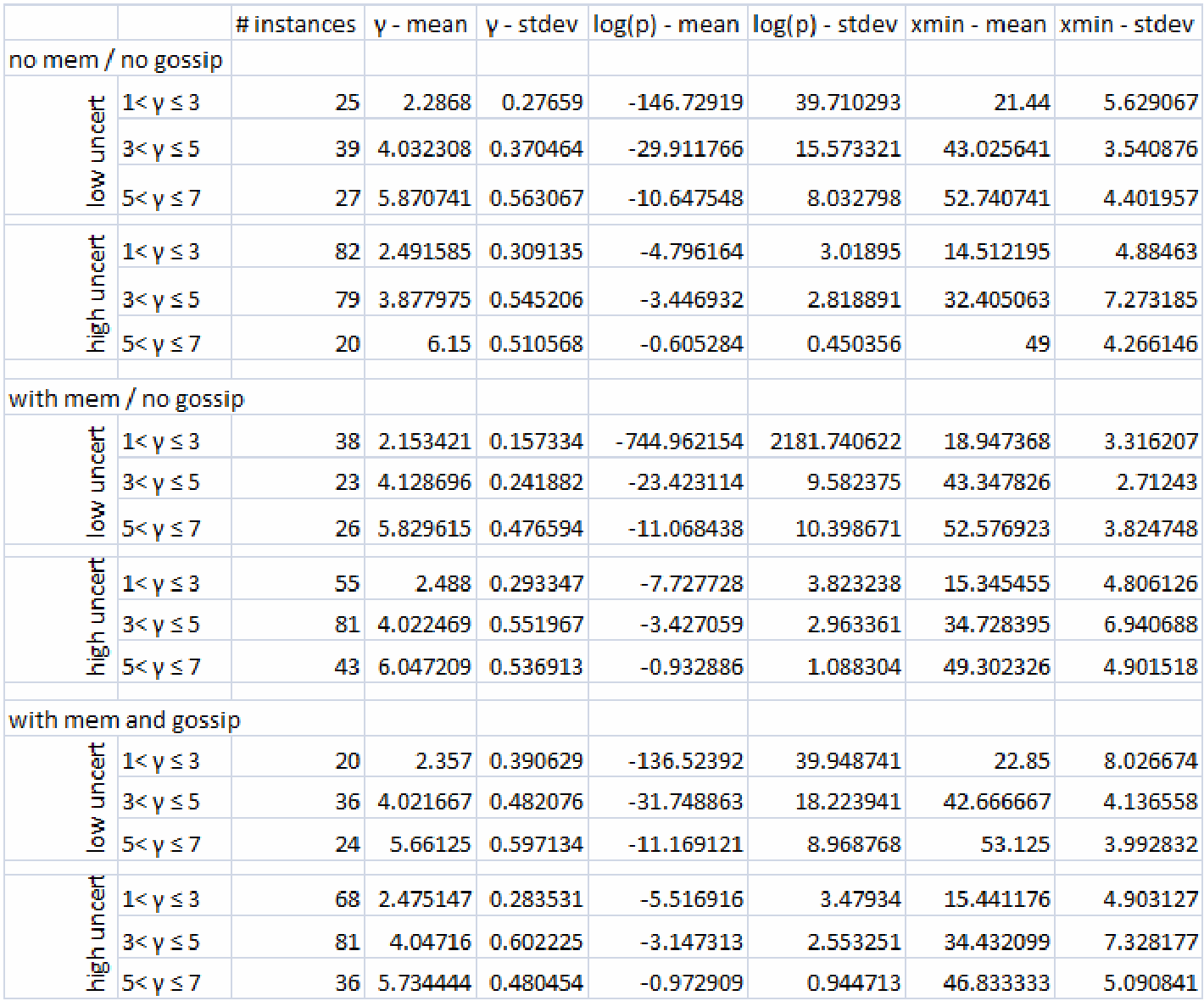 Table 1: The data shows that high uncertainty consistently leads to better fit (higher p-values) for power-law distributions across all memory/gossip settings.
Key Findings: The "Gossip" Myth
The most striking discovery is what didn't matter. We often assume that human social complexity—our ability to remember faces or spread rumors—is what makes our societies so intricately networked.
- Memory & Gossip: Adding these features had no significant effect on the scale-free nature of the networks.
- Uncertainty: This was the "make or break" factor. Under low uncertainty, the networks failed to show robust scale-free properties. Under high uncertainty, the power-law distribution emerged naturally.
Deep Insight & Conclusion
This work challenges the "Preferential Attachment" orthodoxy. It suggests that "the rich get richer" (in terms of social connections) might not be a goal-oriented social strategy, but a mathematical necessity for survival in a high-risk, uncertain environment.
Limitations & Future Work
While the model is elegant, the agents' movements remain "random." In real-world scenarios, agents choose where to go based on social utility. Future research could investigate if non-random movement combined with uncertainty accelerates the formation of scale-free hubs or leads to different topological structures altogether.
The Takeaway: If you want to understand why a social system is structured a certain way, look at the "noise" and "risk" in their environment before you look at their communication technology.