
From Artificial To Collective Intelligence: The A'B'C'D' Evolution of AI
From artificial to collective intelligence: Perspectives and implications
This paper explores the paradigm shift in Artificial Intelligence from individual computation to group-based intelligence, categorized as the "A'B'C'D' of AI" (Artificial, Built-in, Collective, and Derived). It highlights how Collective Intelligence (CI) fuels Web 2.0 and provides new Agent-Based Modeling (ABM) methodologies for social science research.
TL;DR
This paper provides a high-level philosophical and technical retrospective on the evolution of AI. It argues that we have moved from trying to build "Artificial" individuals to leveraging "Collective" and "Derived" intelligence. By analyzing Agent-Based Models (ABM) and the architecture of Web 2.0, the authors reveal how local interactions drive global emergence in both digital and social systems.
Executive Summary
Since its inception in 1956, Artificial Intelligence has oscillated between "Acting Humanly" (Symbolic AI) and "Thinking Humanly" (Cognitive Modeling). However, Singh and Gupta argue that the most significant leap occurred when AI shifted its focus to situatedness and collectivity. This journey is summarized as the A'B'C'D' of AI:
- Artificial: Replicating human functions.
- Built-in: Intelligence within autonomous agents (situatedness).
- Collective: Emergent intelligence from group interactions (Swarm Intelligence).
- Derived: Extracting knowledge from big data and user behaviors via mining.
The Core Motivation: Beyond the "Chinese Room"
Early AI suffered from a lack of ecological validity. As John Searle’s Chinese Room Argument famously pointed out, a system can exhibit behavior without true understanding. The authors emphasize that "situatedness"—the ability of an agent to perceive and act within an environment—is the bridge to true intelligence. This led to the rise of Intelligent Agents, which are the building blocks of both complex optimization algorithms and the modern social Web.
Methodology: Harnessing Collective and Derived Intelligence
1. Web 2.0 as a Collective Knowledge System
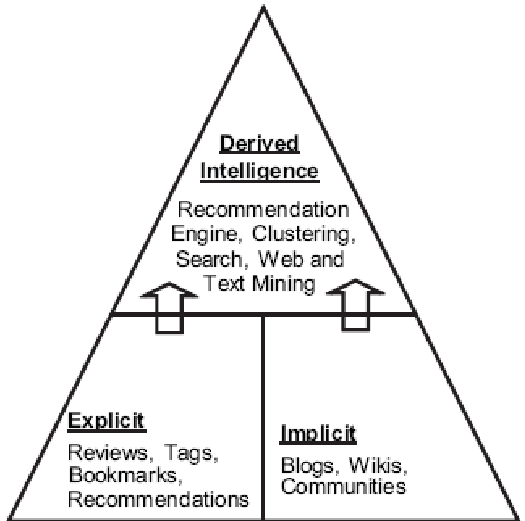
The paper categorizes intelligence on the Web into three streams:
- Explicit: Direct user input (tags, reviews).
- Implicit: Unstructured contributions (blogs, forum posts).
- Derived: Predictive analysis of user logs (e.g., "Users who bought this also bought...").
2. Social Simulation via Agent-Based Modeling (ABM)
Unlike traditional equation-based models that look at macro-statistics (top-down), ABM uses a bottom-up constructive approach. It simulates individual agents with simple rules to see what global patterns emerge.
The authors implemented an extension of Axelrod’s Culture Model using NetLogo. They tested how a "global bias" (a dominant cultural influence) affects individual interactions.
Experimental Insights: Understanding Polarization
The experimental results challenge the intuition that a strong global influence leads to total conformity.
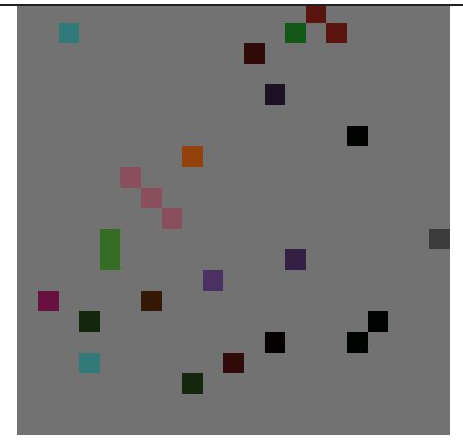 Figure: The visual output of the NetLogo simulation showing distinct cultural clusters despite global bias.
Key Findings:
- Resilience of Diversity: Even with a bias toward one culture, small regions of "dissimilarity" remain. These regions become "immune" to influence because they share no common ground with their neighbors.
- Interaction Barriers: If agents are too dissimilar, they stop interacting, effectively locking in social polarization.
- The Convergence Trigger: Convergence only occurs if the "similarity" requirement for interaction is removed, allowing influence to travel across radically different agent types.
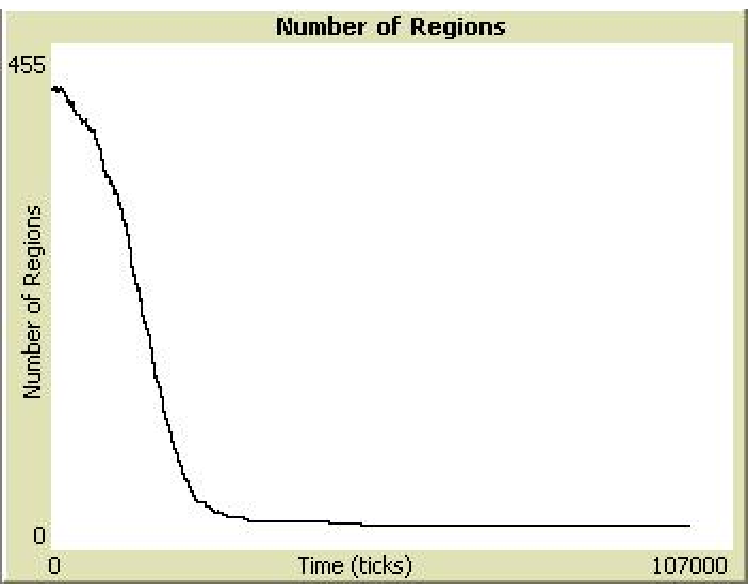 Figure: The graph illustrates how regions aggregate over time (ticks), showing the stabilization of collective behavior.
Critical Analysis & Conclusion
This paper serves as a bridge between computer science and sociology. Its categorization of Derived Intelligence is particularly relevant in the age of Big Data.
Takeaways for the Future:
- Inductive Bias in Design: Designing effective Collective Intelligence requires understanding the "interaction rules" (e.g., recommendation algorithms) that potentially lead to echo chambers.
- Limitations: While ABM provides deep insights into emergent behavior, the paper notes that identifying the exact behavioral rules for human-like social agents remains a complex "Intelligence Science" challenge.
- Collective Future: AI is no longer about a single "brain" in a box; it is about the "nervous system" of the entire Web and the emergent outcomes of our social interactions.