
Toward an Artificial Visual Cortex: Decoding the VC-1 Foundation Model for Embodied AI
Where are we in the search for an artificial visual cortex for embodied intelligence?
The paper presents a large-scale empirical study of Pre-trained Visual Representations (PVRs) for Embodied AI, introducing CORTEXBENCH (17 diverse tasks) and a new foundational model called VC-1. VC-1 is trained on over 4,000 hours of egocentric videos and ImageNet using Masked Auto-Encoding (MAE) and achieves top-tier average performance across navigation and manipulation.
Executive Summary
TL;DR: Researchers from Meta AI, Georgia Tech, and several top universities have conducted the most comprehensive study to date on visual foundation models for Embodied AI (EAI). They introduce CORTEXBENCH, a massive evaluation suite of 17 tasks, and VC-1, a Vision Transformer pre-trained on 5.6 million egocentric frames. The study reveals a crucial nuance: while scaling data and model size helps on average, "one-size-fits-all" dominance remains elusive without task-specific adaptation.
Positioning: This work is a rigorous "reality check" for the field, moving beyond narrow SOTA-chasing to establish a unified benchmark and a versatile base model that bridges navigation, locomotion, and manipulation.
The "Broken" Scaling Hypothesis
In the world of LLMs, "Scaling Laws" are gospel—more data equals better performance. In Embodied AI, however, this paper uncovers a more complex reality.
The authors find that while PVRs generally outperform learning-from-scratch, no existing model (not even OpenAI's CLIP) dominates every task. A model trained for navigation often fails at dexterous manipulation. This suggests that the "Artificial Visual Cortex"—a single module capable of converting any sight into any movement—does not yet exist in a frozen state.
Methodology: Building VC-1
To push the boundaries, the team combined egocentric videos from 7 different sources (Ego4D, Epic Kitchens, etc.) with ImageNet to create a massive 5.6M image dataset.
The Architecture
They employed a Vision Transformer (ViT-L) architecture with 307M parameters, trained using Masked Auto-Encoding (MAE). The logic behind MAE is that forcing the model to reconstruct occluded patches compels it to learn a deep structural and spatial understanding of the physical world.
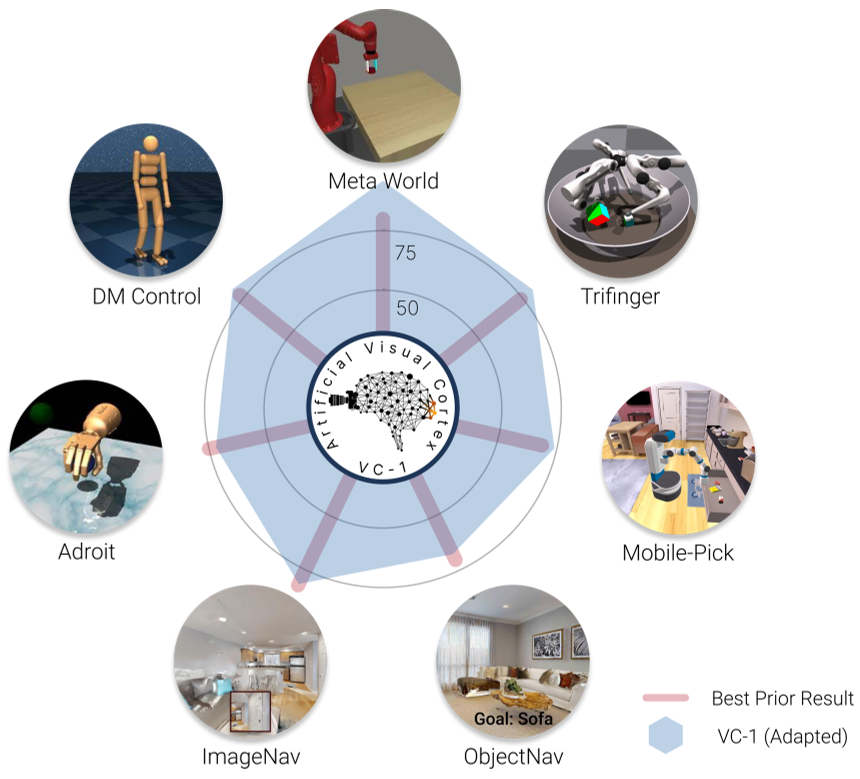 Figure 1: The pipeline from diverse egocentric data to a pre-trained ViT, evaluated on CORTEXBENCH.
Adapting to the Task: The Secret Sauce
One of the paper's most significant contributions is the analysis of Adaptation. They discovered a split in what works:
- Large-scale RL (e.g., Navigation): End-to-End (E2E) fine-tuning is superior.
- Few-shot Imitation Learning (e.g., Manipulation): E2E fine-tuning often leads to overfitting. Instead, MAE Adaptation (continuing the self-supervised objective on in-domain data) provides a massive boost without "breaking" the pre-trained weights.
Experimental Results
VC-1 achieved a mean rank of 2.4 across all benchmarks, outperforming every prior PVR including MVP, CLIP, and R3M.
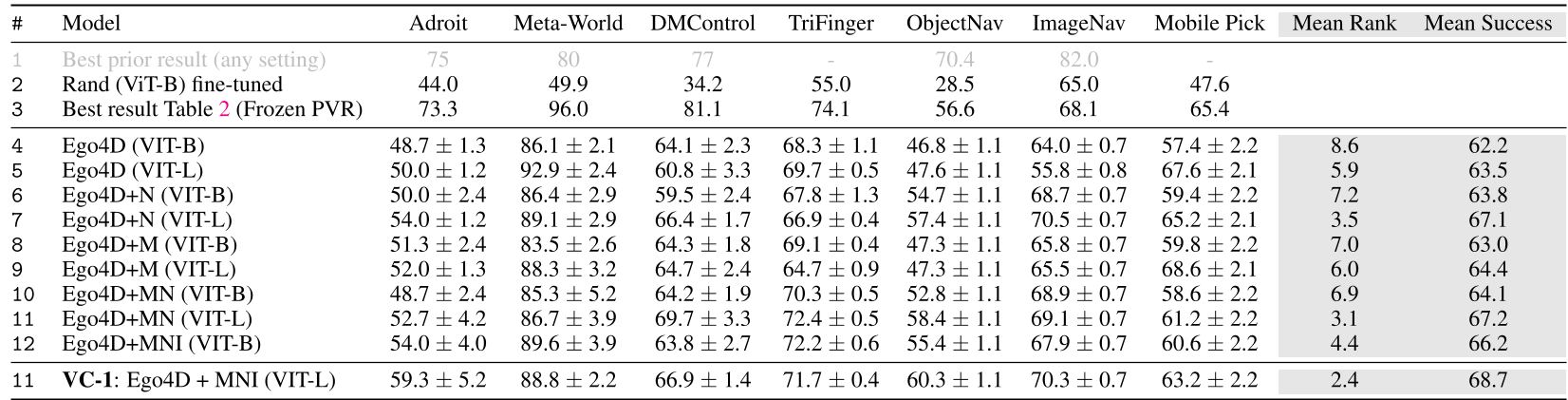 Table 1: VC-1 demonstrates superior average performance compared to best prior results.
In hardware experiments using a Franka Emika Panda arm, VC-1 with MAE adaptation showed a 15-30% higher success rate than the best pre-existing models, proving its efficacy in the messy real world.
Critical Insights & Future Outlook
- Data Diversity > Dataset Size: Increasing diversity (e.g., adding navigation data to manipulation sets) provided bigger jumps in performance than just adding more frames of the same type.
- The Inductive Bias Trade-off: Interestingly, ResNet-based models (like R3M) still occasionally outperform Transformers in low-level control, suggesting that we may need new architectures that blend the scalability of ViTs with the spatial inductive biases of CNNs.
- Standardization: CORTEXBENCH provides the community with a much-needed "north star" to avoid fragmented research.
Conclusion
VC-1 isn't just another model; it's a foundational framework. It proves that while we don't have a "plug-and-play" visual cortex yet, we have a robust "pre-trained" one that, with the right touch of adaptation, can master the vast spectrum of embodied intelligence.
For more details on implementation and to access the open-sourced weights, visit the EAI-VC Project Page.